Listen to New Voices on Studs Terkel our partnership with 826CHI-here! Read the Story


Showing 16 - 30 of 365 results
-

Terkel comments and Ronald Blythe reads Report from an English village ; part 2
Sep. 19, 1986 Reading "Report from an English Village" and interviewing the author Ronald Blythe while Studs was in London.
-
Terkel comments and presents musical performance of Joe Glazer
Jan. 17, 1983 Presenting music live with labor singer-songwriter Joe Glazer.
-
Terkel comments and presents "Hard Times: an Oral History of the Great Depression"; Chapter 8
1971 Presenting "Hard Times: an Oral History of the Great Depression" The Farmer is the Man: Chapter 8. Harry Terrell remembers the Farm Holiday Movement. Oscar Heline explains deficit financing and farmer's actions in response to farm foreclosures. Frank and Rome Hentges recall the threatening of a judge in Le Mars, IA by farmers protesting foreclosures. Orin Kelley was mistakenly arrested in connection with the judge assault and discusses his time in jail. Emil Loriks gives his perspective of the Farmer's Holiday Association. Ruth Loriks talks about grasshopper swarms.
-
Terkel comments and presents "Hard Times: an Oral History of the Great Depression"; chapter 6
1971 Presenting "Hard Times: An Oral History of the Great Depression" Chapter 6: Three Strikes. Dr. Lewis Andreas talks about being at the 1937 Memorial Day massacre and providing medical care during the Depression. Justin McCarthy discusses his job conditions at Ford Assembly Plant prior to the unions implementation. Mike Widman remembers heading up union negotiations and the strike at the Ford Plant in 1940-41. Bob Stinson discusses working at General Motors and how the sit-down strike began. Union songs performed by the Almanac Singers are played throughout the episode.
-
Terkel comments and presents "Hard Times: an Oral History of the Great Depression"; chapter 6
1971 Presenting "Hard Times: An Oral History of the Great Depression" Chapter 6: Three Strikes. Bob Stinson discusses working at General Motors and how the sit-down strike began. Justin McCarthy discusses his job conditions at Ford Assembly Plant prior to the unions implementation. Mike Widman remembers heading up union negotiations and the strike at the Ford Plant in 1940-41. Dr. Lewis Andreas talks about being at the 1937 Memorial Day massacre and providing medical care during the Depression.
-
Terkel comments and presents "Hard Times: an oral history of the great depression" ; Program 5 ; part 1
1971 Presenting "Hard Times: An oral history of the great depression": "Bonnie laboring boy" with Joe Morrison, Evelyn Finn and Jose Yglesias (program V).
-
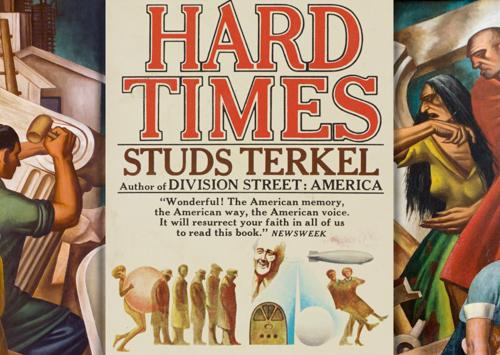
Terkel comments and presents "Hard Times: an Oral History of the Great Depression" ; Chapter 7
1971 Presenting "Hard Times: an Oral History of the Great Depression" High Life, Sixteen Ton: Chapter 7. Sally Rand talks about the creation of her signature fan dance and predictions for future depressions. Doc Graham discusses his upbringing, Chicago mobs, and Count Victor Lustig. Tony Soma talks about prohibition before and after the 1929 crash. Jerome Zerbe talks about inventing paparazzi photography, spending 2 weeks working in a coal mine, and the New Deal. Buddy Blankenship recalls working 16 hour days in West Virginia coal mines. Mary Owsley remembers life as a coal miner's wife.
-
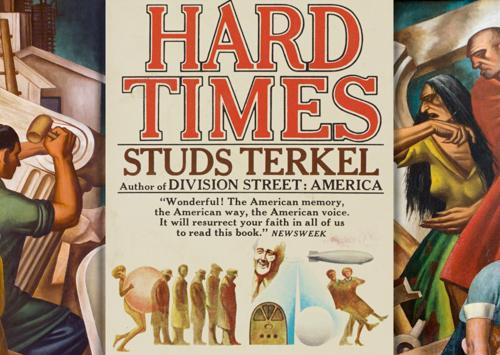
Terkel comments and presents "Hard Times: an Oral History of the Great Depression" ; Chapter 7
1971 Presenting "Hard Times: an Oral History of the Great Depression" High Life, Sixteen Ton: Chapter 7. Sally Rand talks about the creation of her signature fan dance and predictions for future depressions. Doc Graham discusses his upbringing, Chicago mobs, and Count Victor Lustig. Tony Soma talks about prohibition before and after the 1929 crash. Jerome Zerbe talks about inventing paparazzi photography, spending two weeks working in a coal mine, and the New Deal. Buddy Blankenship recalls working 16 hour days in West Virginia coal mines. Mary Owsley remembers life as a coal miner's wife.
-
Talking to James Steele and Donald Barlett
Jun. 24, 1992 The investigative journalists discuss and read from America: What Went Wrong? The book is based on a series of articles in the Philadelphia Inquirer about corporate greed and its effects on the middle class.*Please note: some sections have been edited out from the original recording due to copyright considerations
-
Talking about Poland, with Lawrence Weschler
May. 2, 1984 The American author and staff writer at The New Yorker talks about the Solidarity movement in Poland, as further detailed in his book, The Passion of Poland.*Please note: some sections have been edited out from the original recording due to copyright considerations
-
Talking about dogs and dog training with Barbara Woodhouse
1980 While on her book tour, author Barbara Woodhouse discusses canine training and the book, No Bad Dogs: The Woodhouse Way. Ms. Woodhouse talks about using the three T's with dogs - Touch, Tone, and Telepathy. Her fundamental belief is that all animals and humans are good, and if a dog exhibits bad behavior, it's a learned behavior from humans.*Please note: some sections have been edited out from the original recording due to copyright considerations
-
Talking about America, with Richard Reeves
Jun. 14, 1982 While traveling for his book - American Journey: Traveling with Tocqueville in Search of Democracy in America - Richard Reeves was surprised to learn how much people really loved America and being Americans.*Please note: some sections have been edited out from the original recording due to copyright considerations
-
Swedish Prime Minister Olaf Palme discusses his socialist political viewpoints with Studs Terkel in Sweden at the House of Parliament
Nov. 5, 1973 Studs Terkel interviews Sweden Prime Minister Olaf Palme at the House of Parliament. They discuss socialist political viewpoints and touch on a large variety of subjects. Major topics include work environment, working women, issues of ordinary people, industrialism, the post-industrial society, technology, and communities. Studs gives a short post script to inform listeners about the arrest of five journalists in Sweden, who were charged with exposing information about a secret police called the Information Branch. It was said that they jeopardized Sweden's security.
-
-
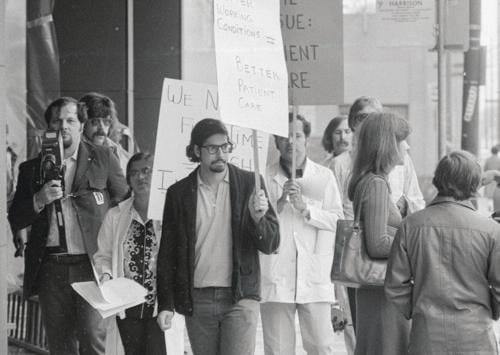
Studs Terkel interviews three Cook County Hospital doctors about their 1975 strike
Nov. 12, 1975 Studs interviews three Cook County Hospital doctors: Dr. Tessa Fischer Dr. Mark Bonnell Dr. David Moore Main topic of conversation is the 18-day residents and interns strike at Cook County Hospital, Chicago, October-November 1975. At the time it was the longest doctors’ strike in U.S. history. Topics include: Patient care, benefits and wages, and working conditions. The distinction is made between a "strike" and what the doctors call a "job action".