Listen to New Voices on Studs Terkel our partnership with 826CHI-here! Read the Story


Showing 1 - 15 of 18 results
-

-

Richard Hoggart discusses culture and media
1968 Content Warning: This conversation includes racially and/or culturally derogatory language and/or negative depictions of Black and Indigenous people of color, women, and LGBTQI+ individuals. Rather than remove this content, we present it in the context of twentieth-century social history to acknowledge and learn from its impact and to inspire awareness and discussion. Richard Hoggart talks about the media and the cultural explosion. Hoggart explains that facts are not knowledge.
-

R. Buckminster (Richard ) Fuller talks with Studs Terkel
Jan. 20, 1965 A sprawling conversation with R. Buckminster Fuller including his great aunt Margaret Fuller, future communication, the nature of work, human nature, and physics.
-
-
Kermit Eby discusses his book "Protests of an ex-organization man."
Nov. 21, 1961 *Please note: some sections have been edited out from the original recording due to copyright considerations
-
Interviewing Pete Seeger, Cleofes Vigil, and Nimrod Workman
1970 Pete Seeger, Cleofes Vigil, and Nimrod Workman discuss folk music and their upcoming appearance at an anthropology conference.*Please note: some sections have been edited out from the original recording due to copyright considerations
-
Interviewing Paul Wilkes
Mar. 6, 1975 Paul Wilkes discusses his book, Trying Out the Dream: a Year in the Life of an American Family, about a blue-collar worker and his family adapting to suburban life in the 1970s. Includes a clip from an interview with steelworker Mike Lefevre.*Please note: some sections have been edited out from the original recording due to copyright considerations
-
Interviewing Jane Stern
Dec. 18, 1975 Jane Stern discusses her book, Trucker: A Portrait of the Last American Cowboy, and the life, culture, and myths of truck drivers. The program includes an excerpt from an interview with a truck driver named Paul Deitch.*Please note: some sections have been edited out from the original recording due to copyright considerations
-
-
Interview with Raleigh Campbell, Nan Hardin and Johanna Saylor ; part 2
1964 Interviewing Raleigh Campbell of the Council of Southern Mountains, also Nan Hardin and Johanna Saylor: "Appalachian in Chicago"
-
Horace Cayton discusses his book "Long Old Road" ; part 2
Sep. 7, 1966 Content Warning: This conversation has the presence of outdated, biased, offensive language. Rather than remove this content, we present it in the context of twentieth-century social history to acknowledge and learn from its impact and to inspire awareness and discussion. Loneliness and hardships of both fitting in and finding a job are covered in the continuation of Horace Cayton's, "Long Old Road: An Autobiography." By living in a middle class home in Seattle with a full time Japanese servant, Cayton was seen as better off than most people.
-

Henry Ollendorff discusses refugees and migrants in Europe
Feb. 14, 1974 Content Warning: This conversation includes racially and/or culturally derogatory language and/or negative depictions of Black and Indigenous people of color, women, and LGBTQI+ individuals. Rather than remove this content, we present it in the context of twentieth-century social history to acknowledge and learn from its impact and to inspire awareness and discussion. Henry Ollendorff spent much of his life working as a social worker. Ollendorff talks about the migrant workers in Europe and how there were many job openings.
-
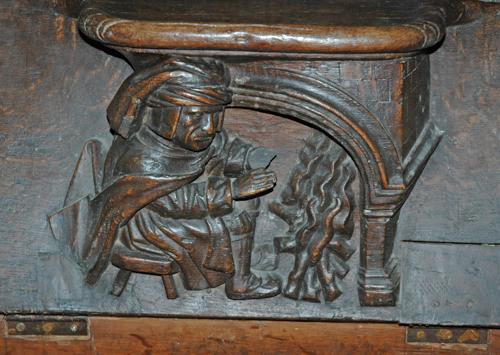
Dorothy and Henry Kraus discuss the book "The Hidden World of Misericords."
Feb. 10, 1976 Dorothy and Henry Kraus describe how they discovered an entire European collection of church-located woodcarvings depicting a wide variety of scenes crafted by local artisans. Hundreds of years of political, religious, and social events shaped the portrayals, and they explore many of the illustrations in their book, focusing on the themes of labor, animals, and religion. They marvel at the skill and craftsmanship and observe that the works can be a rich source of primary research material for modern scholars.
-
Discussing the homeless and homelessness with a panel of guests
Jul. 24, 1990 Discussion about the homeless with a panel of guests
-
Discussing the book "The managed heart: the commercialization of human feeling" with the author Arlie Russell Hochschild
Oct. 14, 1983 Discussing the book "The managed heart: the commercialization of human feeling" with the author Arlie Russell Hochschild.