Listen to New Voices on Studs Terkel our partnership with 826CHI-here! Read the Story


Showing 166 - 180 of 272 results
-

Hank De Zutter, Betty Jane Wagner, Barbara Kotto in conversation with Studs Terkel
Sep. 16, 1992 Discussing the Chicago Area Writing Project with authors and educators Hank De Zutter, Betty Jane Wagner and Barbara Kotto.
-
Handasyde Buchanan and Miss Dillon discuss life in London, England and Scotland, bookshops, and book selling; part 1
1962 Interviewing booksellers Handasyde Buchanan and Miss Dillon while Studs was in England. They discuss life in London, England and Scotland, their bookshops, and book selling.
-
Gladys Joyce Adams and Yvonne Hammond discuss female youth in Chicago ; part 2
1968 The D. J.'s, a group of teenagers, discuss their lives, interests, and ambitions. Gladys Joyce Adams and Yvonne Hammond discuss the female youth and youth groups in Chicago. Joyce and Hammond discuss the girl's club the Divine Ladies and other girl's clubs. Christy and Frank Carney in "West Side" (part 3).
-
George Drossos, The Thacker Family, Mrs. Webb and Benny Bearskin discuss living in Chicago
1968 The third program of "Division Street: America" features four profiles: George Drossos, an elderly, Greek man, the Thacker family who recently moved to Chicago, Mrs. Webb, a corner store owner and Native American Benny Bearskin. George Drossos talks about first moving to Chicago and getting acclimated to the city. He recalls visiting other states for a month and then having that feeling of "nostos," or wanting to return home to Chicago. A mother of 15 children and 21 grandchildren, Mrs. Thacker said she doesn't like all the hoodlum business that goes on in Chicago.
-
General Chaney, Charles Roche and Mary Lou Wolff discuss the Citizens Action Program
Nov. 27, 1973 Interviewing General Chaney, Charles Roche and Mary Lou Wolff of the Citizens Action Program.
-
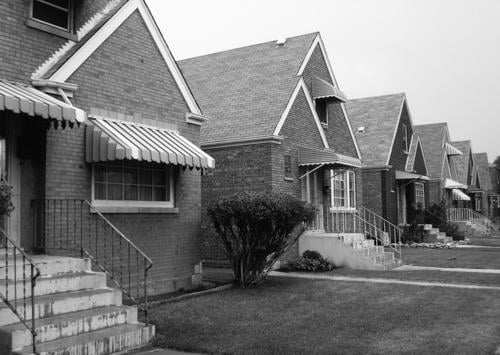
Gale Cincotta discusses community organizing for fair housing and loan practices
Jul. 7, 1977 Interviewing Gale Cincotta, a co-author of the book "Urban Disinvestment: New Implications for Community Organization, Research, and Public Policy." Cincotta is an expert on discrimination in mortgage loans and its effects in Chicago and other cities.
-
Gage Park residents discuss race relations and racial integration at Gage Park High School ; part 2
Aug. 4, 1970 A diverse panel of Gage Park residents discuss racial integration at Gage Park High School, neighborhood change, and race relations in general.
-
Gage Park residents discuss race relations and racial integration at Gage Park High School ; part 1
Aug. 4, 1970 A diverse panel of Gage Park residents discuss racial integration at Gage Park High School, neighborhood change, and race relations in general.
-
Frederick Wiseman discusses public welfare
Feb. 20, 1976 Discussing public welfare and interviewing Frederick Wiseman, director of the documentary film, "Welfare."
-
Fred Morris discusses his time working in the rural churches in Brazil
Nov. 14, 1974 Content Warning: This conversation includes graphic descriptions of physical abuse. A Methodist minister, Fred Morris, talks about the 11 years he lived in Brazil. Morris found it difficult to preach to the poor people whose children were dying of starvation. Morris also talks about the time he was abducted and tortured.*Please note: some sections have been edited out from the original recording due to copyright considerations
-
Fred Christy and Frank Carney discuss life in Chicago ; part 1
1968 Fred Christy and Frank Carney discuss life, family, youth, and demographics in Chicago. Includes Studs Terkel interviewing a group of teenagers who call themselves the D.J.'s. about their life and ambitions.
-
-
Florence Scala and Studs Terkel on the site of Hull House as it is dismantled ; part 2
Jul. 9, 1963 The tour continues on Maxell and Halsted Streets. Anita is sad to be leaving a place where she was born & raised. Mrs. Belmont said the mayor promised housing but they're currently living in a hotel. A 17-year resident of Hull House, Mrs. Morales says there will never be another place like it. The general feeling from everyone was that of sadness in having to leave their homes and businesses.
-
Florence Scala and Studs Terkel on the site of Hull House as it is dismantled ; part 1
Jul. 9, 1963 Florence Scala gives Studs Terkel a guided tour of the area around Hull House. Terkel talks to people in the neighborhood. Mr. Briata spoke of how he would go to Hull House once a week to take a bath. Mrs. Picardi liked the area because it had good schools for her kids. Together they visit Scala's favorite butcher, who will have to relocate his business after 40 years.
-
Ella Jenkins discusses her music and her influences
Dec. 7, 1963 Using a Trobriand drum and harmonica, Ella Jenkins plays examples of call and response music with Studs. A few of her popular songs play between their discussion. Ella explains how her music came to be from the Chicago neighborhood streets with influences from her Uncle and other blues and folk musicians. Songs played include "Tahboo," "Miss Mary Mack," "You'll Sing a Song and I'll Sing a Song," "Come Dance By the Ocean," and "Dulce." Songs have been removed due to copyright restrictions.