Listen to New Voices on Studs Terkel our partnership with 826CHI-here! Read the Story


Showing 106 - 120 of 777 results
-

Seymour Melman discusses his book "Pentagon Capitalism: The Political Economy of War"
Jun. 8, 1970 Seymour Melman discusses his book "Pentagon Capitalism: The Political Economy of War." Topics of discussion include the military-industrial complex and the state management of industry, particularly in regards to defense.
-

Seymour M. Hersh reads from and discusses his book "My Lai 4"
May. 22, 1970 Innocent, unarmed villagers were murdered in the horrific massacre in March of 1968. In Seymour M. Hersh's book, "My Lai 4: A Report on the Massacre and Its Aftermath," Seymour further explains that to the soldiers, the killing was simply a game to them, of who could kill the most bodies.
-
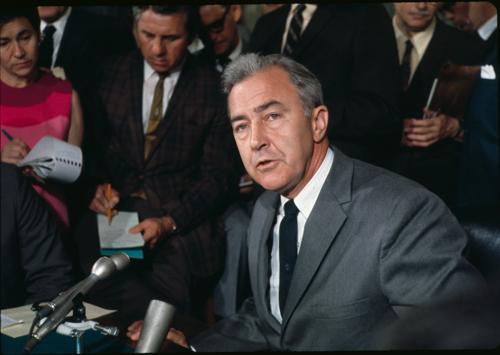
Senator Eugene McCarthy talks about his presidential campaign
Mar. 3, 1975 Former Minnesota Senator Eugene McCarthy talks about his presidential campaign. Includes an excerpt of a 1968 program in which Studs and James Cameron visit Lincoln Park after the Chicago Democratic Convention riots.
-
Scott Ridley discusses the book “Power Struggle: The Hundred-Year War Over Electricity”
Feb. 25, 1987 Author Scott Ridley discusses the book “Power Struggle: The Hundred-Year War Over Electricity” and the corruption in the private power industry. Studs plays "Roll on Columbia" by Judy Collins (1972) and "Grand Coulee Dam" by Woody Guthrie (1941).
-
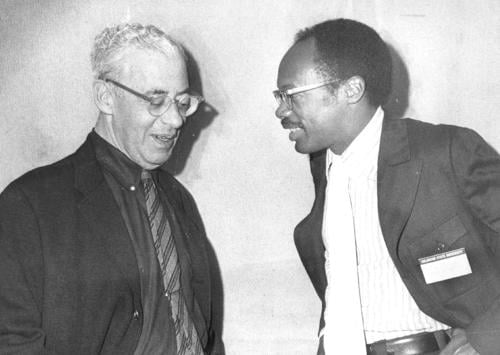
Saul Alinsky, American community organizer, political activist, and writer discusses his book "Rules for Radicals" with Studs Terkel
1971 Community organizer and social activist, Saul Alinsky speaks about his newest book, "Rules for Radicals," and reminisces about his work in the Back of the Yards neighborhood, his advocacy for African-American labor rights, and his connection with the Mexican-American civil rights movement in California. Although Studs' introduction states that this is a rebroadcast of a 1962 interview, that is incorrect. The interview was recorded in 1971.
-
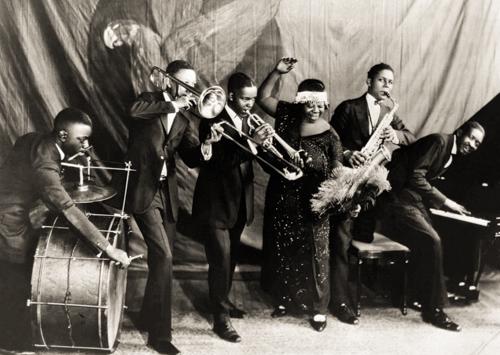
Sandra Lieb discusses the book "Mother of the Blues: A Study of Ma Rainey"
Jan. 12, 1982 Sandra Lieb discusses the book "Mother of the Blues: A Study of Ma Rainey." Includes songs sung by Ma Rainey such as "Runaway Blues," "See See Rider," "Moonshine Blues," and "Oh, Papa Blues." Includes poem "Ma Rainey" by Sterling Brown. Includes "Oh, Daddy," by Ethel Waters. Includes "Young Woman's Blues" by Bessie Smith.
-
Russell Baker reads from and discusses his book "The Good Times"
Sep. 21, 1990 Back in his day, there was no journalism school, explained Russell Baker. He spent time with the police and that's how he often got his stories about the underclass or the superfluous. Baker pointed out when a paper didn't want to print one of his stories, Baker was told the subject matter was in poor taste.
-
Ross Miller discusses his book "American Apocalypse: The Great Fire and the Myth of Chicago"
Jun. 7, 1990 Author Ross Miller discusses his latest work, which centers around Chicago and the aftermath of the Great Chicago Fire and its effects on rebuilding the metropolis and the advantages of gaining a new take on architecture and society.
-
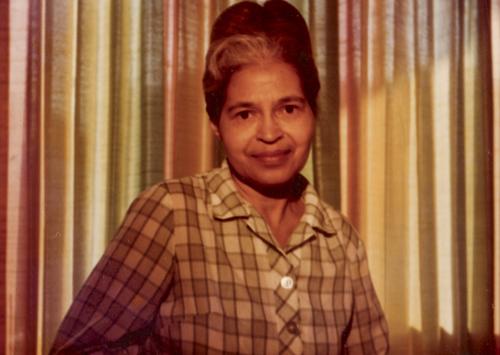
Rosa Parks and Myles Horton discuss the Highlander Folk School, the Montgomery Bus Boycott, and the American Civil Rights Movement
Jun. 8, 1973 Rosa Parks and Myles Horton discuss the importance of the Highlander Folk School, the Montgomery Bus Boycott, and the American Civil Rights Movement. The story of these two prominent figures of the Civil Rights Movement have intervened in their fight for social equality. Includes a fragment of an interview with E. D. Nixon well known civil rights leader.
-
Ronnie Dugger discusses his book "Politician: The Life and Times of Lyndon Johnson"
Jul. 15, 1982 Ronnie Duggar’s book, “Politician: The Life and Times of Lyndon Johnson,” shows Johnson’s rise to power. Duggar explained that from a young age, Johnson knew to court power. While at the Teachers College in Texas, Johnson told his cousin, “It starts at the president’s office,” where Johnson was the president’s right arm man. Once in the Senate, Johnson chose to be on the Armed Services Committee because he knew Senator Richard Russell ran the Senate. Johnson courted powerful men and in exchange, these men would advance his career.
-
Ronnie Dugger discusses his book "On Reagan: The Man & His Presidency"
Nov. 29, 1983 Past radio transcripts of former President Ronald Reagan were being hidden or suppressed. Ronnie Dugger worked tirelessly at getting the transcripts so that people would learn the truth about Reagan. In Dugger’s book, “On Reagan: The Man & His Presidency,” Dugger points out that President Reagan was against the ERA. He didn’t believe in anti-trust, and he opposed every civil rights act every placed in front of him. Dugger said Reagan’s genius was that he’d get elected without people knowing of his records.
-
Ron Kovic discusses his autobiography "Born on the Fourth of July"
Jul. 29, 1977 Studs interviews Vietnam veteran and anti-war activist Ron Kovic upon the paperback release of his autobiography "Born on the Fourth of July." Kovic recounts his All-American upbringing and unblinking faith in the country and its ideals before volunteering for the Marines and Vietnam.
-
Roger Wilkins discusses his book "A Man's Life"
Aug. 30, 1982 Discussing the book "A man's life" with the author Roger Wilkins.
-

Roger G. Kennedy discusses his book "Hidden Cities"
Sep. 22, 1994 American cities, American Indians, architecture and archaeology are all apart of Roger G. Kennedy's book, "Hidden Cities: The Discovery and Loss of Ancient North American Civilization." Kennedy explained how we are destroying the past by building new towns and cities and erecting brand new buildings onto some places that were once ancient grounds.
-

Roger Buffalohead Native American educator, scholar and activist talks about Native American history and education
Nov. 15, 1971 Mr Buffalohead a Native American educator, scholar and activist talks to Studs in Minnesota about Native American history and about creating space at universities for Native / Indigenous studies programs. At the end Studs states that there is another 15 minutes of the program, that will be presented at another time.