Listen to New Voices on Studs Terkel our partnership with 826CHI-here! Read the Story


Showing 121 - 135 of 199 results
-

-
Frances FitzGerald in conversation with Studs Terkel
Oct. 23, 1986 Discussing the book "Cities on a Hill: A Journey Through Contemporary American Cultures" (published by Simon & Schuster) with the author, journalist Frances FitzGerald. Program includes an excerpt of a June 3, 1986 interview with activist and social worker Maggie Kuhn.
-
Fela Sowande discusses his career and Nigerian music ; part 2
Jul. 3, 1962 Fela Sowande discusses his career, different types of Nigerian and African music, the Yoruba people, and religion. Includes clips of an African Yoruba pagan hymn "Oyigiyigi," a Christian version of that hymn, and an organ version of that hymn. Includes Sowande's song "Roll de Ol' Chariot." Quotes a poem by [Anthony Gregascoigne], an English poet he met in England.
-
Fela Sowande discusses his career and Nigerian music ; part 1
Jul. 3, 1962 Fela Sowande discusses his career, Nigerian music, and compares African culture and Western culture. Includes clips of musical performances by Highlife musicians and orchestra. Music: A clip of high-life music, "Folk Symphony for Full Orchestra."
-
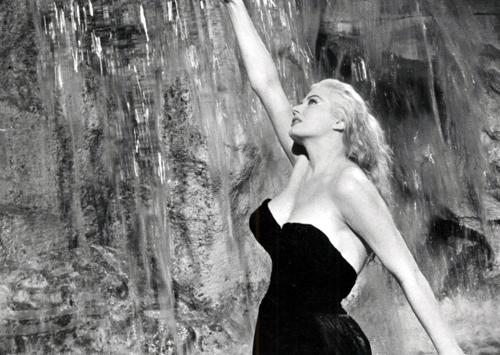
Federico Fellini and actors discuss their film "La Dolce Vita" and the character Steiner
Dec. 1, 1962 Studs Terkel plays interview clips of actors [Marcello Mastroianni and Alain Cuny] and the director Federico Fellini discussing their film "La Dolce Vita" and the character Steiner. At the beginning of the program Studs Terkel interviews Nelson Algren, a writer, and Mario Devecki (a person who made the film "La Dolce Vita" happen) about La Dolce Vita and Steiner.
-
Father Roy Bourgeois discusses why the School of the Americas must be closed down
Mar. 24, 1994 Father Roy Bourgeois travels the country, talking to groups of people who aren't aware that their tax dollars go to fund the School of the Americas. Bourgeois discovered that money provided was for military weapons & for the training of soldiers to torture and to kill people of Latin American countries.
-
Father Jose Alas discusses his time spent in El Salvador
Oct. 7, 1985 In 1970, because he was considered a troublemaker when helping the peasants in El Salvador obtain a better life, Father Jose Alas was kidnapped by the National Guard and left for dead. Alas explains if he were to return to El Salvador, he would be killed because he is considered a traitor. Caitriona Ruane talks for a couple of minutes about her work helping the poor in the Latin American countries.
-
Father John McKenzie and Dr. Howard Schomer discuss personal responsibility, morality and hate, as it pertains to the Vietnam War ; part 2
1965 The interview continues with Father John McKenzie and Dr. Howard Schomer talking about fear and dissent. Schomer says Christians have the duty to dissent when they believe their beliefs are being contradicted by policy. He also talks about not understanding a dampening down of the human mind when it comes to human issues. Father McKenzie adds that society is made up of the best educated ignoramuses that ever existed.
-
Father John McKenzie and Dr. Howard Schomer discuss personal responsibility, morality and hate, as it pertains to the Vietnam War ; part 1
1965 Whether in the United States or Vietnam, Dr. Schomer asks what are our personal responsibilities for the atrocities? Father John McKenzie talks about a lowering of people's moral tone. People have put their morality in their pockets, so as to get cleared of something and not get involved, added Father McKenzie.
-
Father James Kavanaugh discusses his book "A Modern Priest Looks at His Outdated Church"
Jul. 5, 1967 Father James Kavanaugh discusses his book “A Modern Priest Looks at His Outdated Church," confession, how he’s treated as a priest, Vatican II, celibacy, Includes excerpts of interviews with Diane Romano, a Catholic woman who discusses her marriage, her family, birth control
-
Father Don Hedley, Sister Kay Kelly, Rene Golden and Secundine Ramirez discuss the tragic state of El Salvado
Feb. 19, 1981 Who's guilty for the death of 10,000 peasant farmers in El Salvador, the group of Father Don Hedley, Sister Kay Kelly, Rene Golden and Secundine Ramirez want to know. The fight and struggle for basic human rights has been going on in El Salvador for many, many years. The most recent tragic deaths of the four Catholic missionaries were because they sided with the poor.
-
Father Daniel Berrigan discusses his life
Jun. 1, 1972 Fr. Daniel Berrigan speaks about his early life, and relationship with his family, on his becoming a priest, and on being an anti-Vietnam War activist.
-
Father Bernard Serval discusses his background and his experiences in Nicaragua
Oct. 16, 1978 His belief of experiencing something for himself led Father Bernard Serval to live in the 3rd world country of Nicaragua. People there are so poor, they live on the side of the roads, explained Serval. People work long hours and only earn $2.00 a day. Contracting malaria is an issue because people can't afford the $5.00 it costs to buy a net for protection. Serval wants people to be aware all the poverty in Nicaragua but he knows it will never become of importance because the US will never benefit monetarily from that country.
-
Father Basil Von Rensburg and Peter Walshe discuss politics and their lives in South Africa
Apr. 30, 1986 South African Catholic priest Father Basil van Rensburg and Peter Walshe discuss their fights against apartheid. Rensburg pursued his fight through a hunger strike, and Walshe discusses the government's stance on apartheid and religion.
-
Excerpts from the Division Street recordings Oral Histories, regarding race, religion and humanity
1970 Studs presents excerpts from the Division Street recordings, regarding race, religion and humanity.