

-
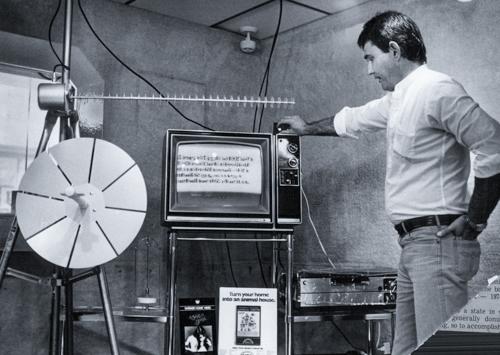
Nicholas Johnson talks about communication and its impact
Jan. 16, 1981 Interviewing Nicholas Johnson, a former member of FCC in which discusses communication, advanced technology, the role of the public, censorship and control of information
-

Newton Minow discusses broadcasting
Jan. 11, 1964 Interviewing Newton Minow, Chicago lawyer and chairman of the Federal Communications Commission. He discusses broadcasting as a public service and spends a great deal of time on the history of commercials and how they changed over time.
-
Nelson Algren and Mario De Vecchi discuss "La Dolce Vita," part 1
Jun. 17, 1961 Nelson Algren and Mario De Vecchi discuss the international appeal of Federico Fellini’s film, “La Dolce Vita.” In part one, Algren and Devecchi focus on the film’s main character, journalist Marcello Rubini, and his quest for identity, particularly in relation to his interactions with the film’s intellectual character, Steiner. They discuss the film’s key metaphorical images and its portrayal of the influence of media and the emotional detachment and dehumanization it can create.
-

Neil Sheehan discusses his book "A Bright Shining Lie"
Nov. 1, 1988 With his book, "A Bright Shining Lie: John Paul Vann and America in Vietnam", Neil Sheehan wanted to tell what happened in Vietnam and why it happened through telling the story of Lt. Colonel John Paul Vann. Sheehan said Vann had a keen sense of reality. Vann knew if they didn't change the Saigon government into something decent that would appeal to its own people, they'd never succeed at anything other than getting American soldiers killed for nothing. Although readers will find painful experiences in the book, Sheehan explained that his book is not an anti-war book.
-
Neil Postman discusses his book "Teaching as a Conserving Activity"
Nov. 6, 1979 In schools, reading, writing and speech are all on the decline because there are too many visual images from the TV, according to Neil Postman’s book, “Teaching as a Conserving Activity”. Postman criticized “Sesame Street” for its instantaneity. There are no short cuts in teaching, said Postman. He believed the worst thing a teacher could do was to make teaching entertaining for their students.
-
Neil and Susan Sheehan discuss their respective books “A Bright Shining Lie: John Paul Vann and America in Vietnam" and "Is There No Place on Earth for Me?"
Apr. 11, 1990 Studs Terkel speaks with journalists Neil and Susan Sheehan about their respective books “A Bright Shining Lie: John Paul Vann and America in Vietnam” and “Is There No Place on Earth for Me?” Further discussion is had about journalism and Neil and Susan’s collaborations together. Audio clips of when Neil Sheehan and Susan Sheehan were previously on Terkel’s program are played.
-
Neil and Susan Sheehan discuss journalism
Jun. 9, 1972 Studs Terkel talks with journalists Neil and Susan Sheehan about objective and responsible journalism, as well as what can influence a news story. A sound bite of photographer Jerome Zerbe is played where Zerbe discusses taking photos of the upper class during the Great Depression. Another sound bite is played of a man named Joe Begley discussing how laws created during the Great Depression should have met the needs of the people better.
-
-
My (Pseudonym) discusses the book "Observations from a Treadmill"
Oct. 4, 1973 Discussing the book "Observations from a Treadmill" and interviewing the author My (pseudonym).
-
Milton Sanford Mayer in conversation with Studs Terkel
Nov. 11, 1975 The journalist and editor joins to Studs to talk about his latest collection of essays, The Nature of the Beast.*Please note: some sections have been edited out from the original recording due to copyright considerations
-
Milton Mayer reads and discusses his article, "Ill Met by Moonlight"
Dec. 31, 1968 Million Mayer, journalist, reads his article, "Ill Met by Moonlight" and discusses his thoughts on technology and automation replacing jobs and human interactions.he also talks about youth, non-violence protesting for change, and education.
-
Milton Mayer discusses the educational philosophy of Robert Hutchins
May. 27, 1977 Milton Mayer discusses the state of U.S. education and the educational ideas of Robert Hutchins.
-
Milton Mayer discusses Quakerism and the impact they have had on society
Dec. 27, 1974 Milton Mayer, journalist and educator, talks with Studs about Quakerism. They talk about how religion relates to society in the times of change. Mr Mayer describes an exchange with a gentleman who asked what is a Quaker. The man had been an SS officer who told Mr Mayer his story. The man had been touched by the anonymous generosity of the Quakers many years before. Mr Mayer speaks of A. J. Musty, clergyman and political activist as his mentor and friend, and the things he learned from him.
-
Mike Royko, Dick Griffin, and Rob Warden discuss and read from the book “Done in a Day: 100 Years of Great Writing from the Chicago Daily News”
Mar. 15, 1977 Chicago journalists Mike Royko, Dick Griffin, and Rob Warden discuss and read from the book “Done in a Day: 100 Years of Great Writing from the Chicago Daily News.” The group discusses prominent journalists featured in this book including Robert J. Casey and Ellen Warren. Studs plays "The Moon Shines on the Moonshine" - Bert Williams (1920) and "Elanoy" - Win Stracke (1958).
-
Mike Royko discussing his book "Up Against It"
1967 Mike Royko discusses his book "Up Against It" which is a collection of early columns from the Chicago Daily News. The topic in his columns varies from machine politicians and gangsters to professional athletes, from well-heeled Chicagoans to down-and-out hoodlums.