

-

Katherine Dunham discusses her studies in dance anthropology
Sep. 28, 1978 Interviewing Katherine Dunham, anthropologist, choreographer, and dancer. Dunham discusses various subjects including Haitian Vodou, an African diasporic religion, and the importance of cultural dance. Content Warning: This conversation has the presence of outdated, biased, offensive language. Rather than remove this content, we present it in the context of twentieth-century social history to acknowledge and learn from its impact and to inspire awareness and discussion.
-
-
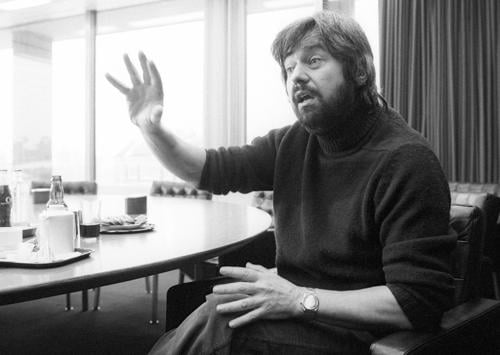
Jurek Becker discusses his background
1986 While in his home in Berlin, Jurek Becker covers various topics. He first talks about being arrested back in 1978 in New Orleans. Becker also talks about his lack of memories from being in the concentration camp. When he was 3, 4, or 5, Becker said that when he was there, there was nothing, and therefore, there's nothing to remember.
-
June Terpstra and two women, Ann and Donna, discuss battered women
Oct. 28, 1983 Discussing battered women with the director of the Evanston Shelter for Battered Women, June Terpstra. Two women, Ann and Donna, talk about their experiences of abuse with their husbands.
-
June Sochen discusses her book "Movers and Shakers"
Dec. 17, 1973 Northeastern Illinois University professor June Sochen discusses her book "Movers and shakers;: American women thinkers and activists, 1900-1970". Sochen and Studs cover a wide range of female activists and radicals who fundamentally reshaped American society via their efforts in the labor movement and union organizing, the arts and culture, and research.
-
Juliet Mitchell discusses women, family, and oppression
Apr. 25, 1971 An interview with teacher and lecturer, Juliet Mitchell, who is a Marxist. She shares her support for the women's movement and talks about issues that affect women especially gender inequality. Juliet also refers to some comparisons between British and American women's movement.
-
Julie Harris discusses the poetry of Emily Dickinson
Mar. 11, 1976 In preparation to play Emily Dickinson in, "The Belle of Amherst" Julie Harris read both the letters and the poems written by Dickinson. Harris said she had become fascinated by Dickinson's persona. This interview includes two excerpts: "Because I could not stop for Death," and "Before I got my eye put out."
-
-
-
-
Jules Feiffer discusses his cartoonist history and his play "Elliot Loves"
Apr. 12, 1990 Jules Feiffer and Studs read several of Feiffer's previous cartoons as they discuss his history as a cartoonist and his retrospective on display at the Walton Street Gallery in Chicago. Feiffer discusses his attempt to move away from political cartoons and instead shift focus to social commentary. Feiffer also discusses his play "Elliot Loves", a love story that captures the complications of love and the “gap” between the sexes.
-
Jules Feiffer discusses his book “Ackroyd”
Jun. 2, 1977 American author and cartoonist Jules Feiffer presents readings and discusses topics from his book “Ackroyd.”
-
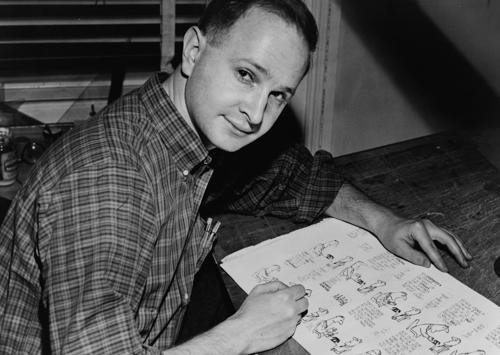
Jules Feiffer discusses his book "Feiffer on Nixon"
Nov. 10, 1974 Content Warning: This conversation has the presence of outdated, biased, offensive language. Rather than remove this content, we present it in the context of twentieth-century social history to acknowledge and learn from its impact and to inspire awareness and discussion. In his book, "Feiffer on Nixon: The Cartoon Presidency," Jules Feiffer tries to give his readers his take on politics and the government. In addition, through his descriptions of the cartoon panels, Feiffer offers his explanations of who President Nixon was.
-
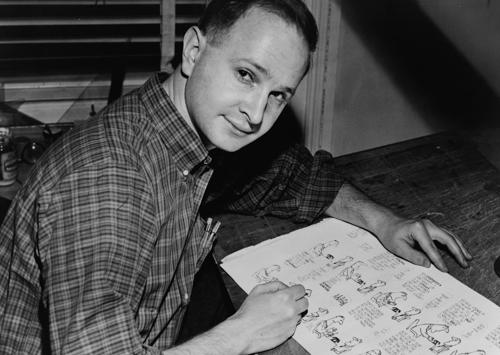
Jules Feiffer and Jamie Gilson talk with Studs Terkel
May. 13, 1960 Cartoonist Jules Feiffer discusses his book "The Explainers" and his thoughts on American society, gender roles, and political corruption as is satirized in his cartoons; cartoon strips are read throughout the program with Jamie Gilson.
-

Judy Tenuta discusses being a Love Goddess
Self-proclaimed Love Goddess, Judy Tenuta, was also known as the Aphrodite of the Accordion, to her fans. Tenuta talks about how she saw Elvis in her Cheese Whiz and he told her to start her own religion, which is known as Judyism. Calling herself the Love Goddess came to be after her brothers literally kissed her hands and feet when she asked them to. This is a very short conversation that ends abruptly.