

-

Edith Wilson discusses her career
Dec. 26, 1977 Edith Wilson talks about her singing and acting career in California and throughout the states. Songs have been removed due to copyright restrictions.
-
Edith Mason discusses her childhood and career in the opera ; part 1
1966 Madam Mason discusses her childhood as it pertains to her career. She shares her training and study in Paris. Mason recalls the many composers and conductors she has worked with and the various opera companies she worked for. The musical numbers are removed from this edited version of the original recording.
-
Edith Mason discusses her childhood and career in the opera
1966 Studs replays his interview with Edith Mason 21 years ago. Madam Mason discusses her childhood as it pertains to her career. She shares her training and study in Paris. Mason recalls the many composers and conductors she has worked with and the various opera companies she worked for. The musical numbers are removed from this edited version of the original recording.
-
Edith Mason discusses her career in opera ; part 2
1966 They talk about other performers Madam Mason worked with. Edith shares her view on the difference between opera in her day and the current opera. Parts of this version appears to be a duplicate of another, but there are a few parts that are not duplicates. The musical pieces are removed from this edited version of the original recording.
-
Edgar Zodiag Friedenberg talks with Studs Terkel
Mar. 11, 1960 Edgar Zodiag Friedenberg talks about his book "The Vanishing Adolescent." He discusses how experience of adolescence has changed.
-
Eddie Gallogo, Mimi, Fred in conversation with Studs Terkel
1980 Interviewing Eddie Gallogo, Mimi, and Fred.
-
Eddie Balchowsky talks with Studs Terkel
1970 Eddie Balchowsky tells stories about being an Observation Scout during the Spanish Civil War and marching with a British battalion. He plays and sings several songs of the time.(unknown titles)
-
Ed Sadlowski discusses unions
Feb. 11, 1992 Union official Ed Sadlowski, along with Joe Gutierrez, discusses the changing culture and values of union workers, their families, and management with Studs Terkel.
-
Ed Paulsen discusses the Great Depression its impact
Oct. 1, 1981 Ed Paulsen discusses the Great Depression its impact.
-

Ed & Marlene Sadlowski discuss his campaign and victory to become Director of District 31
Nov. 18, 1974 Marlene and Ed Sadlowski talk about their blue collar Chicago backgrounds, hopes for improving labor workers conditions, and Ed's underdog 2 to 1 victory to become the Director of the largest steel union's district.
-
Economist Robert Theobald discusses his ideas for a better world
Jan. 8, 1968 Poor people, politicians, guaranteed basic income and power are all among the topics that Robert Theobald covers to achieve a better world for mankind. Using the media better to sway the public's opinion, so that the politicians will vote in the masses' interests are all apart of Theobald's plan, too.
-
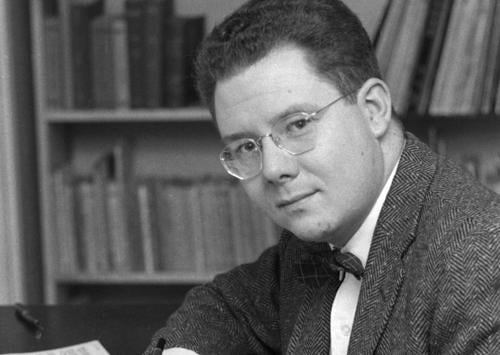
Easley Blackwood, Midwestern composer, pianist and educator at University of Chicago, discusses his music
Mar. 1, 1961 Studs and Mr. Blackwood discuss his musical theory of tonal composition, and Mr. Blackwood plays several excerpts of his piece "Chamber Work for Fourteen Winds" on the piano.
-
Easley Blackwood, Leonard Meyer and Ralph Shapey talk about standards of composition in contemporary music, part 1
1965 The program begins with an excerpt from BBC Radio about a hoax piece of music by Pietorzac (Hans Keller). Hans Keller and a friend went into studio and made noise and presented it as music. In this round table discussion the three gentlemen - all composers, musicians, and educators, discuss with Studs, contemporary music and the standards for defining a composition as music. In the second hour, they discuss what level of knowledge of music a critic should have in order to form a proper opinion of music. All animatedly offer their opinion to both the pro's and the cons.
-
Easley Blackwood, Leonard Meyer and Ralph Shapey discuss the standards of composition in contemporary music, part 2
1965 In this round table discussion the three gentlemen - all composers, musicians, and educators - discuss with Studs contemporary music and the standards for defining a composition in music. In the second hour they discuss what level of knowledge of music a critic should have in order to form a proper opinion of music. All animatedly offer their opinion to both the pro and the con. A movement of both Blackwood and Shapey compositions is played.
-
Easley Blackwood, David Schrader and Ramon Salvatore in discussion with Studs Terkel about music
Apr. 14, 1993 Presenting music published by Chicago record label Cedille Records including the music of composer and pianist Easley Blackwood along with David Schrader and Ramon Salvatore.