

-

Horace Cayton discusses is book "Long Old Road" ; part 3
Sep. 7, 1966 Content Warning: This conversation includes racially and/or culturally derogatory language and/or negative depictions of Black and Indigenous people of color, women, and LGBTQI+ individuals. Rather than remove this content, we present it in the context of twentieth-century social history to acknowledge and learn from its impact and to inspire awareness and discussion.
-
Horace Cayton discusses his book "Long Old Road" ; part 2
Sep. 7, 1966 Content Warning: This conversation has the presence of outdated, biased, offensive language. Rather than remove this content, we present it in the context of twentieth-century social history to acknowledge and learn from its impact and to inspire awareness and discussion. Loneliness and hardships of both fitting in and finding a job are covered in the continuation of Horace Cayton's, "Long Old Road: An Autobiography." By living in a middle class home in Seattle with a full time Japanese servant, Cayton was seen as better off than most people.
-
Horace Cayton discusses his book "Long Old Road" ; part 1
Sep. 7, 1966 Content Warning: This conversation includes racially and/or culturally derogatory language and/or negative depictions of Black and Indigenous people of color, women, and LGBTQI+ individuals. Rather than remove this content, we present it in the context of twentieth-century social history to acknowledge and learn from its impact and to inspire awareness and discussion. In "Long Old Road: An Autobiography," Horace Cayton talks about growing up in Seattle in a well to do, mostly white neighborhood. Cayton's grandfather was the first Black man elected to the U.S.
-

Hollie Brock and Jim Potter both paraplegics, discuss what it is to "be" a paraplegic
1968 Mr. Brock, a recreational therapist, and Mr. Hollie, a nurse, discuss paraplegia. Each of the gentlemen discuss the individual accidents that caused their injuries, their recovery and how they got through it. They talk to Studs about the things they enjoy doing and goals they are trying to reach.
-
Hoagy B. Carmichael discusses his father’s life as a jazz musical
May. 20, 1993 Hoagy B. Carmichael discusses his father and legendary jazz musician, Hoagy Carmichael. He also explores his work as a music producer, author, bamboo fly rod builder, and manager of his father’s music. Includes a test tone that lasts 25 seconds. music.
-
Hiram Sherman discusses the play “Mary, Mary” ; part 2
Sep. 7, 1962 Studs Terkel and actor Hiram Sherman discuss Sherman’s upcoming play “Mary, Mary,” the Actors’ Equity Association, and what it is like to be an actor.
-
Hiram Sherman discusses the play “Mary, Mary” ; part 1
Sep. 7, 1962 Studs Terkel and actor Hiram Sherman discuss Sherman’s upcoming play “Mary, Mary,” the Actors’ Equity Association, and what it is like to be an actor.
-
Hiram Sherman discusses the play “A Flea in Her Ear”
Apr. 23, 1968 Studs Terkel speaks with actor Hiram Sherman about Sherman’s play “A Flea in Her Ear,” winning awards, and the differences between American theater and European theater.
-
Hildegard Knef discusses her book, "The Gift Horse: Report on a Life" and the experiences of her life in Nazi Germany and as an actress in America post World War II
1971 Studs interview with Hildegard Knef, actress and writer. They discuss her life in Nazi Germany during the war and her experience as an actress when she came to America. Studs and Hildegard read together from her book, "The Gift Horse." Knef describes her family, Nazi Germany, survival, and her experience as a German in American post WWII. Her husband, David Anthony Palastanga, also reads an excerpt from her book.
-
Hilda Bernstein discusses her life and exile from South Africa
May. 21, 1975 Hilda Bernstein tells Studs about her and her husband's activism in South Africa, apartheid, and the Sharpville demonstration. Includes an excerpt from the program with Chief Albert John Luthuli (Wav ID 1895817-6-1).
-
-
-
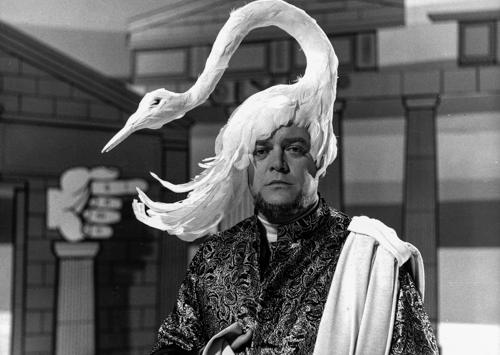
Hermann Prey discusses his career
Dec. 9, 1971 This is an interview with Herman Prey about his music career and the history of the opera music. This record contains music fragments from Papageno's lyrics of The Magic Flute.
-
Herman Shumlin discusses his work in theater ; part 2
Dec. 12, 1964 Studs Terkel talks with theater producer Herman Shumlin about Shumlin’s work in theater and some of the plays he has produced. This is the final part of the interview with Shumlin.
-
Herman Shumlin discusses his work in theater ; part 1
Dec. 12, 1964 Studs Terkel talks with theater producer Herman Shumlin about Shumlin’s work in theater and some of the plays he has produced. Audio clips from the play “The Little Foxes” and the opera “Regina” are played. This is the first part of the interview with Shumlin.