

-

John Bird and Eleanor Bron discuss television and the theatre ; part 2
1962 Eleanor Bron explained that audiences want something new from actors all the time. Bron said she was leery of all the newness because people would get bored. John Bird added that at times, it's difficult to be creative. In the end, they both spoke of their looking around for a two-person show to do together.
-
John Bird and Eleanor Bron discuss television and the theatre ; part 1
1962 Eleanor Bron said television provided its audience with too many facts. Bron also said it’s dreadful to hear about all the misery and tragedy going on in today’s world. In contrast, John Bird said the television offered its audience an opportunity to learn more about world affairs. Switching to the topic of theatre, Bron said she preferred working in the theatre because, as an actor, she has more control over what’s done at every performance. In contrast again, Bird said he did not like acting on the stage.
-
John Bernard discusses his life, politics and his work with the Farmer Labor Party
Aug. 1, 1977 Interviewing labor organizer, civil rights activist, and former Congressman John Bernard. Bernard was elected as a Farmer-Labor candidate to the U.S. House of Representatives and served from 1937-1939.
-
John Bergman, Mike Bail, Jill Reiner, Tom Swift, Geese Theatre Company in conversation with Studs Terkel
May. 23, 1988 Interviewing members of the Geese Theatre Company; Mike Bail, Jill Reiner, Tom Swift, and Artistic Director John Bergman. The Geese Theatre Company specializes in drama therapy in prisons, for correctional staff, and for sexual and violent offenders.
-
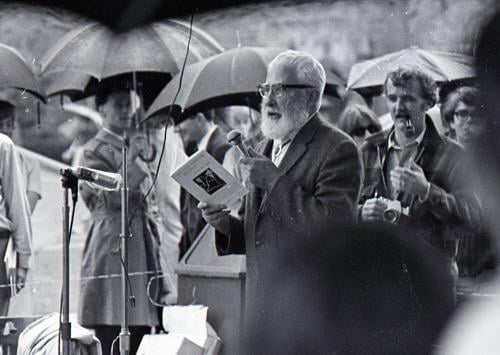
John Beecher talks about his poetry collection "To Live & Die in Dixie"
1969 Discussing "To Live & Die in Dixie & Other Poems". Includes excerpt from Studs' 1965 Montgomery program that features Beecher (1905917-3-1). Beecher reads "To Live and Die in Dixie", "Chainey", "The Better Sort of People", "After Christus", "Bestride the Narrow World", "Wisdom of the Abbott Macarius", "Josiah Turnbull took no part in politics", "A Commemorative Ode".
-
John Bailey, Robert Tucker, and Dick W. Simpson discuss housing and transportation ; part 4
Oct. 9, 1974 Dick Simpson's book, "Chicago's Future: An Agenda for Change," is discussed with the author, John Bailey and Robert Tucker, all employees of Chicago universities. The group discusses housing and transportation issues that many working class citizens face. The group discusses possible ways to fix the issues including government help and re-zoning.
-
-
-
-
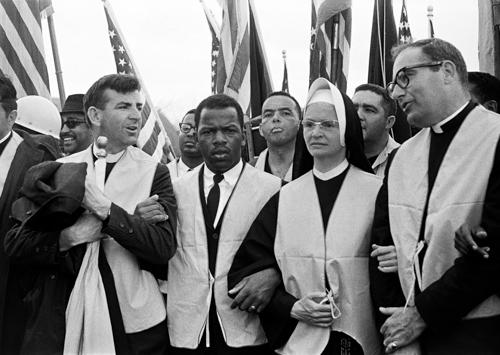
John A. McDermott and Sister Mary Peter discuss Catholic Church's Participation in Civil Rights Movement
Sep. 15, 1965 John A. McDermott and Sister Mary Peters discuss Catholic Church's Participation in Civil Rights Movement. Includes interview with unknown Catholic man opposed to nuns' and priests' involvement. Includes song "It Isn't Nice" by Judy Collins.
-
John (Fire) Lame Deer and Richard Erdoes dicusss their book "Lame Deer, Seeker of Visions"
Sep. 15, 1972 *Please note: some sections have been edited out from the original recording due to copyright considerations
-
Joel R. Connally and Howard J. Dooley discuss their book "Hesburgh's Notre Dame: Triumph in Transition"
Dec. 18, 1972 Authors and Notre Dame alumni Joel R. Connally and Howard J. Dooley discuss their biography of former University of Notre Dame president Rev. Theodore Hesburgh, titled "Hesburgh's Notre Dame: Triumph in Transition."
-
Joel Henning talks with Studs Terkel about "Holistic running"
Oct. 17, 1978 Discussing "Holistic running" with Joel Henning.
-
Joel Hall, Lynn Colburn, Larry Schoeneman discuss the Chicago Metropolitan Dance Festival
Jun. 10, 1980 Studs Terkel disccuses the Chicago Dance Festival with Joel Hall, Lynn Colburn, and Larry Schoeneman.
-
Joe Venuti discusses his family and career in Jazz
Sep. 24, 1976 Studs interviews Joe Venuti, who reflects on his career with various bands and shows. John McDonough cohosts the interview with Studs. Venuti speaks about various instruments he and others use in Jazz. He shares a story of how the depression affected him. Venuti discusses the pranks he pulled on people and other musicians he has worked with. The musical numbers are removed from this edited version of the original recording.