

-

Shana Alexander discusses her book "Happy Days"
Nov. 10, 1995 The book, "Happy Days: My Mother, My Father, My Sister and Me," gives a lot of background about Shana Alexander's father, Milton Ager. A few of Ager's songs are played throughout the interview. Alexander also glosses over her time spent with "Life Magazine," and with "60 Minutes."
-

Seymour Melman discusses his book "Pentagon Capitalism: The Political Economy of War"
Jun. 8, 1970 Seymour Melman discusses his book "Pentagon Capitalism: The Political Economy of War." Topics of discussion include the military-industrial complex and the state management of industry, particularly in regards to defense.
-
Seymour M. Hersh reads from and discusses his book "My Lai 4"
May. 22, 1970 Innocent, unarmed villagers were murdered in the horrific massacre in March of 1968. In Seymour M. Hersh's book, "My Lai 4: A Report on the Massacre and Its Aftermath," Seymour further explains that to the soldiers, the killing was simply a game to them, of who could kill the most bodies.
-
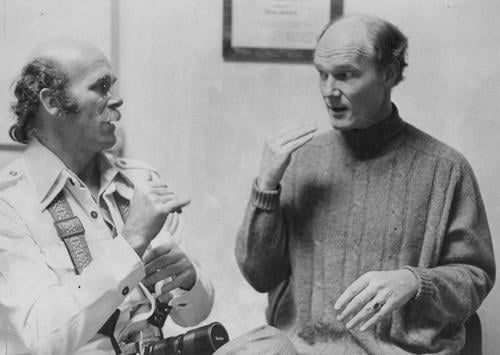
Several members of the cast of The Theater for the Deaf discuss their production ; Couples with a brief interview with John Cage and "Music for Carillon" is played.
Apr. 23, 1968 Rilla Bergman, Lou Fant, and Bill Reese converse with Studs about The National Theater for the Deaf and the production they are presenting. Two of the actors Ms. Bergman and Mr. Reese discuss what it took to learn, as hearing people, the best ways to express themselves with sign language. They all talk about how much more expressive the actors in the Deaf Theater have to be to convey the message of the piece they are presenting.
-
Sergeant Garland Davis discusses his profession ; part 2
Even though his life was threatened, when a young man told him his goal in life was to see Davis dead, Sergeant Garland Davis, continues to work in the youth crime division, in the hopes by be-friending the young people, they will do something positive with their lives. Davis also adds that the parents of these young people, along with the communities in which they live, play parts in the youths' behavior.
-
Sergeant Garland Davis discusses his profession ; part 1
An officer with the Chicago department, Sergeant Garland Davis, talks about his presence in the community, in hoping that some of the young people he works with see him as a friend and not solely as a cop. Davis also talks about the priority being helping the youth before their lives take a wrong turn into a life of crime.
-
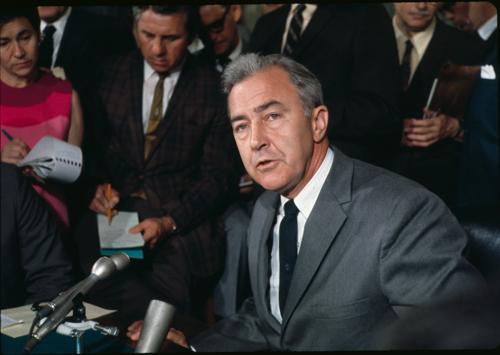
Senator Eugene McCarthy talks about his presidential campaign
Mar. 3, 1975 Former Minnesota Senator Eugene McCarthy talks about his presidential campaign. Includes an excerpt of a 1968 program in which Studs and James Cameron visit Lincoln Park after the Chicago Democratic Convention riots.
-
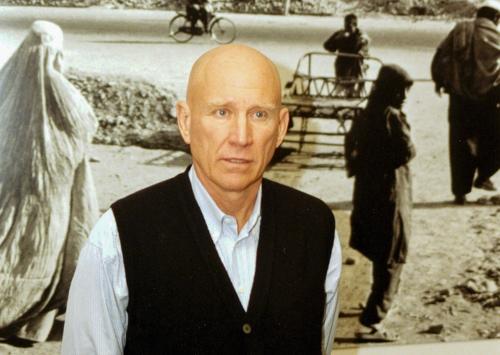
Sebastiao Salgado discusses the book "Workers: An Archaeology of the Industrial Age"
Sep. 27, 1993 Sebastiao Salgado, a Brazilian documentary photographer and photojournalist, converses with Studs about his book "Workers: An Archaeology of the Industrial Age". Mr. Salgado shares stories with Studs of the people he has photographed, and the things he has learned about the perseverance of human nature. Several songs are interspersed;
-
Seamus Heaney talks about his poetry with Studs Terkel
Mar. 1, 1981 The Irish poet and playwright shares with Studs how he was drawn to poetry and how his education and early life in Northern Ireland helped him to find his voice.*Please note: some sections have been edited out from the original recording due to copyright considerations
-
-
Scott Ridley discusses the book “Power Struggle: The Hundred-Year War Over Electricity”
Feb. 25, 1987 Author Scott Ridley discusses the book “Power Struggle: The Hundred-Year War Over Electricity” and the corruption in the private power industry. Studs plays "Roll on Columbia" by Judy Collins (1972) and "Grand Coulee Dam" by Woody Guthrie (1941).
-
Scott McCloud discusses his book “Understanding Comics: The Invisible Art”
Jun. 30, 1994 Artist and author Scott McCloud discusses and reads from his book “Understanding Comics: The Invisible Art.” This discussion focuses heavily on the history of comics, or sequential art, and notable figures using this artform. Studs plays "Seven Studies on Themes of Paul Klee: 4. The Twittering Machine" - Gunther Schuller (1966).
-
Scott Donaldson in conversation with Studs Terkel
Aug. 1, 1992 Discussing the book "Archibald MacLeish: An American Life" (published by Houghton Mifflin) with the author Scott Donaldson.
-
Scott and Helen Nearing discuss their book "Living the Good Life"
Nov. 13, 1970 After being thoroughly disillusioned and disgusted with city life, Scott and Helen Nearing moved to a farm. They talk about homesteading in their book, "Living the Good Life: How to Live Sanely and Simply in a Troubled World". They built their house of stone and they farmed the land. They ate no meat, as they didn't believe in hunting or killing animals. The Nearings hadn't seen a doctor in over 40 years.*Please note: some sections have been edited out from the original recording due to copyright considerations
-
Scharmel Iris reads from "Spanish Earth"
Jul. 21, 1965 Interviewing Scharmel Iris reading excerpts from his "Spanish earth"