

-

Nancy Walker discusses her career
Feb. 8, 1962 A discussion of Nancy Walker's early career as actress and comedian of stage, screen, radio, and television.*Please note: some sections have been edited out from the original recording due to copyright considerations
-
Morris Dees discusses his latest book "A Season for Justice: the Life and Times of Civil Rights Lawyer Morris Dees"
May. 31, 1991 Southern Poverty Law Center founder and attorney Morris Dees discusses his career and pursuit of ending racism. Some cases associated with Morris Dees include NAACP v. Dothard and Person v. Carolina Knights of the Ku Klux Klan.
-
Morris Carnovsky, Phoebe Brand, and Randall Kim discuss acting and theater
May. 15, 1989 Content Warning: This conversation has the presence of outdated, biased, offensive language. Rather than remove this content, we present it in the context of twentieth-century social history to acknowledge and learn from its impact and to inspire awareness and discussion. Actors Morris Carnovsky, Phoebe Brand, and Randall Kim discuss their various roles in theater, Shakespeare’s plays, and their work at the American Players Theater in Chicago.
-
Morris Carnovsky discusses theatre
Oct. 20, 1959 The Stanislavski Method, Shakespeare's play "The Merchant of Venice," and the role of Shylock are all topics covered in this interview. Carnovsky said that the highpoint of his acting career was playing Shylock. Public relations man, Danny Newman, talks at the end about subscriptions to the Goodman Theatre.*Please note: some sections have been edited out from the original recording due to copyright considerations
-
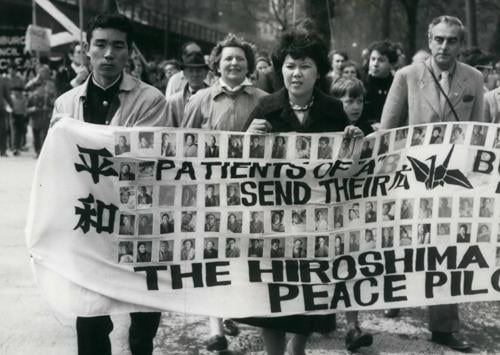
Miyoko Matsubara discusses her experiences as a survivor of the atomic bombing of Hiroshima
Mar. 29, 1962 Miyoko Matsubara, a Japanese survivor of the atomic bomb dropped on Hiroshima, discusses her experiences through translator Joan Takada. Later in life, she went on to work with disadvantaged children and as an advocate for world peace and the prevention of nuclear testing and warfare.
-
Milton Mayer reads and discusses his article, "Ill Met by Moonlight"
Dec. 31, 1968 Million Mayer, journalist, reads his article, "Ill Met by Moonlight" and discusses his thoughts on technology and automation replacing jobs and human interactions.he also talks about youth, non-violence protesting for change, and education.
-
Mike Royko, Dick Griffin, and Rob Warden discuss and read from the book “Done in a Day: 100 Years of Great Writing from the Chicago Daily News”
Mar. 15, 1977 Chicago journalists Mike Royko, Dick Griffin, and Rob Warden discuss and read from the book “Done in a Day: 100 Years of Great Writing from the Chicago Daily News.” The group discusses prominent journalists featured in this book including Robert J. Casey and Ellen Warren. Studs plays "The Moon Shines on the Moonshine" - Bert Williams (1920) and "Elanoy" - Win Stracke (1958).
-
Mike Royko discussing his book "Up Against It"
1967 Mike Royko discusses his book "Up Against It" which is a collection of early columns from the Chicago Daily News. The topic in his columns varies from machine politicians and gangsters to professional athletes, from well-heeled Chicagoans to down-and-out hoodlums.
-

Mike Cherry discusses his book, "On High Steel: The Education of an Ironworker"
Nov. 1, 1974 Ironworker and writer Mike Cherry discusses his book, "On High Steel: The Education of an Ironworker."
-
Micheál Mac Liammóir discusses his show "The Importance of Being Oscar"; part 2
Nov. 17, 1961 Micheál Mac Liammóir, actor and playwright, discusses his upcoming performance based on the writings of Irish playwright and poet Oscar Wilde.
-
Michael Feinstein discusses George and Ira Gershwin
Feb. 26, 1990 Interviewing Michael Feinstein, American singer, pianist, and music revivalist, about his music and his work cataloging Ira Gershwin’s collection of phonograph records.
-
Michael Burton discusses John Henry Faulk and John Henry Faulk discusses American history and politics
May. 3, 1982 This interview contains two parts. The first focuses on writer and John Henry Faulk biographer, Michael Burton, in which Burton discusses John Henry Faulk’s life as an American storyteller as well as his book entitled “John Henry Faulk: The Making of a Liberated Mind.” Burton makes mention of how the Hollywood Blacklist affected Faulk’s career.
-
Metro High School students talk with Studs Terkel
Apr. 7, 1975 Interviewing Shelby Taylor, Paul Goren, Jean Tucker, Paul McCree from Metro High School in Chicago, Ill.
-
Meridel Le Sueur discusses her book "Ripening: Selected Work, 1927-1980," published in 1981
Mar. 30, 1982 Meridel Le Sueur discusses the publication of her selected works and her life as an activist, fighting for socialist ideals and women's rights. She goes on to discuss the time she spent with Native American Navajo tribes and their theory of nonlinear time.*Please note: some sections have been edited out from the original recording due to copyright considerations
-
Mel Lambert and five Puerto Rican boys discuss life in Chicago and the Latin King gang ; part 2
1968 Studs interview with five Puerto Rican boys: Hector, Jose, Victor, Harry and Carlos. Two other young men enter the conversation at the end: Raphael and Benjamin. Each boy describes a memory and some express a desire to return to Puerto Rico, while others wish to stay in America. The boys describe some about gang life with the Latin Kings and the violent relationship between gangs in Chicago. Studs suggests a peace conference with all gang leaders, and the boys describe their opinion of the outcome of such a meeting.