

-

Naomi Lazard joins Studs to talk about her work
1970 The graphic designer turned poet shares some insight into her creative process, especially in the collections, Cry of the Peacocks, The Moonlit Upper Deckerina, and Ordinances.*Please note: some sections have been edited out from the original recording due to copyright considerations
-
Nancy Walker discusses her career
Feb. 8, 1962 A discussion of Nancy Walker's early career as actress and comedian of stage, screen, radio, and television.*Please note: some sections have been edited out from the original recording due to copyright considerations
-
Morris Dees discusses his latest book "A Season for Justice: the Life and Times of Civil Rights Lawyer Morris Dees"
May. 31, 1991 Southern Poverty Law Center founder and attorney Morris Dees discusses his career and pursuit of ending racism. Some cases associated with Morris Dees include NAACP v. Dothard and Person v. Carolina Knights of the Ku Klux Klan.
-
Morris Carnovsky discusses theatre
Oct. 20, 1959 The Stanislavski Method, Shakespeare's play "The Merchant of Venice," and the role of Shylock are all topics covered in this interview. Carnovsky said that the highpoint of his acting career was playing Shylock. Public relations man, Danny Newman, talks at the end about subscriptions to the Goodman Theatre.*Please note: some sections have been edited out from the original recording due to copyright considerations
-
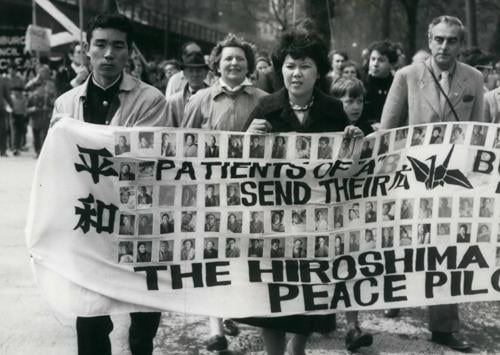
Miyoko Matsubara discusses her experiences as a survivor of the atomic bombing of Hiroshima
Mar. 29, 1962 Miyoko Matsubara, a Japanese survivor of the atomic bomb dropped on Hiroshima, discusses her experiences through translator Joan Takada. Later in life, she went on to work with disadvantaged children and as an advocate for world peace and the prevention of nuclear testing and warfare.
-
Milton Mayer reads and discusses his article, "Ill Met by Moonlight"
Dec. 31, 1968 Million Mayer, journalist, reads his article, "Ill Met by Moonlight" and discusses his thoughts on technology and automation replacing jobs and human interactions.he also talks about youth, non-violence protesting for change, and education.
-
Mike Royko discussing his book "Up Against It"
1967 Mike Royko discusses his book "Up Against It" which is a collection of early columns from the Chicago Daily News. The topic in his columns varies from machine politicians and gangsters to professional athletes, from well-heeled Chicagoans to down-and-out hoodlums.
-
Micheál Mac Liammóir discusses his show "The Importance of Being Oscar"; part 2
Nov. 17, 1961 Micheál Mac Liammóir, actor and playwright, discusses his upcoming performance based on the writings of Irish playwright and poet Oscar Wilde.
-
Meridel Le Sueur discusses her book "Ripening: Selected Work, 1927-1980," published in 1981
Mar. 30, 1982 Meridel Le Sueur discusses the publication of her selected works and her life as an activist, fighting for socialist ideals and women's rights. She goes on to discuss the time she spent with Native American Navajo tribes and their theory of nonlinear time.*Please note: some sections have been edited out from the original recording due to copyright considerations
-
Mary Norris Lloyd discusses her book " A Dream of Mansions"
Mar. 8, 1962 Social activist and author Mary Norris Lloyd discusses her work and its reflection on Christian morality and views on the South. Topics covered include segregation, racism, and religion and how it has coincides with the issues of race.
-
Martina Arroyo discusses her opera career ; part 2
Aug. 1969 When the announcement was made, to let the audience know the opera singer they came to see would not be performing but that Martina Arroyo would be singing the part of Aida, Arroyo recalls that you could hear the crowd groan all the way in Chicago. Arroyo talks about singing in the operas. She also talks about even though she may have a starring role in the opera, the show is not hers, but rather everyone in the company works hard to put out a good production.
-
Martina Arroyo discusses her opera career ; part 1
Aug. 1969 When the announcement was made, to let the audience know the opera singer they came to see would not be performing but that Martina Arroyo would be singing the part of Aida, Arroyo recalls that you could hear the crowd groan all the way in Chicago. Arroyo talks about singing in the operas. She also talks about even though she may have a starring role in the opera, the show is not hers, but rather everyone in the company works hard to put out a good production.
-
Martin Bernal discusses Chinese politics and history
Interviewing Martin Bernal, British scholar of Chinese political history. He discusses various aspects of Chinese history, including the Cultural Revolution, communism, and Chairman Mao.
-
Marlon Brando discusses his views on mankind ; part 3
Apr. 19, 1963 Content Warning: This conversation includes racially and/or culturally derogatory language and/or negative depictions of Black and Indigenous people of color, women, and LGBTQI+ individuals. Rather than remove this content, we present it in the context of twentieth-century social history to acknowledge and learn from its impact and to inspire awareness and discussion. In conclusion, Marlon Brando added that his being a famous actor posed an ugly and difficult burden to his son.
-
Marlon Brando discusses his views on mankind ; part 2
Apr. 19, 1963 Content Warning: This conversation includes racially and/or culturally derogatory language and/or negative depictions of Black and Indigenous people of color, women, and LGBTQI+ individuals. Rather than remove this content, we present it in the context of twentieth-century social history to acknowledge and learn from its impact and to inspire awareness and discussion. In a surprising twist, Marlon Brando asks Studs Terkel why he is so obsessed with asking people so many questions and Terkel’s reply was curiosity.