

-

Gore Vidal on politics and literature
Nov. 1, 1974 The writer and public intellectual discusses his recent publications, Myron: A Novel, and, Burr, an historical novel about Founding Father, Aaron Burr.*Please note: some sections have been edited out from the original recording due to copyright considerations
-
Gisela May discusses her role in "Mother Courage and her Children"
Oct. 1972 While in a dressing room, Gisela May talks about the songs that she sings in the play, "Mother Courage and Her Children". May also talks about lessons learned from Bertolt Brecht's plays.
-
George V. Bobrinskoy discusses Mark Twain's popularity in Russia ; part 2
Apr. 20, 1959 After reading Twain's books, Bobrinskoy believed that all Russian boys, at one point or another, thought about running away to America. Twains' books depicted lives filled with adventure in the United States. Bobrinskoy's final thought was that Mark Twain was the greatest American writer.
-
George V. Bobrinskoy discusses Mark Twain's popularity in Russia ; part 1
Apr. 20, 1959 When he was a school boy in 1912, George V. Bobrinskoy got to know the works of Mark Twain. He loved Twain's stories and talks about his favorites, "Tom Sawyer" and "The Adventures of Huckleberry Finn".*Please note: some sections have been edited out from the original recording due to copyright considerations
-
Garry Wills discusses his book "John Wayne's America: The Politics of Celebrity"
Mar. 10, 1997 Garry Wills, writer and historian, discusses his book "John Wayne's America: The Politics of Celebrity." He explores the popularity of John Wayne that took him from an actor and made him into an American symbol. He explores how the symbol of John Wayne is used by white male politicians to influence their decisions and how that affected the Vietnam War. Wills gives a biography of John Wayne, including the many influential people in his life such as his working partner, John Ford.
-
Garry Davis discusses renouncing his American citizenship ; part 1
May. 23, 1973 May 25, 1973, is the 25th anniversary of when Garry Davis renounced his American citizenship. Davis explained it is a grave injustice to be governed by laws that were set up by people who are now dead. The problem says Davis, is the laws have to catch up to the 20th century. Davis goes on to talk about the World Service Authority.
-
Garry Davis discusses his book "Ready or Not: World Government"
Jun. 18, 1985 Garry Davis, an international peace activist and founder of the World Government Authority, discusses his philosophy on world peace and his stance on being a world citizen.
-
Gar Alperovitz discusses his book “Atomic Diplomacy: Hiroshima and Potsdam”
Gar Alperovitz, historian, writer, and political economist, discusses the bombing of Hiroshima, the Potsdam Conference, and the American confrontation with Soviet power.
-

Gail Levin discusses the work of Edward Hopper and the Art Institute of Chicago's Hopper's exhibition
Oct. 2, 1981 Discussing the book "Edward Hopper: The Art and the Artist." Includes recordings of Robert Frost reading "The Road Not Taken," Carl Sandburg reading "Gone," and Tom Waits' song "Nighthawks."
-
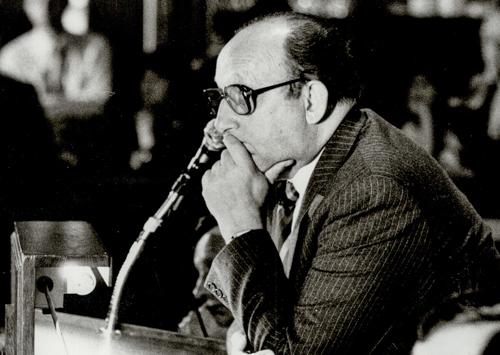
G. A. Arbatov in conversation with Studs Terkel
Aug. 26, 1992 Discussing the book "The System: An Insider's Live in Soviet Politics" (published by Times Books) with the author Georgi Arbatov.
-
From the Wax Museum - 009 - South African writer Alan Paton discusses life in South Africa
1963 South African writer Alan Paton likened the white South African people to the ostrich. Paton said the ostrich keeps its head in the sand, and some people do the same in South Africa, too. With their heads in the sand, they don’t see any problems existing. Paton said he can not understand his country’s government. He can’t understand why the Black people are not allowed to own homes. Because of the government, Paton also talks about having to be careful about what he writes and he says the Americans are very lucky to have their U.S. Constitution.
-
Fred W. Friendly discusses his book "Due to Circumstances Beyond Our Control" and his career, part 1
1968 Fred W. Friendly discusses his book "Due to Circumstances Beyond Our Control" and his career. Fred W. Friendly discusses television and mass media. (Part 1 of 2)
-
Fred W. Friendly discusses his book "Due to Circumstances Beyond Our Control"
1968 Studs Terkel interviews Fred W. Friendly to promote his book "Due to Circumstances Beyond Our Control." Although this interview seems to be the conclusion of a longer discussion, Friendly offers two key points: we should learn from a crisis to better handle the next one and television will shape the world. Duration 1:26. (Part 2 of 2)
-
Fred Freed discusses the atom bomb
Author Fred Freed discusses the history of the atom bomb, its impact on the world, and the scientists involved in its making. He also touches on Japan during World War II and the bombings of Hiroshima and Nagasaki.
-
Frank Donner discusses the article he wrote "Theory and Practice of American Political Intelligence" ; part 2
In his article, "Theory and Practice of American Political Intelligence," Frank Donner brings up the poisonous effect of surveillance on people's invasion of privacy. Donner explained people adjust their lives to it. Donner's last reflection is for people to not just be frightened by surveillance but rather to do something about it like study how much money is spent on surveillance and who is accountable.