

-

Marion Clark and Rudy Maxa discuss their book, "Public Trust, Private Lust: Sex, Power, and Corruption on Capitol Hill"
Jul. 12, 1977 Marion Clark and Rudy Maxa, investigative journalists, discuss their book, "Public Trust, Private Lust: Sex, Power, and Corruption on Capitol Hill." The two recall how Elizabeth Ray contacted them about an affair she was having with U.S. Representative Wayne Hays, who was using taxpayer's money to pay her. The journalists also discuss Koreagate and other corruptions going on in Washington D.C. in the 1970s.
-
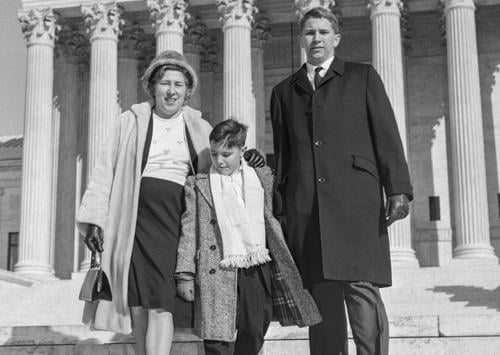
Madalyn Murray discusses her family history, feminism, and theology
Dec. 13, 1966 Madalyn Murray discusses her family history, feminism, and theology and how her experiences with those subjects have shaped her worldview.
-
Laurence Shoup discusses his book, "The Carter Presidency and Beyond: Power and Politics in the 1980s"
1970 Author Laurence Shoup discusses his book, "The Carter Presidency and Beyond: Power and Politics in the 1980s," and explains how President Carter came to be elected. He describes the Trilateral Commission and other groups created by corporations and the richest American families to lobby. the government. He also discusses the Carter presidency and his double-dealing with major issues such as unions and regulating big businesses.
-
James David Barber discusses his book, "The Pulse of Politics: Electing Presidents in the Media Age," with the author James David Barber
May. 30, 1980 James David Barber, author and political scientist, discusses his book, "The Pulse of Politics: Electing Presidents in the Media Age." He explains the premise of his beliefs that presidential elections run a cycle of "conflict, conscience, conciliation," and how media affects this. He uses examples of elections from Teddy Roosevelt to Jimmy Carter. Presidential campaign songs are played throughout the interview. A record is played to hear the voices of Teddy Roosevelt and Franklin D. Roosevelt.
-
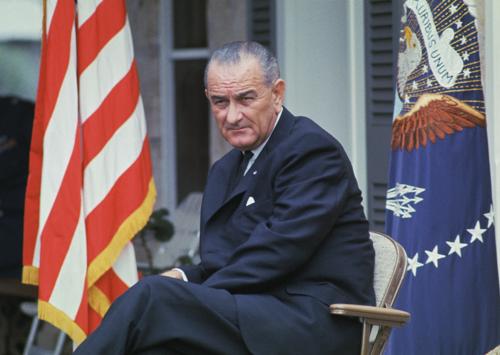
Eric Goldman discusses his experiences as special consultant to President Lyndon Johnson
1967 Historian Eric Goldman discusses his time as special consultant for President Lyndon B. Johnson and his book "The Tragedy of Lyndon Johnson."
-
Dr. Harold Taylor sits down with Studs Terkel
May. 24, 1962 Educator and lecturer Harold Taylor discusses with Studs a variety of higher-education related topics, including being students being politically aware, on-campus activism and the role of instructors in students' lives.
-
Chicago residents Alice and Bob Taylor talk with Studs Terkel
1970 Recorded in the Taylor's home against a backdrop of sounds created by a nine-children family, Studs, Alice and Bob discuss aspects of a white family living in a predominately African-American amidst an exodus of the white, Christian community. Includes a performance of "Onward, Christian Soldiers" by the family around their piano, and "Jesus Loves Me" by two of the children.