

-

-
Henry Steele Commager discusses America, American history, and American relations; part 1
May. 1, 1967 Henry Steele Commager discusses America, American history, and American relations. He also discusses television, historical figures, and wars. (Recorded at the Orrington Hotel in Evanston, Ill.).
-
Helen Vlachos discusses her career and her book "House Arrest"
1970 In 1967, because Helen Vlachos spoke freely and called someone in the junta a clown, she was placed under house arrest. Artists took part in a type of silent resistance, as there was no new music, no new paintings, no new poems or writings that were created. Freedom isn't allowed, explained Vlachos, as people aren't allowed to use their own minds.
-
Harrison Evans Salisbury discusses his book "A Time of Change"
Mar. 18, 1988 His experiences as a journalist are what's covered in Harrison Evans Salisbury's book, "A Time of Change: A Reporter's Tale of Our Time". Salisbury believed as a reporter, one truly needed to be at the event, in order to obtain the true story. Once Salisbury questioned if he was living in America because he was asked to switch rooms at a hotel in Birmingham, only to find out later that there were special, bugged rooms for reporters.
-
Hamilton Fish III discusses American history
Colonel Hamilton Fish III discusses American history. Major topics include The Great Depression, Franklin D. Roosevelt, World War II, and Communism. Fish also reads a personal letter sent to him from Martin Dies, Jr. Content Warning: This conversation has the presence of outdated, biased, offensive language. Rather than remove this content, we present it in the context of twentieth-century social history to acknowledge and learn from its impact and to inspire awareness and discussion.
-
-
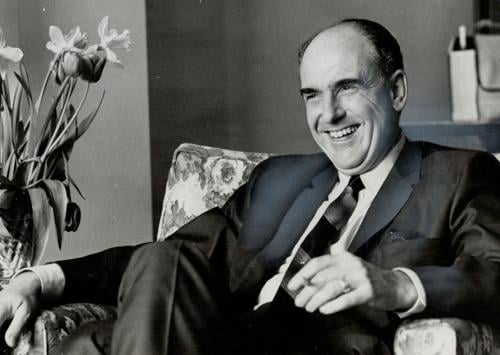
George Blanksten, Irma Edelman, Robert Eisner and Dr. Nicolas Pedritis discuss economist Andreas Papandreou's imprisonment
Apr. 1, 1967 Mr. Blanksten, Ms. Edelmen, Mr. Eisner and Dr. Pedritis, all educators, talk about economist and Prime Minister of Greece Andreas Papandreou's imprisonment.
-
European correspondent Daniel Singer discusses the independently published magazine “The Nation” and French politics and government
Apr. 10, 1996 European correspondent and journalist Daniel Singer discusses the independently published magazine “The Nation” and French politics and government. Singer focuses his discussion on the 1995 strikes in France and the political and economic events leading up to and influencing these strikes. Studs plays the French national anthem “La Marseillaise.”
-
Educator Harold Taylor talks with Studs Terkel ; part 2
1965 A short clip of Studs Interviewing educator Harold Taylor. The two briefly discuss what it would be like for the United States of America to use its resources in a way to become a "vast meeting ground of people," in which American citizens are exposed to a variety of the arts from different cultures in an effort to become a "teacher in the world."
-

Discussing a rebuttal to editorials opposing the nuclear arms freeze
Oct. 27, 1982 Presenting a rebuttal to editorials opposing the nuclear arms freeze with Dr. Jack Geiger, Dr. George Kistiakowsky, Dr. Herbert (Peter) Schoville and Dr. Kosta Tsipis of MIT.
-
Dan Wakefield discusses his book “Supernation at Peace and War”
1960 Writer Dan Wakefield discusses his book “Supernation at Peace and War” with Studs Terkel. Further discussion is had over civil unrest, draft dodging, and social injustices during the Vietnam War.
-
Blanche Wiesen Cook discusses her book, "The Declassified Eisenhower: A Divided Legacy of Peace and Political Warfare"
Aug. 6, 1981 Blanche Wiesen Cook, historian, professor, and author discusses her book, "The Declassified Eisenhower," and explains Eisenhower's peace and war beliefs. She describes his beliefs at the end of World War II and his relationships with fellow generals and leaders.
-
Allan Ryan discusses his book "Quiet Neighbors: Prosecuting Nazi War Criminals in America"
Jan. 29, 1985 Allan A. Ryan, former Director of the Department of Justice's Office of Special Investigations, speaks about his book on the investigation and prosecution of Nazi war criminals in the United States. Ryan says that after WWII, Nazi collaborators and war criminals fled prosecution under the guise of fleeing the threat of communism. Ryan worked on the investigations of prominent war criminals like Ivan the Terrible and John Demjanjuk, and he discusses how he successfully worked with the Soviet Union to obtain crucial evidence located within the USSR for these trials.