Listen to New Voices on Studs Terkel our partnership with 826CHI-here! Read the Story


-

-
Henry Knepler discusses the role of women in American society
1969 According to Henry Kneplers book, " The Gilded Stage," back in the 1600's, highly regarded women were either actresses on the stage or they were aristocrats or nobility. Knepler said the role of primary grade school teachers were women. Currently, there's some discrimination going on, as Knepler pointed out that one never sees a male airline stewardess.
-
Henry Fonda and John Houseman discuss the play "Clarence Darrow"
Henry Fonda and John Houseman talk about working with one another on "Clarence Darrow: A One-Man Play". Houseman is in awe of Fonda's portrayal of Clarence Darrow, explaining that in the play, the audience can really see the growth of Clarence Darrow, from a young lawyer to an experienced, wise one. Fonda talks about the opening scene when Darrow recalls his father talking to him when he was a young boy. Fonda reflects on times when his father talked to him. Fonda recalls being taught not to hate individuals.
-
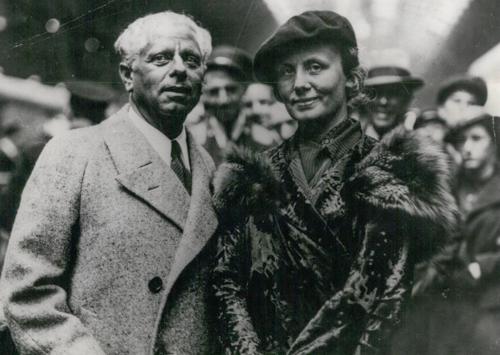
Helene Thimig-Reinhardt discusses her career as an actress and the work of her husband, Max Reinhardt
Mar. 22, 1968 Austrian actress Helene Thimig-Reinhardt discusses her origins and reflects on a long acting career. As the widow of Max Reinhardt, much of the discussion touches on his work as a theater director, film director, and impresario. 00:50:30- 00:52:29 "Ich Muss Wieder Einmal in Grinzing Sein" by Lotte Lehmann
-
Hal Holbrook discusses his Mark Twain impersonation
Oct. 23, 1959 *Please note: some sections have been edited out from the original recording due to copyright considerations
-
-
-
Gisela May discusses her role in "Mother Courage and her Children"
Oct. 1972 While in a dressing room, Gisela May talks about the songs that she sings in the play, "Mother Courage and Her Children". May also talks about lessons learned from Bertolt Brecht's plays.
-
Gilbert Moses discusses The Free Southern Theater and his play "Blues for Mister Charlie" with Studs Terkel ; part 2
Aug. 10, 1966 Studs interviews Gilbert Moses about his play, "Blues for Mister Charlie" and The Free Southern Theater. They discuss a variety of plays that include, "White America," "Roots," and "Blues of Mister Charlie."
-
Gilbert Moses discusses "Waiting for Godot" and the Free Southern Theatre with Studs Terkel ; part 1
Aug. 10, 1966 Studs interviews Gilbert Moses about the Free Southern Theatre that performed throughout Mississippi depicting the lives of Southern blacks. Moses describes the audiences and their reactions to the plays and their own participation in acting out their lives.
-

Geraldine Page discusses her role as Zelda Fitzgerald
1970 Geraldine Page is Zelda Fitzgerald in the play, "Clothes for a Summer Hotel". When first reading the play, Page didn't like Zelda because she believed Zelda was a privileged, rich, spoiled brat. Although she said Zelda had her flaws, Page learned that Zelda had the gift of writing.
-
George Rose discusses his career and upcoming role at the Globe Theatre ; part 2
1963 Tony award-winning actor and singer George Rose discusses his role in the play "Common man: a man for all seasons" by Robert Bolt.
-
Frederick Ritter discusses and preforms classic Austrian Vienna Volks Theatre music
May. 23, 1963 Frederick Ritter, professor, preforms musical numbers from Austria. He also discusses the history of baroque theater and Volk's Theatre, along with Viennese culture. He is joined by Sabine Roupp, Joseph Gardner and David Miller on piano during the performances. Ritter also compares Bertolt Brecht with earlier writers, Johann Nestroy and Ferdinand Raimund. Selected pieces includes works by Mozart and Ferdinand Raymond and Johann Nestroy.
-
Frank Galati discusses the play "She Always Said, Pablo"
Mar. 5, 1987 Director Frank Galati explains that the play "She Always Said, Pablo," was about Gertrude Stein's relationship with Pablo Picasso. Referring to the play itself, Galati also said that he tried to marry their narrative writings with some operatic song.
-
Frank Galati discusses the play "Cry, the Beloved Country"
Jul. 20, 1993 Frank Galati and some cast members of "Cry, the Beloved Country," talk about the play. Fathers, sons, relationships, faith and redemption are all areas covered in the play. Galati explains how the story of the play itself draws the audience inward and gets them mesmerized.