

-

Talking about piano instruction, with David Sudnow
Jun. 20, 1989 The unconventional music teacher returns to the studio to continue lessons from his book, Ways of the Hand: The Organization of Improvised Conduct.*Please note: some sections have been edited out from the original recording due to copyright considerations
-
Talking about piano instruction, with David Sudnow
Dec. 14, 1987 The sociologist, music teacher, and author joins Studs to talk about his book, Ways of the Hand: The Organization of Improvised Conduct, and his unconventional approach to piano instruction.*Please note: some sections have been edited out from the original recording due to copyright considerations
-
Talking about Paul Robeson, with James Earl Jones
Nov. 17, 1977 The star of stage and screen joins Studs to talk about his portrayal of Paul Robeson at The Studebaker Theater.*Please note: some sections have been edited out from the original recording due to copyright considerations
-
Talking about Paul Robeson, with Dorothy Gilliam
Feb. 11, 1977 The American journalist joins Studs to discuss the life of singer, actor, social activist, and lawyer Paul Robeson, as chronicled in her biography, Paul Robeson, All-American.*Please note: some sections have been edited out from the original recording due to copyright considerations
-
Sweet Honey In The Rock, an African American female vocal group, discusses their music
Feb. 2, 1978 Sweet Honey In The Rock, an African American female vocal group, discusses their music. They talk to Studs and play folk/blues/traditional music.
-
Suzanne Bloch discusses her career as a lute player and her appreciation for theater
Mar. 19, 1960 *Please note: some sections have been edited out from the original recording due to copyright considerations
-
Susan Salm discusses her career as a cellist
Oct. 26, 1977 Susan Salm discusses her career as a cellist, the cello, and classical music. Includes an earlier interview with a younger Susan Salm and her mother. Includes an announcer's comments from the BBC at the end of the program.
-
Studs Terkel talks to six young people about their outlooks on life ; part 2
1967 Content Warning: This conversation includes racially and/or culturally derogatory language and/or negative depictions of Black and Indigenous people of color, women, and LGBTQI+ individuals. Rather than remove this content, we present it in the context of twentieth-century social history to acknowledge and learn from its impact and to inspire awareness and discussion. The conversation continues with Studs talking to the group about their futures. They say they're happiest when playing their music.
-
Studs Terkel reflects on trip to People's Republic of China to describe Inner Mongolian music
Jun. 11, 1981 Studs Terkel travels to a Yurt shepherd's farm commune to hear the old song ballad of a Mongolian hero. It concerns a slave uprising from 200 years ago and shows the unity of the Mongolian people. Terkel compares this music to the Hungarian legacy before moving to the School of Story Telling and School of Music and Story Telling in the capital of Inner Mongolia, Hohhot. We are introduced to the four string hu that played Homeric ballads of drinking songs that could last four days.
-

Studs Terkel presents a tribute to Martin Luther King, Jr.
Apr. 5, 1968 Studs Terkel shares a special program honoring the birthday of civil rights leader Martin Luther King, Jr. Includes excerpts from Terkel’s 1965 interview with King about King’s dream for civil rights in the United States, influence of his father, the damaging effects of segregation, and the role of love in bringing about social change. The program also includes excerpts from King’s 1963 “I Have a Dream” speech from the Civil Rights March on Washington, and his 1967 Christmas Eve speech at Bethesda Memorial Church in Atlanta.
-
Studs Terkel presents a performance of the Rhos Welsh Choir
Aug. 23, 1988 Terkel comments and presents musical performance by the Rhos Welsh Choir
-
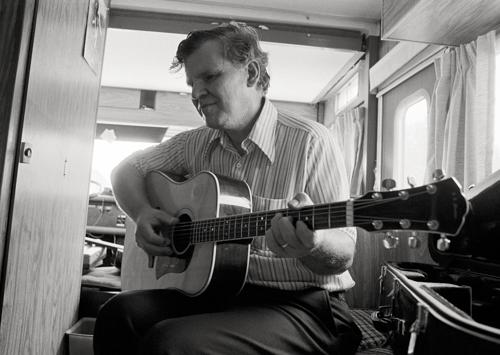
Studs Terkel interviews Doc Watson about his music career
Dec. 10, 1971 Studs Terkel interviews Doc Watson about his music career. The interview includes recordings and live sections of different songs that have shaped his career.
-
-
Studs Terkel in conversation with Buffy Sainte-Marie
Apr. 21, 1972 Studs Terkel interviews Canadian singer-songwriter Buffy Sainte-Marie.
-
Studs Terkel discusses the WPA Arts Project
Sep. 14, 1989 The influence of the WPA on the music of the 1930's. The heroic sounds heard in song, movies, and theater. He provides Bing Crosby's version of Yip Harburg's "Brother Can You Spare a Dime". As well as the Almanac Singers performing "Roll the Union On". Both Moll's Song and the final scene of Blitzstein's, "The Cradle Will Rock" are performed. Terkel provides a host of other songs which highlight the music of the 1930's. Extensive discussion on "The Cradle Will Rock" with its producer John Houseman.