Listen to New Voices on Studs Terkel our partnership with 826CHI-here! Read the Story


Showing 886 - 900 of 1649 results
-

-
Frank Galati discusses the play "She Always Said, Pablo"
Mar. 5, 1987 Director Frank Galati explains that the play "She Always Said, Pablo," was about Gertrude Stein's relationship with Pablo Picasso. Referring to the play itself, Galati also said that he tried to marry their narrative writings with some operatic song.
-
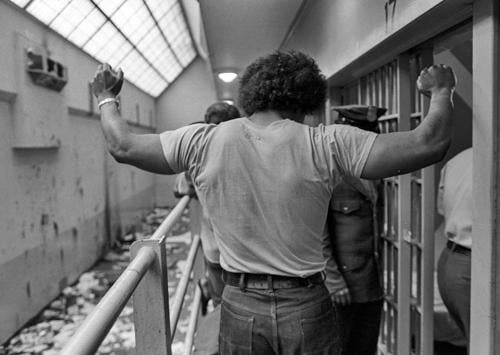
Frank Elli discusses his time as a prisoner and his novel "The Riot"
1968 Begins with a reading by Frank Eli from the opening of the book "The Riot." Mr. Elli discusses his early life, his time in three different prisons, and the writing of his book "The Riot," a personal account of a riot in Walla Walla Prison. (Note: last 5 minutes missing)
-
Frank Dolson in conversation with Studs Terkel
May. 13, 1983 Discussing the book "Beating the Bushes: Life in the Minor League," published by Icarus Press) with sports editor and author Frank Dolson.
-
Frank Chin reads from and discusses his book, "Donald Duk"
May. 21, 1991 Content Warning: This conversation includes racially and/or culturally derogatory language and/or negative depictions of Black and Indigenous people of color, women, and LGBTQI+ individuals. Rather than remove this content, we present it in the context of twentieth-century social history to acknowledge and learn from its impact and to inspire awareness and discussion. Unlike Disney's Donald Donald, this "Donald Duk" is 12-year-old boy who hates his last name and who hates his Chinese background and culture. Chin, also spends time going over characters from his book.
-
Francine du Plessix Gray discusses her book “Soviet Women: Walking the Tightrope”
Mar. 8, 1990 Author Francine du Plessix Gray discusses and reads from her book “Soviet Women: Walking the Tightrope.” The discussion is heavily focused on the feminist movement in Russia as it compares to the 1960s feminist movement in the United Sates; as Gray states the Russian movement being much more radical in terms of free love, eroticism, and artistic expression. Studs plays "Chastushki" - Zinaida Kozakova (1961).
-
Frances Moore Lappe in conversation with Studs Terkel
Oct. 13, 1986 Discussing the book "World Hunger: Twelve Myths" (published by Grove Press) with author and world hunger policy analyst Frances Moore Lappe.
-
Frances FitzGerald in conversation with Studs Terkel
Oct. 23, 1986 Discussing the book "Cities on a Hill: A Journey Through Contemporary American Cultures" (published by Simon & Schuster) with the author, journalist Frances FitzGerald. Program includes an excerpt of a June 3, 1986 interview with activist and social worker Maggie Kuhn.
-
Former President Jimmy Carter and Rosalynn Carter discuss their book "Everything To Gain"
Jun. 5, 1987 From the book, “Everything to Gain: Making the Most of the Rest of Your Life”, in a country with such great wealth, to see so many (people) without a place to live is devastating, according to Rosalynn Carter, and President Jimmy Carter said it was embarrassing. Their backgrounds, their time in the White House, the homeless and Habitat for Humanity are some of the topics covered in the Carters’ book. At the time when the Carters started to write this book, they had been married for 40 years. Mr. Carter revealed that writing this book together was the worst experience they shared.
-
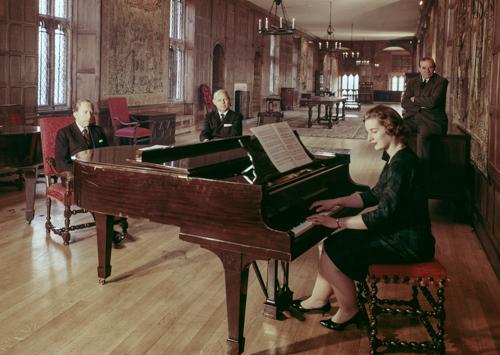
Ferdinand Lundberg discusses his book "The rich and the super rich"
1967 Ferdinand Lundberg discusses his book "The rich and the super-rich" and the current state of wealth distribution and political, cultural, and social power in the United States. Topics of discussion include inherited wealth, the wealthy “Eastern Establishment” families compared to wealthy families in the American southwest, wealth and crime, and corporations. Studs reads an excerpt from F. Scott Fitzgerald’s short story “The Rich Boy” at the beginning of the program and an excerpt of an interview Studs conducted with a man who comments on his ability to get rich.
-
Fela Sowande discusses his career and Nigerian music ; part 3
Jul. 3, 1962 Fela Sowande discusses his career, music, and compares African culture and music to Western culture and music. Includes two songs that are sung by tenor Max Worthley. Includes a clip of a Nigerian Youth song. Includes performance by a Nigerian skiffle band. Sowande was inspired by [Anthony Gregascoigne], an English poet he met in England.
-
Eugene Kennedy discusses his book "Re-Imagining American Catholicism"
Feb. 17, 1986 Discussing the book "Re-Imagining American Catholicism: The American Bishops and Their Pastoral Letters," (published by Vintage Books) with the author Eugene Kennedy.
-
-
-
Eugene C. Kennedy in conversation with Studs Terkel
May. 4, 1989 Discussing the book "Fixes" (published by Doubleday) with the author Eugene Kennedy.