Listen to New Voices on Studs Terkel our partnership with 826CHI-here! Read the Story


Showing 1 - 15 of 17 results
-

Talking about Shakespeare, with Helene Rozenberg
Apr. 27, 1979 Power, the misuse of power, and the hollowness of one's heart and soul are the main themes covered by Helene Rozenberg in her adult courses on the plays of William Shakespeare.*Please note: some sections have been edited out from the original recording due to copyright considerations
-
Reverend William Bell Glenesk discusses his ministry
Becoming a preacher was the last thing Reverend William Bell Glenesk ever had in mind. Glenesk found ministers and their sermons to be long and boring. The church, Glenesk said is very much like theatre and he wanted people to attend church or the gymnasium of God and to be a part of lots of music and dance.
-
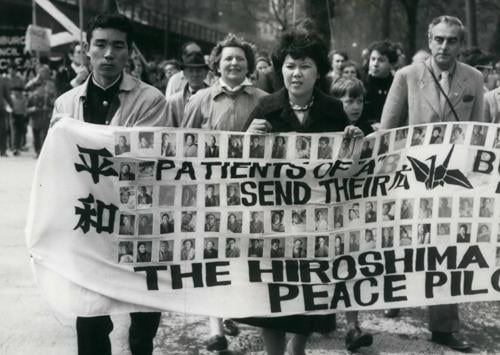
Miyoko Matsubara discusses her experiences as a survivor of the atomic bombing of Hiroshima
Mar. 29, 1962 Miyoko Matsubara, a Japanese survivor of the atomic bomb dropped on Hiroshima, discusses her experiences through translator Joan Takada. Later in life, she went on to work with disadvantaged children and as an advocate for world peace and the prevention of nuclear testing and warfare.
-
Milton Mayer reads and discusses his article, "Ill Met by Moonlight"
Dec. 31, 1968 Million Mayer, journalist, reads his article, "Ill Met by Moonlight" and discusses his thoughts on technology and automation replacing jobs and human interactions.he also talks about youth, non-violence protesting for change, and education.
-
Interviewing Samuel Thaviu
Feb. 18, 1988 The music professor and well-traveled concertmaster of several orchestras joins Studs to discuss Bach, William Jennings Bryan, and the Chautauqua education and social movement.*Please note: some sections have been edited out from the original recording due to copyright considerations
-
Interviewing Janos Starker
Jan. 27, 1963 The Hungarian-American cellist discusses his career, his travels, and his work with pianist Gyorgy Sebok.*Please note: some sections have been edited out from the original recording due to copyright considerations
-
Interview with Gabriel Fielding
1969 The English novelist began his writing career after having established a medical practice in Kent. Here, he discusses his time in the Royal Army Medical Corps as well as his careers in medicine, literature, and academia.*Please note: some sections have been edited out from the original recording due to copyright considerations
-
George V. Bobrinskoy discusses Mark Twain's popularity in Russia ; part 2
Apr. 20, 1959 After reading Twain's books, Bobrinskoy believed that all Russian boys, at one point or another, thought about running away to America. Twains' books depicted lives filled with adventure in the United States. Bobrinskoy's final thought was that Mark Twain was the greatest American writer.
-
George V. Bobrinskoy discusses Mark Twain's popularity in Russia ; part 1
Apr. 20, 1959 When he was a school boy in 1912, George V. Bobrinskoy got to know the works of Mark Twain. He loved Twain's stories and talks about his favorites, "Tom Sawyer" and "The Adventures of Huckleberry Finn".*Please note: some sections have been edited out from the original recording due to copyright considerations
-
Discussing The Hammonds of Redcliffe, with Carol Bleser
Dec. 2, 1981 After discovering the family letters of James Henry Hammond in the archives of a South Carolina library, Carol Bleser set about telling a rather troubling saga - of slavery, sexual assault, and hypocrisy in the South, before and after the Civil War.*Please note: some sections have been edited out from the original recording due to copyright considerations
-
Debra Evenson and Gisela Lopez discuss the U.S. embargo on Cuba
Sep. 1, 1994 Attorney Debra Evenson and Gisela Lopez discuss the U.S. embargo on Cuba, the 1994 Cuban craft crisis, and food shortages and life in Cuba.
-
An interview with Tom Kochman
Dec. 16, 1982 The author and communications professor offers some insight into his book Black and White Styles in Conflict. This program includes clips from recordings of a Black preacher's sermon and a white attendee of the 1963 March on Washington.*Please note: some sections have been edited out from the original recording due to copyright considerations
-
Allan Evans and Henry Jordan discuss The Foundation Years ; part 2
1970 Allan Evans and Henry Jordan, two young man who grew up in Chicago and attended Dartmouth, discuss The Foundation Years project. They talk about trying to recruit friends to Dartmouth, their campus experiences, and their coursework. They also talk about their experiences going through the public school system in Chicago, where they point out many of the inequalities for black students.
-
Allan Evans and Henry Jordan discuss "The Foundation Years" ; part 1
1970 Allan Evans and Henry Jordan, two young man who grew up in Chicago and attended Dartmouth, discuss their childhoods and adolescent dealing with crime. The two also talk about their gang, The Vice Lords, and the police brutality they experienced. Next, the group talks about the The Foundation Years, a project from Dartmouth.
-
A conversation with Joy Humes
Aug. 1, 1978 Joy Humes, a teacher of poetry at Virginia State Penitentiary's continuing education program, describes her experiences working with death row inmates.*Please note: some sections have been edited out from the original recording due to copyright considerations