

-

Director Frank Galati discusses "Postcard From Morocco"
May. 17, 1991 Frank Galati talks about the production of, "Postcard From Morocco." The stories are told through the seven people stranded at the train station. Galati notes that the luggage the people have with them also represent people's baggage through out their lives.
-
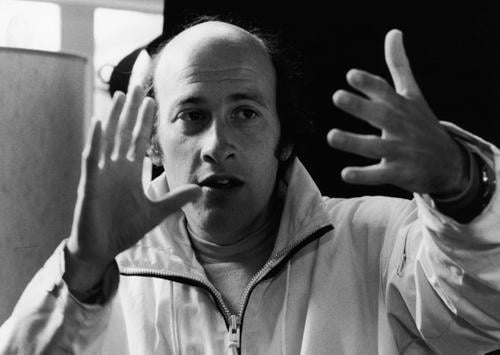
Dick Lester Impressions of London with Studs Terkel
Studs Terkel interviews film producer Dick Lester and receives Lester's impression of London.
-
David Attenborough discusses the book and television documentary "Life On Earth"
Oct. 29, 1981 Biologist, natural historian, and author David Attenborough discusses his book and upcoming television series “Life on Earth.” The book, show, and this interview focus on discussing the evolution of life.
-
Daniel Duell discusses his work with Ballet Chicago
Jun. 9, 1988 Interviewing Daniel Duell, choreographer and artistic director of Ballet Chicago. He discusses his career, ballet techniques, and men in ballet. Includes a 30 second testing tone. Content Warning: This conversation has the presence of outdated, biased, offensive language. Rather than remove this content, we present it in the context of twentieth-century social history to acknowledge and learn from its impact and to inspire awareness and discussion.
-
Dan Tucker discusses his opera writings and Sasha Gerritson, David Richards, and David Laub discuss their works
Jun. 18, 1997 Studs interviews Chicago Tribune reporter turned opera composer, Dan Tucker. He discusses how his music was inspired by poets Federico García Lorca and William Shakespeare and authors Peter S. Beagle and Christopher Fry. Sasha Gerritson, soprano and founder of the L'Opera Piccola opera troupe, David Laub, bass baritone, and David Richards, L'Opera Piccola music director and pianist are in studio and talk about their work and thoughts on the opera songs.
-
Dalton Trumbo reads from and discusses his book "Additional Dialogue ; part 1
Nov. 27, 1970 In his book, "Additional Dialogue: Letters of Dalton Trumbo, 1942-1962," Dalton Trumbo gives his audience a better understanding of why he was believed to have been warty, abrasive and stubborn. Trumbo believed people have the right to silence and they have the right to speak. He was angered when a book review was written about one book but another author's book was ignored. Trumbo spent time in prison where he was not allowed to write anything negative about the living conditions.
-
Dalton Trumbo reads from and discusses his book ; part 2
Content Warning: This conversation includes racially and/or culturally derogatory language and/or negative depictions of Black and Indigenous people of color, women, and LGBTQI+ individuals. Rather than remove this content, we present it in the context of twentieth-century social history to acknowledge and learn from its impact and to inspire awareness and discussion. Resuming the conversation with regards to his book, "Additional Dialogue: Letters of Dalton Trumbo, 1942-1962," Dalton Trumbo now talks about his time after being in prison for 10 months.
-
Christine Fox, Annie Merrill, Jennie Wilkes of the BBC
1975 This interview is a follow up, four years later, to the first interview with these women (1965115-3-1)
-

Charles Eames discusses his life of travel and his study of design and architecture, part 1
Oct. 1, 1965 Charles Eames, an architect, designer, artist, filmmaker and student of human nature, talks with Studs about his years of travel in India and Europe. He discusses studying architecture and working as an architect and the nature of his film making. (Part 1 of 2)
-

Charles E. Silberman and his wife Arlene Silberman discuss education
Sep. 15, 1970 Charles E. Silberman and his wife Arlene Silberman discuss education and Charles Silberman's book "Crisis in the Classroom". Includes a clip of Studs Terkel interviewing a student.
-
Celebration in honor of music director Jim Unrath's 25th Anniversary at WFMT radio
Nov. 14, 1984 Celebration in honor of Jim Unrath's 25th Anniversary
-
Cast members discuss the documentary Union Maids
Jan. 18, 1977 Julia Reichert, Sylvia Woods, and Stella Nowicki discuss their documentary film "Union Maids" and the tradition of unions in the United States.
-
Carole Langer discusses her documentary film "Radium City"
Feb. 4, 1988 Truth be told, Carol Langer was doing research for another film when she stumbled upon the silent enemy in Ottawa, IL, and then as a result, she made the film "Radium City". Back in the 1920's, young women had jobs to paint clock dials with radium-dipped brushes. The interview includes personal narratives and accounts from the film.
-
Buzz Hirsch discusses the film "Silkwood"
Jan. 6, 1983 Discussing the film "Silkwood" a movie about Karen Silkwood and the circumstances surrounding her death with movie producer Buzz Hirsch.
-
Bob Koester discusses jazz and blues
Mar. 3, 1993 Bob Koester, record producer and owner of Delmark Records, the United State's oldest independent jazz and blues label, talks about jazz, blues, and bebop musicians.