Listen to New Voices on Studs Terkel our partnership with 826CHI-here! Read the Story


Showing 91 - 105 of 512 results
-

Pete Gent reads from and discusses his book "North Dallas Forty"
Oct. 5, 1974 Drugs, painkillers, football contracts, and survival are all covered in Pete Gent's book, "North Dallas Forty." Gent said the business of football meant players would take painkillers and abuse their bodies with drugs all in order to do whatever was necessary to win a game. An excerpt of an interview with George Allen is included.*Please note: some sections have been edited out from the original recording due to copyright considerations
-

Paul Theroux discusses his book “Picture Palace”
Jun. 23, 1978 Writer Paul Theroux discusses his book “Picture Palace” and the meaning of a photograph with Studs Terkel. Both Theroux and Terkel read excerpts from Theroux’s book, and an audio clip of a photographer discussing what photography means to them is played.
-

Paul Theroux discusses his book "Mosquito Coast"
Feb. 23, 1982 Discussing the book "Mosquito coast" with the author novelist Paul Theroux.
-
Paul Angle, historian and writer, and Win Stracke, folk musician, discuss "Crossroads: 1913," part 3
Jul. 1, 1963 Paul Angle discusses his book "Crossroads: 1913," and Win Stracke provides a musical review. The three gentlemen talk in depth about the book with live and recorded music interspersed. Music: "Water--Oh!, Water For Me" and "The Rosary." "The Voice of Vienna" (a waltz).
-
Paul Angle, historian and writer, and Win Stracke, folk musician, discuss "Crossroads: 1913," part 2
Jul. 1, 1963 Paul Angle discusses his book "Crossroads: 1913," and Win Stracke provides a musical review. The three gentlemen talk in depth about the book with live and recorded music interspersed. Songs include: "Casey Jones - The Union Scab," "Sweet Adeline," "We Shall Overcome," "Oh, Dear, What Can the Matter Be," and "Immortality" by William Jennings Bryan (1908).
-
-
-
-
-
Oria and Iain Douglas-Hamilton discussing their book "Among the Elephants"
Jul. 7, 1975 Oria and Iain Douglas-Hamilton discuss their lives among the elephants at Lake Manyara National Park in Tanzania. They talk about the elephant life-cycle and the elephant social behavior. The two also discuss conservation and preservation of elephants across Africa.
-
Oliver W. Sacks discusses his book "Awakenings"
1985 In the of first of many appearances on Studs' radio show, Oliver Sacks discusses his book "Awakenings" and recounts several patient profiles from his groundbreaking treatment application of L-DOPA to sufferers of Sleeping sickness and Parkinson's disease. They explore his work in the context of Studs' concept of Feeling Tone and Sacks tells of a remarkable scene with aphasic patients reacting to a speech of then President Ronald Reagan.
-
Novelist Robert Kotlowitz reads from and discusses his book "The Boardwalk"
Feb. 3, 1977 Content Warning: This conversation includes racially and/or culturally derogatory language and/or negative depictions of Black and Indigenous people of color, women, and LGBTQI+ individuals. Rather than remove this content, we present it in the context of twentieth-century social history to acknowledge and learn from its impact and to inspire awareness and discussion. Almost all the characters in Robert Kotlowitz's book, "The Boardwalk" are fictitious with the exception of Teddy, a Jewish, 14-year-old boy, who Kotlowitz explains is Robert Kotlowitz.
-
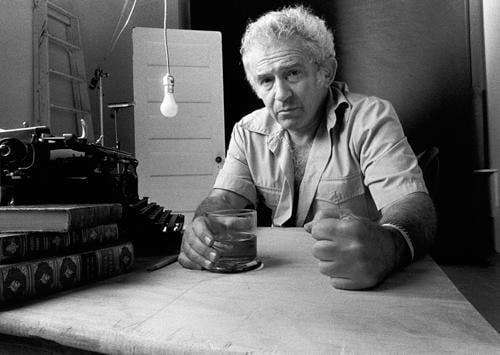
Norman Mailer discusses his writing, literature, and American life
Mar. 17, 1960 Norman Mailer discusses his writing, literary criticism, and American life. Other topics of conversation include Mailer’s thoughts on “affirmative” literary works, apathy and a lack of passion in modern life, beat writers and their reception in the United States, and many of his contemporary writers.
-
Norman Maclean reads from and discusses his book "A River Runs Through It"
Jun. 8, 1976 Fly fishing, relationships and people Norman Maclean has met are all apart of his book, "A River Runs Through It." Maclean's father taught Maclean and his brother the art of fly fishing. Maclean's book is semi-autobiographical with three short stories.
-
Nora Sayre discusses her book Running Time: Films of the Cold War
May. 4, 1982 Nora Sayre discusses her book "Running time: Films of the Cold War" and how Russian-American relations affected Hollywood and celebrity blacklists.