Listen to New Voices on Studs Terkel our partnership with 826CHI-here! Read the Story


Showing 331 - 345 of 460 results
-

Folk singer Mary Travers talks about music and her career
Nov. 18, 1976 Folk singer Mary Travers - of the group Peter, Paul & Mary - talks about some of the artists that inspired her, like Pete Seeger and The Weavers.*Please note: some sections have been edited out from the original recording due to copyright considerations
-
Ewan MacColl discusses literature and his music ; part 2
Nov. 16, 1962 Scottish folk singer and song collector Ewan McColl discusses the folk song revival occurring in the United Kingdom and his repertoire of folk songs
-
Ewan MacColl discusses his singing career ; part 1
Nov. 16, 1962 Scottish folk singer and song collector Ewan McColl discusses the folk song revival occurring in the United Kingdom and his repertoire of folk songs.
-
-
Ewan MacColl and Peggy Seeger discuss Scottish folk music
Nov. 4, 1960 The following songs were removed due to copyright restrictions: Weaver's song, Robert Burns, "A Wee Drop of It," "Come, Fill Up Your Glasses," and "This Is Not My House."
-
Ewa Demarczyk discusses her career
Jan. 28, 1987 Interviewing Polish singer Ewa Demarczyk on her career as a multilingual poet singer.
-
Erroll Garner discusses music and his career
Jul. 20, 1962 Erroll Garner, jazz pianist, talks about his music style and his career. He explains how he taught himself to play and how he creates new music. He continues to explain his unique style and how it compares to other jazz musicians.
-
Ernst Haefliger discusses his career
1970 Ernst Haefliger discusses the story of the Magelone songs by Brahms. He talks about his upbringing in Switzerland and his path to becoming a singer. He also discusses his interpretations of the roles he has played in various operas, like Tomino in "The Magic Flute". Music is played throughout: "Ruhe, Süssliebchen" by Brahms, "Leb denn wohl, Heimatland"by Janáček, an aria and a recitative from "St. Matthew Passion"by Bach, an aria from "The Magic Flute" by Mozart, and "Dichterliebe, Op.48" by Schumann. Music has been removed from this file for copyright reasons.
-
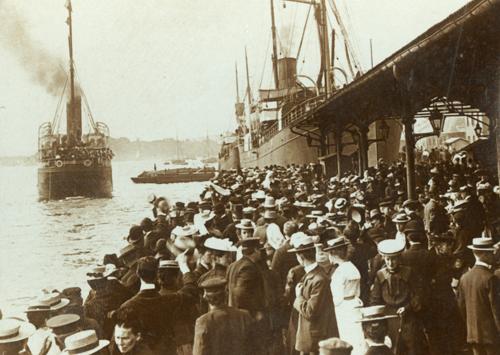
Erik Bye discusses the history of Norwegian immigration to America in the 19th century and his work as a television journalist and singer
Aug. 18, 1975 Studs interviews Erik Bye about Norwegian immigration to America and his music. They discuss the reasons why people left Norway in the 19th century and the conditions they suffered when they settled in New York. Bye explains Norwegian history and why the Norwegians moved from the American east coast to the west. Studs notes that Bye is in Chicago to gather information to produce a Norwegian television documentary about early Norwegian immigrants. Bye shares his interpretations of some of his songs and explains Norwegian music.
-
Enrique Arias discusses music from Colonial Latin America
Jun. 21, 1993 Enrique Arias and Studs Terkel explore music from Colonial Latin American and discuss an upcoming concert featuring music from the opera “La Purpura de la Rosa.”
-
Empire Brass discuss who they are and their backgrounds
1986 The quintet of Empire Brass was founded by Rolf Smedvig after he was asked to take part in Leonard Bernstein's "Mass". All the men came from families with musical backgrounds. Currently on tour, Empire Brass plays at Orchestra Hall this evening, the day of the recording. They have been to Europe seven times, Japan twice and they have been to all the United States except for Hawaii.
-
Elsa Charleston and Abraham Stokman discuss classical music
Nov. 24, 1975 Presenting music soprano Elsa Charleston and pianist Abraham Stokman.
-
Ella Jenkins discusses her music and her influences
Dec. 7, 1963 Using a Trobriand drum and harmonica, Ella Jenkins plays examples of call and response music with Studs. A few of her popular songs play between their discussion. Ella explains how her music came to be from the Chicago neighborhood streets with influences from her Uncle and other blues and folk musicians. Songs played include "Tahboo," "Miss Mary Mack," "You'll Sing a Song and I'll Sing a Song," "Come Dance By the Ocean," and "Dulce." Songs have been removed due to copyright restrictions.
-
Ella Jenkins discusses call and response music
Jul. 17, 1993 Using past recordings, Ella discusses how she works with children to help them find their rhythms using call and response music and percussion. She explains the West African and Latin music influences within her own music. Music played includes Jenkins' own music such as "Miss Mary Mack," "Tahboo," and "Where Has My Little Dog Gone?" She also plays song written by Carl Orff and performed by the Chorus of the Children's Opera Group, such s "Pat-a-Cake," and "Name-Calling." Untitled West African music is also played. Music has been removed due to copyright restrictions.
-
Elisabeth Schwarzkopf discusses her roles and interpretation ; part 2
Apr. 11, 1962 According to Elisabeth Schwarzkopf, at a young age, she first started to play the piano and viola before she studied singing. Madame Schwarzkopf explained the importance of being able to play different roles. With regards to luck, Schwarzkopf says it happens only once, when one finds the right teacher. All the rest, explains Schwarzkopf is hard work.