Listen to New Voices on Studs Terkel our partnership with 826CHI-here! Read the Story


Showing 46 - 60 of 86 results
-

Dr. Samuel Epstein discusses his book, "Hazardous Waste in America"
Mar. 14, 1983 Dr. Samuel Epstein, author and Director of Occupational and Environmental Medicine, at the University of Illinois Medical School, talks about his book, "Hazardous Waste in America." Dr. Epstein explains the four types of hazardous waste, (nuclear, petroleum, mining, and fossil fuels) and describes how they can better be disposed of including burning, recycling/renewing, and interim storage. He also describes a case study of Hoffman-Taff in Verona, Missouri.
-
Dr. Ronald Glasser discusses his the book "The Greatest Battle"
Nov. 29, 1976 Dr. Ronald Glasser talks about his book "The Greatest Battle," which explores cancer and the environmental factors that can cause it. He talks about smoking, food additives and diet, infectious diseases, and germs.
-
Dr. Paul R. Ehrlich discusses his book "The Population Bomb"
1969 At the conclusion of this interview, Dr. Paul Ehrlich predicts that 5 to 6,000 people will have died of starvation. "The Population Bomb," covers why women should stop having children and why the government should pass out $500 every year to women who don't have kids.*Please note: some sections have been edited out from the original recording due to copyright considerations
-
Dr. Oliver Sacks discusses his book "The Island of the Colorblind"
Jan. 16, 1997 His book, "The Island of the Colorblind," was the result of Dr. Oliver Sacks' travels to Micronesia. Sacks was puzzled by how people that were color blind could tell if a banana was ripe. A man told him that one must rely on the smell of the banana and its texture. The second part of the book is devoted to Sacks' travels to Guam.*Please note: some sections have been edited out from the original recording due to copyright considerations
-
-
Dr. Leo Seren discusses atomic fission and nuclear experiments
Feb. 21, 1978 Nuclear physicist, Dr. Leo Seren, discusses atomic fission and nuclear experiments.
-
Dr. Kosta Tsipis discusses the dangers of nuclear war
Mar. 9, 1982 Discussing the dangers of nuclear war and its effect on people with nuclear physicist and co-director of the program of Science and Technology at MIT, Dr. Kosta Tsipis.*Please note: some sections have been edited out from the original recording due to copyright considerations
-
Dr. Joseph Burkhalter and Dr. Charles Price talk with Studs about Pharmaceutical Chemistry ; part 2
1964 Studs has a conversation with Dr. Charles Price, American Chemical Society president and chairman of chemistry department at University of Pennsylvania and Dr. Joseph Burkhalter, Professor of pharmaceutical chemistry at University of Michigan, and chairman of American Chemical Society's division of medicinal chemistry. Dr. Price And Dr. Burkhardter discuss the drug industry and working with the government to develop pharmaceutical medicines. Both doctors voice the debate about creation of nuclear technology and how that impacted science in general.
-
Dr. Joseph Burkhalter and Dr. Charles Price talk with Studs about Pharmaceutical Chemistry ; part 1
1964 Studs has a conversation with Dr. Charles Price, American Chemical Society president and chairman of chemistry department at University of Pennsylvania and Dr. Joseph Burkhalter, Professor of pharmaceutical chemistry at University of Michigan, and chairman of American Chemical Society's division of medicinal chemistry. Dr. Price And Dr. Burkhardter discuss the drug industry and working with the government to develop pharmaceutical medicines. Both doctors voice the debate about creation of nuclear technology and how that impacted science in general. (part 1)
-
Dr. John C. Lilly discusses his book "Center of the Cyclone"
Feb. 22, 1972 Discussing the book "Center of the Cyclone: An Autobiography of Inner Space" with the author Dr. John C. Lilly.*Please note: some sections have been edited out from the original recording due to copyright considerations
-
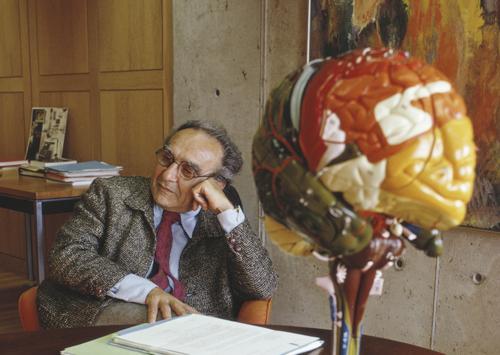
Dr. Jacob Bronowski discusses the philosophy of science in the post World War II world
Jan. 1, 1971 Dr. Jacob Bronowski, a mathematician and philosopher, discusses how the study of science has changed since the onset of government regulation or the military industrial complex. He also talks about humanity and explains how humans are the best species and therefore should come together to continue progress instead of killing each other. Content Warning: This conversation has the presence of outdated, biased, offensive language.
-
Dr. George Wald discusses the have and the have nots of society
Oct. 12, 1974 Interviewing Dr. George Wald, Professor of Biology at Harvard University, who often spoke on the social aspects of science, human ecology, and the environment.
-
Dr. Christopher Riche Evans discusses dreams, the human brain, and computers
1966 Psychologist and computer scientist Dr. Christopher Riche Evans discusses dreams, the human brain, and computers. [Last minute and a half is a different interview. No mention of the subject.]
-
Dr. Charles Clements discusses his book "Witness to War"
Apr. 29, 1985 After having flown 50 missions in Vietnam, Charles Clements went to medical school and became a physician and a human rights activist. Dr. Clements talks about his observations in the poorest sections of Nicaragua. Because medicine for the poor people was considered contraband, Clements had to resort to putting rusty nails into a cup of water and having his patients drink the water for iron supplements. Clements reminds the audience if we don't know our history, we are bound to repeat it.
-
Dr. Alan Solem and Dr. John Engel discuss their upcoming research trip to Australia
Jun. 9, 1976 Dr. Alan Solem, a malacologist, and Dr. John Engle, a bryologist, from the Field Museum discuss a research trip they plan to take to Australia. The two doctors also discuss climate and ecology in the Americas and in Australia. Dr. Solem will be researching land snails and Dr. Engel moss and liverworts.