Listen to New Voices on Studs Terkel our partnership with 826CHI-here! Read the Story


Showing 121 - 135 of 212 results
-

George Von Hilsheimer discusses his book “How To Live with Your Special Child: A Practical Guide for Parents and Teachers” ; part 2
Oct. 6, 1970 George Von Hilsheimer, educator and author of “How To Live with Your Special Child: A Practical Guide for Parents and Teachers,” discusses his work with troubled youth.
-
George Von Hilsheimer discusses his book “How To Live with Your Special Child: A Practical Guide for Parents and Teachers” ; part 1
Oct. 6, 1970 George Von Hilsheimer, educator and author of “How To Live with Your Special Child: A Practical Guide for Parents and Teachers,” discusses his work with troubled youth.
-
George V. Bobrinskoy discusses Mark Twain's popularity in Russia ; part 2
Apr. 20, 1959 After reading Twain's books, Bobrinskoy believed that all Russian boys, at one point or another, thought about running away to America. Twains' books depicted lives filled with adventure in the United States. Bobrinskoy's final thought was that Mark Twain was the greatest American writer.
-
George V. Bobrinskoy discusses Mark Twain's popularity in Russia ; part 1
Apr. 20, 1959 When he was a school boy in 1912, George V. Bobrinskoy got to know the works of Mark Twain. He loved Twain's stories and talks about his favorites, "Tom Sawyer" and "The Adventures of Huckleberry Finn".*Please note: some sections have been edited out from the original recording due to copyright considerations
-
George Drossos, The Thacker Family, Mrs. Webb and Benny Bearskin discuss living in Chicago
1968 The third program of "Division Street: America" features four profiles: George Drossos, an elderly, Greek man, the Thacker family who recently moved to Chicago, Mrs. Webb, a corner store owner and Native American Benny Bearskin. George Drossos talks about first moving to Chicago and getting acclimated to the city. He recalls visiting other states for a month and then having that feeling of "nostos," or wanting to return home to Chicago. A mother of 15 children and 21 grandchildren, Mrs. Thacker said she doesn't like all the hoodlum business that goes on in Chicago.
-
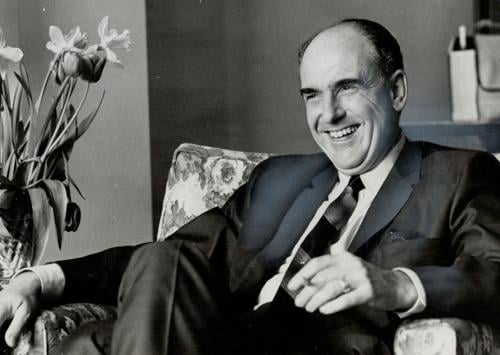
George Blanksten, Irma Edelman, Robert Eisner and Dr. Nicolas Pedritis discuss economist Andreas Papandreou's imprisonment
Apr. 1, 1967 Mr. Blanksten, Ms. Edelmen, Mr. Eisner and Dr. Pedritis, all educators, talk about economist and Prime Minister of Greece Andreas Papandreou's imprisonment.
-
George Anastaplo discusses his denial into the Illinois State Bar Association
Feb. 6, 1986 Before admittance, 17 members of the Illinois Bar Association asked George Anastaplo two questions. Should people in the Communist Party be allowed to practice law, to which Anastaplo answered yes. The members then asked Anastaplo if he was a member of the party. Anastaplo refused to answer that question because he deemed it an improper question for the Bar to ask. Anastaplo himself argued his case in front of the U.S. Supreme Court.
-
G. William Domhoff in conversation with Studs Terkel
Feb. 24, 1984 Discussing the book "Who Rules America Now?: A View for the '80s" with author and educator William Domhoff.
-

Francis Edmonds discusses education and the Waldorf School, part 2
Mar. 9, 1970 Educator Francis Edmonds discusses education and the Waldorf School, part 2 of 2. Topics include the London Waldorf School philosophy, which can be summed up by a quote from founder Rudolf Steiner-- "Accept the children with reverence, educate them with love, send them forth in freedom."
-
Francis Edmonds discusses education and the Waldorf School, part 1
Mar. 9, 1970 Educator Francis Edmonds discusses education and the Waldorf School, part 1 of 2. Topics include art therapy, color philosophy, and the London Waldorf School philosophy, which can be summed up by a quote from founder Rudolf Steiner-- "Accept the children with reverence, educate them with love, send them forth in freedom." The interview also includes a brief clip from Mr. Ogletree from the Esperanza School in Chicago.
-
Father John McKenzie and Dr. Howard Schomer discuss personal responsibility, morality and hate, as it pertains to the Vietnam War ; part 2
1965 The interview continues with Father John McKenzie and Dr. Howard Schomer talking about fear and dissent. Schomer says Christians have the duty to dissent when they believe their beliefs are being contradicted by policy. He also talks about not understanding a dampening down of the human mind when it comes to human issues. Father McKenzie adds that society is made up of the best educated ignoramuses that ever existed.
-
Father John McKenzie and Dr. Howard Schomer discuss personal responsibility, morality and hate, as it pertains to the Vietnam War ; part 1
1965 Whether in the United States or Vietnam, Dr. Schomer asks what are our personal responsibilities for the atrocities? Father John McKenzie talks about a lowering of people's moral tone. People have put their morality in their pockets, so as to get cleared of something and not get involved, added Father McKenzie.
-
Ernest Morgan discusses the Arthur Morgan School in Burnesville, NC with Studs Terkel
Aug. 9, 1965 Interview with Ernest Morgan about the Arthur Morgan School in Burnesville, NC that was founded by family. They discuss the teaching and learning ideology for the students (aged 12-16) who attend the school. Ernest describes the curriculum that includes outdoor learning in Black Mountain where the school is located. Includes a piece from an interview with Alexander Sutherland Neill about student and school adjustment. Ernest Morgan quotes Martin Luther King on maladjustment.
-
Elisabeth Schwarzkopf discusses her roles and interpretation ; part 2
Apr. 11, 1962 According to Elisabeth Schwarzkopf, at a young age, she first started to play the piano and viola before she studied singing. Madame Schwarzkopf explained the importance of being able to play different roles. With regards to luck, Schwarzkopf says it happens only once, when one finds the right teacher. All the rest, explains Schwarzkopf is hard work.
-
Elisabeth Schwarzkopf discusses her roles and interpretation ; part 1
Apr. 11, 1962 Studs Terkel talks with Elisabeth about her career in opera. She discusses her thoughts of her overall career.