Listen to New Voices on Studs Terkel our partnership with 826CHI-here! Read the Story


Showing 226 - 240 of 400 results
-

Herbert Block, known as "Herblock," discusses his drawings as an editorial cartoonist and the new book "Straight Herblock"
Nov. 13, 1964 Herblock and Studs talk about his newest book "Straight Herblock." They talk about some of his most acclaimed drawings and the social/political questions they pose.
-
Helen Vlachos discusses her career and her book "House Arrest"
1970 In 1967, because Helen Vlachos spoke freely and called someone in the junta a clown, she was placed under house arrest. Artists took part in a type of silent resistance, as there was no new music, no new paintings, no new poems or writings that were created. Freedom isn't allowed, explained Vlachos, as people aren't allowed to use their own minds.
-
-
Harrison Salisbury discusses the book "The New Emperors: China in the Era of Mao and Deng", and his time in China
Mar. 31, 1992 American author, journalist, and one time New York Times correspondent in Moscow, Harrison Salisbury, discusses his book "The New Emperors: China in the Era of Mao and Deng" They discuss the politics of China and Mr Harrison shares stories of the politicians, and Chinese people he spent time with. Studs shares an excerpt of an interview with physician George Hatem regarding China and her people. The interview closes with; "Che lai" performed by Paul Robeson
-
Harrison Salisbury discusses his views on the constantly changing world of Russia ; part 2
Jun. 8, 1962 Salisbury continues talking about the artists like writers, musicians and dancers being national assets to Russia. In a country with its history of tyranny, Russian society is becoming more permissive and relaxed, explained Salisbury. Khrushchev keeps the peace right now, says Salisbury but wonders, like the title of a new book he's working on, is this "A New Russia?".
-
Harrison Salisbury discusses his views on the constantly changing world of Russia ; part 1
Jun. 8, 1962 Being a correspondent for the New York Times in Moscow gave others the chance to see Russia through Harrison Salisbury's reporting. Inside their country, the people, says Salisbury, they have started to loosen up and they have started to talk to one another. The freedoms of the arts have come back, too.
-
Harrison Salisbury discusses his book "The 900 Days: The Siege Of Leningrad" and Isabella Zorina discusses a trip to mass graves
Jul. 1, 1982 Harrison Salisbury discusses his book “The 900 Days: The Siege Of Leningrad” and the lasting impact of the siege on the Soviet Union and life in Leningrad during the siege. Salisbury reads a poem by Olga Bergholz.Isabella Zorina discusses a trip to mass graves, including the many young people who were also visiting, some as part of wedding ceremonies, and the music played at the graves. Terkel plays Beethoven's Symphony No. 3, conducted by Leonard Bernstein, at the end of the program.
-
Harrison Evans Salisbury discusses his book "A Time of Change"
Mar. 18, 1988 His experiences as a journalist are what's covered in Harrison Evans Salisbury's book, "A Time of Change: A Reporter's Tale of Our Time". Salisbury believed as a reporter, one truly needed to be at the event, in order to obtain the true story. Once Salisbury questioned if he was living in America because he was asked to switch rooms at a hotel in Birmingham, only to find out later that there were special, bugged rooms for reporters.
-
Harrison E. Salisbury discusses his book on the 1917 Russian revolution, "Black Night, White Snow"
Feb. 2, 1978 Studs Terkel talks to New York Times journalist Harrison E. Salisbury about his book on the Russian Revolution of 1917 entitled, "Black Night, White Snow", detailing the roles of the SR's, Lenin and the Bolsheviks, the Mensheviks, the Narodniks, Kerensky, Kropotkin, Stalin, Zinoviev and more.
-
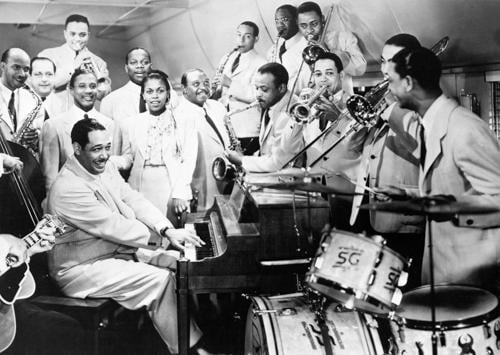
Harriet Choice discusses jazz
Aug. 7, 1978 Chicago Tribune jazz critic Harriet Choice plays and discusses some favorite records from her own personal collection with Studs Terkel.
-
Gwynee Dyer reads from and discusses his book "War"
Oct. 18, 1985 After having served in three Navies, Gwynee Dyer, wrote his book, "War." Dyer explains people are willing to kill foreigners to protect their own land, possessions, and rights, etc. Dyer also points out that the only reason for war is to obtain power and to determine, by mass destruction, who gets what.
-
-
Gore Vidal on politics and literature
Nov. 1, 1974 The writer and public intellectual discusses his recent publications, Myron: A Novel, and, Burr, an historical novel about Founding Father, Aaron Burr.*Please note: some sections have been edited out from the original recording due to copyright considerations
-
Gore Vidal draws parallels between the United States of 1876 and 1976.
Mar. 18, 1976 Writer Gore Vidal discusses his novel, 1876, and how the political corruption and social atmosphere of the times inspired its plot. Vidal reads several excerpts from the book.*Please note: some sections have been edited out from the original recording due to copyright considerations
-
Gore Vidal discusses his novel, Kalki
Apr. 7, 1978 Writer Gore Vidal discusses his book, the Eastern philosophy behind it, and its themes on media sensationalism.*Please note: some sections have been edited out from the original recording due to copyright considerations