Listen to New Voices on Studs Terkel our partnership with 826CHI-here! Read the Story


Showing 1321 - 1335 of 5186 results
-

Michael Anania discusses his poetry collection, "The Color of Dust"
1970 Poet and editor Michael Anania discusses his poetry collection, “The Color of Dust” and reads selected works from the collection. Anania discusses Midwest history and geography and his own Nebraska roots as influences on the work and its themes of love, war, and social issues. Episode includes relevant music and theatrical recordings, including “Immortality” read by William Jennings Bryan, “Rake and Rambling Boy,” Jefferson Airplane’s “Somebody to Love,” “Dust Bowl Refugee” by Woody Guthrie, and “The Battle Hymn of the Republic.”
-
Michael Anania discusses his poetry collection, "Riversongs"
Mar. 2, 1979 Poet and editor Michael Anania discusses his poetry collection, “Riversongs” and reads selected works from the collection. Anania discusses the themes of place, transience, and permanence in the Midwest. Episode includes relevant music recordings, including a number of unidentified instrumental recordings and songs by Woody Guthrie, Los Jaivas, and Joni Mitchell.
-
Michael Anania discusses and reads his books of poetry "The Red Menace" and "The Sky At Ashland"
Nov. 24, 1986 Michael Anania discusses and reads his from his books of poetry called "The Red Menace" and "The Sky At Ashland". Anania also discusses his life and inspirations. Includes a clip of children speaking about the world and war. Includes a clip of a jazz song called "Lester Leap In" by Count Basie at the end of the program.
-
Metro High School students talk with Studs Terkel
Apr. 7, 1975 Interviewing Shelby Taylor, Paul Goren, Jean Tucker, Paul McCree from Metro High School in Chicago, Ill.
-
Meridel Le Sueur discusses her book "Ripening: Selected Work, 1927-1980," published in 1981
Mar. 30, 1982 Meridel Le Sueur discusses the publication of her selected works and her life as an activist, fighting for socialist ideals and women's rights. She goes on to discuss the time she spent with Native American Navajo tribes and their theory of nonlinear time.*Please note: some sections have been edited out from the original recording due to copyright considerations
-

Merce Cunningham and John Cage discuss music and dance
Jan. 14, 1971 Merce Cunningham, choreographer and John Cage musician and composer speak about music and dance. The two gentlemen discuss with Studs how music and dance come together to create the avant-garde of art in both worlds (music and dance).
-
Members of the Shanghai Quartet discuss their backgrounds
May. 17, 1989 The day before their concert performance at North Park College, the Shanghai Quartet was at the WFMT studios. Betty Bucchari explained her job was to search for great musicians that were not well-known. The Li brothers were destined to play the violins, as their parents were music teachers for 15 years.
-
Members of the Mexican ensemble Los Folkloristas discuss their music and culture
Feb. 5, 1991 Ernesto Anaya, Hector Sanchez, José Ávila, Olga Alanís, and Rosalinda Renoso discuss the influence of Mexican culture and history in the music they perform and the instruments they use.
-
Members of the Fine Arts Quartet discuss chamber music
Oct. 1, 1964 Studs Terkel interviews the members of the Fine Arts Quartet, 1st violin Leonard Sorkin, 2nd violin Abram Loft, viola Gerald Stanick, and cello George Sopkin. The members of Fine Arts Quartet discuss the following: Elizabeth Sprague Coolidge's contributions to chamber music in America, the centennial anniversary of Coolidge's birth, the history of chamber music in America, the nature of their rehearsals, and their performances.
-
Members of the Earth Club radio show discuss their musical repertoires
Feb. 14, 1994 Howard Levy, Stuart Rosenberg, and Johnny Frigo reminisce about their discovery of musical genres that inspired them and discuss the early roots of folk music.
-
Melvin Douglas and Frank Lovejoy discuss their roles in the play "The Best Man"
Oct. 2, 1961 Melvin Douglas and Frank Lovejoy discuss their roles in Gore Vidal's play "The Best Man", politics, and their careers.
-
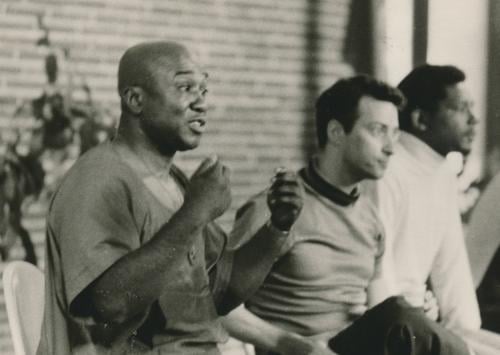
Mel River, Ken Jackson, and Fran Christman discuss criminal justice reform and advocacy
Nov. 20, 1970 Discussing prisons and interviewing members of the Fortune Society, an reentry services and advocacy group for individuals with justice involvement, headquartered in New York City. They also discuss capital punishment and life in prison. www.fortunesociety.org
-
Mel Lambert and five Puerto Rican boys discuss the Jobs Project and life in Chicago ; part 1
1968 Studs interview with Mel Lambert and five Puerto Rican boys (Harry, Carlos, Vic, Jose, and Hector) about their life in Puerto Rico and Chicago. They discuss learning English and other subjects in the jobs project. The five boys talk about gang involvement and interactions with other race and ethnic groups. They also discuss their goals, economic opportunity in Chicago, and their difficult experiences of learning English and getting an education.
-
Mel Lambert and five Puerto Rican boys discuss life in Chicago and the Latin King gang ; part 2
1968 Studs interview with five Puerto Rican boys: Hector, Jose, Victor, Harry and Carlos. Two other young men enter the conversation at the end: Raphael and Benjamin. Each boy describes a memory and some express a desire to return to Puerto Rico, while others wish to stay in America. The boys describe some about gang life with the Latin Kings and the violent relationship between gangs in Chicago. Studs suggests a peace conference with all gang leaders, and the boys describe their opinion of the outcome of such a meeting.
-