

-

Alfred Alvarez discusses his book "The Savage God: A Study of Suicide"
May. 5, 1972 Alfred Alvarez, poet and author, talks about his new book, "The Savage God," and how depression and suicide affects people. He talks about his past experience with his friend Sylvia Plath and the end of her life. The two men also discuss the history of suicide including the Greeks, Judas, Middle Ages, and the Renaissance. Alvarez also talks about famous artists who have committed suicide and why the 20th century may have caused so many suicides. Alvarez reads the opening passage and epilogue of his book.
-
Thor Heyerdahl discusses his book "The Ra Expeditions" and his sailing adventures
Sep. 16, 1971 Thor Heyerdahl, an adventurer and ethnographer, discusses his newly published book, "The Ra Expeditions." He talks about his adventures sailing from Africa to South America on the ships "Ra" and "Ra II" which were made from papyrus. Heyerdahl explains the trial and error he had getting the papyrus reeds, building the ship, and sailing. Briefly the two discuss environmental concerns with the ocean. Heyerdahl also talks about ancient peoples and their cultures and technologies they used. Near the end of the interview Thor reads a passage of his book.
-
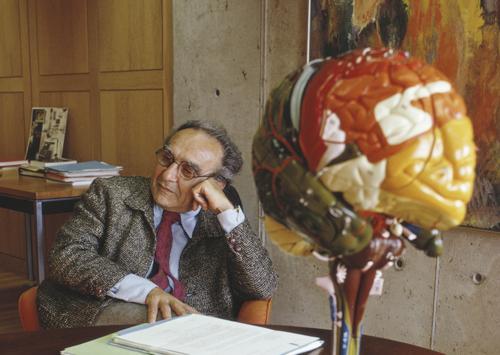
Dr. Jacob Bronowski discusses the philosophy of science in the post World War II world
Jan. 1, 1971 Dr. Jacob Bronowski, a mathematician and philosopher, discusses how the study of science has changed since the onset of government regulation or the military industrial complex. He also talks about humanity and explains how humans are the best species and therefore should come together to continue progress instead of killing each other. Content Warning: This conversation has the presence of outdated, biased, offensive language.
-
Studs Terkel is interviewed by Mitch Kraus and Edward Teller and Albert Szent-Gyorgy discuss science and politics
Dec. 29, 1970 Part 1 of this recording is Mitch Kraus interviewing Studs Terkel on his thoughts of self-indulgence, stereotypes, generational challenges, and historical events.
-
Philip Hilts discusses his book "Behavior Mod"
Oct. 3, 1974 Philip Hilts, an author and journalist, discusses behavior modification and it advantages and dangers. He delves into B. F. Skinner and Ivan Pavlov's work and explains how behavior modification is used today. Hilts discusses cases used in prisons, schools, and workplaces. Hilts also talks about typical medications given to children who are said to experience hyperactivity.
-
Arnold A. Hutschnecker discusses his book "The Drive For Power"
Jan. 8, 1975 Arnold A. Hutschnecker, a doctor with specialization in psychiatry, talks about his book, "The Drive For Power." He explores mental illness and its negative connotation. He explores how people who look for power tend to need mental help, but that the negative stigma around it tends to make them shy away, which leads to national aggravation and war. He also recalls his meetings with Richard Nixon from before he was president and how continued help may have changed the Vietnam War.
-
Joan Cook discussing her book "In Defense of Homo Sapiens"
Jan. 13, 1975 Joan Cook discusses her book "In Defense of Homo Sapiens" and talks about research done by other scientists working with Chimps and other primates. She explains her stance that not all humans lean towards violence and that nature, not nurture, and the environment creates aggression and violence. The conversation compares economics and Darwinism for a view of humanistic economics.
-
Oria and Iain Douglas-Hamilton discussing their book "Among the Elephants"
Jul. 7, 1975 Oria and Iain Douglas-Hamilton discuss their lives among the elephants at Lake Manyara National Park in Tanzania. They talk about the elephant life-cycle and the elephant social behavior. The two also discuss conservation and preservation of elephants across Africa.
-
Edward T. Hall discusses his book "Beyond Culture"
Apr. 28, 1976 Edward T. Hall talks about his beliefs on culture. The discussion includes how cultures differ between countries with a focus on Vietnam. They also discuss the cultural differences in America. Hall also explores how technologies, such as computers and vehicles change culture and cause people to become more like the machine itself. The end of the interview includes a short reading of "Beyond Culture".
-
Dr. Alan Solem and Dr. John Engel discuss their upcoming research trip to Australia
Jun. 9, 1976 Dr. Alan Solem, a malacologist, and Dr. John Engle, a bryologist, from the Field Museum discuss a research trip they plan to take to Australia. The two doctors also discuss climate and ecology in the Americas and in Australia. Dr. Solem will be researching land snails and Dr. Engel moss and liverworts.