

-
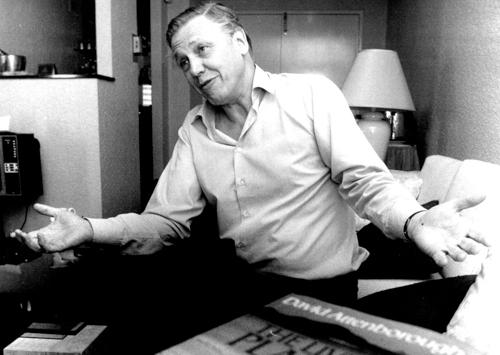
Interview with David Attenborough
Feb. 8, 1985 Discussing the television program "The Living Planet," with broadcaster David Attenborough.
-

-
Naturalist May Theilgaard Watts and Julie Nadelhoffer discuss "Reading the Landscape of America"
1969 Julie Nadelhoffer and Illinois naturalist May Theilgaard Watts discuss the changing landscape of America and the conflict between nature and development.
-

Walter J. Hickel discusses politics
Oct. 18, 1971 Discussing the book "Who Owns America?" and interviewing the author Walter J. Hickel, who became Governor of Alaska and Secretary of the Interior.
-
Dr. Edward Twitchell Hall discusses urban life
Jan. 23, 1970 High rise buildings being built because of growing populations are detrimental to our environment, explains Dr. Edward Twitchell Hall. Problems include the lack of oxygen and the lack of greenery said Hall. The number of automobiles on the road and the large size of the cars is also problematic,
-
Mrs. Bailey Bishop and Edith Neisser talk about education of children, part 2
1965 Part 2 of a series sponsored by the national conference of Christians and Jews. Includes "Rearing the Child of Good Will" and "The Child and the Changing World." Mrs. Bailey Bishop and Ms. Neisser discuss the importance of an open mind and a accepting environment in education and at home, and how this helps the children to accept change as it happens.
-
Jill Nelson discusses her book "Volunteer Slavery"
Jul. 14, 1993 Family and family secrets like Ms. Nelson's bout with alcoholism or her sister's mental health issues are covered in the book. Working for the Washington Post, she thought would be the highlight of her career, however, she talks about losing her journalistic integrity while working at that environment.
-
Rodney Wright discusses solar energy
Nov. 23, 1976 Discussing solar energy and solar houses with architect Rodney Wright.*Please note: some sections have been edited out from the original recording due to copyright considerations
-
Discussing the book, "The Closing Circle: Confronting the Environmental Crisis" by Dr. Barry Commoner
Nov. 3, 1971 Discussing the book, "The Closing Circle: Confronting the Environmental Crisis," and interviewing the author, Dr. Barry Commoner.
-
Michael H. Brown discusses his book "Laying Waste"
May. 16, 1980 "Laying Waste: The Poisoning of America by Toxic Chemicals," is Michael H. Brown's study of the Hooker Chemical Company and of toxic waste being dumped into the Love Canal. The toxic chemicals caused some women to suffer miscarriages. Some children were born with deformities, and some people developed cancer.*Please note: some sections have been edited out from the original recording due to copyright considerations