

-
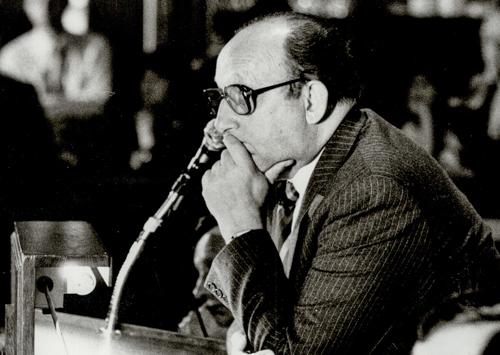
G. A. Arbatov in conversation with Studs Terkel
Aug. 26, 1992 Discussing the book "The System: An Insider's Live in Soviet Politics" (published by Times Books) with the author Georgi Arbatov.
-

Frye Gaillard in conversation with Studs Terkel
1980 Discussing the book "Lessons From the Big House: One Family's Passage through the History of the South: a Memoir," (published by Down Home Press) with author Frye Gaillard.
-
From the Wax Museum - 009 - South African writer Alan Paton discusses life in South Africa
1963 South African writer Alan Paton likened the white South African people to the ostrich. Paton said the ostrich keeps its head in the sand, and some people do the same in South Africa, too. With their heads in the sand, they don’t see any problems existing. Paton said he can not understand his country’s government. He can’t understand why the Black people are not allowed to own homes. Because of the government, Paton also talks about having to be careful about what he writes and he says the Americans are very lucky to have their U.S. Constitution.
-
Friedelind Wagner talks to Studs Terkel
Nov. 13, 1964 Opera director Friedelind Wagner describes her interest in Indian music, Hinduism, and Buddhism and how these Eastern traditions influenced the musical compositions of her grandfather Richard Wagner.*Please note: some sections have been edited out from the original recording due to copyright considerations
-
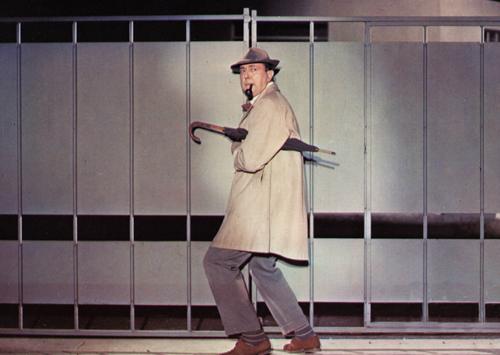
French humorist Jacques Tati talks with Studs Terkel
Nov. 1, 1962 Filmmaker Jacques Tati and Studs discuss finding the humor in everyday life and people becoming their gadgets. The two also go in-depth about Tati's film "Mon Oncle" and the development of the character Monsieur Hulot.
-
-
Frederick Wiseman discusses public welfare
Feb. 20, 1976 Discussing public welfare and interviewing Frederick Wiseman, director of the documentary film, "Welfare."
-
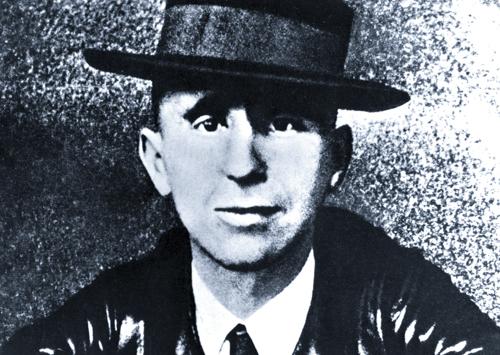
Frederick Ritter discusses Bertolt Brecht; part 1
Jun. 24, 1959 Frederick Ritter, professor at Illinois Institute of Technology, discusses the life and work of playwright Bertolt Brecht, the genre of epic theater, and more.
-
Frederick Ritter discusses Bertolt Brecht and philosophy of epic German theater with in studio performances
May. 3, 1962 Frederick Ritter discusses the life and work of playwright and poet Bertolt Brecht and preforms a few his songs. He also discusses the philosophy of epic theater and literature in Germany. Sabina Roupp joins Ritter with Brecht's music.
-
Frederick Ritter discusses and preforms classic Austrian Vienna Volks Theatre music
May. 23, 1963 Frederick Ritter, professor, preforms musical numbers from Austria. He also discusses the history of baroque theater and Volk's Theatre, along with Viennese culture. He is joined by Sabine Roupp, Joseph Gardner and David Miller on piano during the performances. Ritter also compares Bertolt Brecht with earlier writers, Johann Nestroy and Ferdinand Raimund. Selected pieces includes works by Mozart and Ferdinand Raymond and Johann Nestroy.
-
Frederick Manfred discusses his book "The King of Spades"
Nov. 25, 1966 Frederick Manfred's, "The King of Spades" is the last novel of the five-part series, "The Buckskin Man Tales." The west, family, and tragedy are all apart of Manfred's novel, which he said was the hardest to write. As a writer, Manfred soon learned his interests were with themes and topics as opposed to writing about history.
-
-
Frederick Busch reads from and discusses his book "Long Way from Home"
May. 25, 1993 When Frederick Busch wrote his book, "Long Way from Home," he wanted to understand, How does a mother leave her child? To Busch, fiction is people in motion trying to find a dream or people in motion, running away from a nightmare.
-
Fred Wiseman discusses his film “Juvenile Court”
Nov. 9, 1973 Discussing the making of film documentaries with Fred Wiseman, especially his film, "Juvenile Court." Includes excerpts of the sound track from a juvenile detention center in Memphis, Tennessee.
-
Fred W. Friendly discusses his book "Due to Circumstances Beyond Our Control" and his career, part 1
1968 Fred W. Friendly discusses his book "Due to Circumstances Beyond Our Control" and his career. Fred W. Friendly discusses television and mass media. (Part 1 of 2)