

-

Maurice Sendak discusses his ideas for books
1970 After having received the Caldecott Medal for "Where the Wild Things Are," Maurice Sendak knew he had to do a different kind of book. Sendak recalled his trips to Brooklyn as a child and how going out to eat was a huge treat. From there, Sendak's book, "Night Kitchen," was born.
-
-
Madeleine L'Engle discusses her novel "A Severed Wasp"
Jan. 30, 1983 Author Madeleine L'Engle discusses her novel "A Severed Wasp," about a retired concert pianist (Katherine Forrester, who appeared in L'Engle's first novel, "The Small Rain") who puts on a benefit concert at the Cathedral of St. John the Divine at the request of her old friend, Felix Bodeway. Like Katherine, L'Engle is a pianist and the interview is interspersed with Bach fugues throughout. In addition to discussing the plot, Terkel and L'Engle discuss several of the book's characters and their histories and motivations.
-
Madeleine L'Engle discusses her book "A Wrinkle in Time"
Jun. 8, 1990 Author Madeleine L’Engle discusses her book “A Wrinkle in Time”, a young adult novel that wrestles with spirituality, science fiction, and fantasy. L’Engle discusses how difficult it was for publishers to see her writing as young-adult, as she was often told adolescence would not be able to handle these challenging topics. This program includes an excerpt of a 1961 interview with Madeleine L’Engle in which she discusses the difference between fact and fiction, or lack thereof, in children’s literature.
-
Kimon Friar discusses Nikos Kazantzakis and the art of Greek translation
Dec. 12, 1977 Poet and translator Kimon Friar discusses Nikos Kazantzakis and the art of Greek translation. Friar discusses the common theme in all of Kazantzaki’s works, how all of nature is set out to transform matter into spirit. Friar discusses and reads Nikos Kazantzakis’s “The Odyssey: A Modern Sequel”, Constantine Cavafy’s “Ithaka”, and Odysseus Elytēs’s “The Autopsy”. This program includes an excerpt of an interview with Eleni Kazantzakis, Nikos’s wife, where she describes how Nikos always saw the excitement in every person he met.
-
Joseph Campbell discusses his book "Myths to Live By"
Jan. 31, 1973 According to Joseph Campbell's book, "Myths to Live By," myths put people in touch with dimensions of their own being and consciousness. Dreams, Campbell explained, are private myths and myths are a public dream. Campbell also talks about how the west and the orient view myths and symbols.
-
John Steinway discusses the family business of making pianos
Nov. 4, 1965 As a result of making cabinets, the family business of making pianos started in 1853. John Steinway is a 4th generation piano-maker. Steinway talks about his own apprenticeship and first learning about wood. He feels the pianos are made better today because long ago, only two men made a piano versus a six or eight man crew to perfect the craftmanship today.*Please note: some sections have been edited out from the original recording due to copyright considerations
-
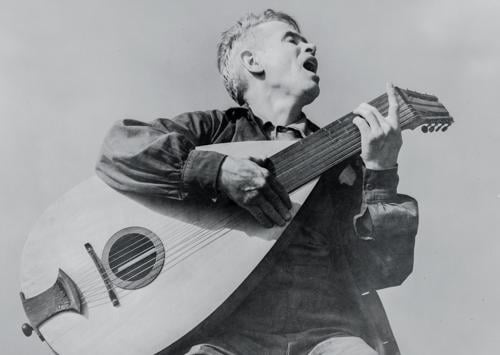
John Jacob Niles discusses his music
May. 10, 1957 The dulcimer is not only a musical instrument that John Jacob Niles plays, but he builds them too. Playing some scales, Niles gives a brief demonstration of the dulcimer, Niles explained people often requested he play his love songs. Niles believed love is something that is easily relatable to many people.
-
John Henry Faulk talks with Studs Terkel
Oct. 8, 1975 The American radio host discusses his part in the popularization of folk music, the fight against the blacklisting of the 1950s, and the corporatization of media outlets.*Please note: some sections have been edited out from the original recording due to copyright considerations
-
-
-
-
John Henry Faulk discusses the Vietnam War and current state of America
Nov. 1, 1969 John Henry Faulk discusses his experience lecturing at so-called knife and fork clubs and colleges across the United States; feelings of fear and powerlessness in America; the value of young people's activism in the United States; and the enlistment of poor men to serve in the Vietnam War. Faulk also speaks as several characters he plays to challenge and comment on the Vietnam War.
-
John Henry Faulk discusses politics and storytelling
1980 Content Warning: This conversation has the presence of outdated, biased, offensive language. Rather than remove this content, we present it in the context of twentieth-century social history to acknowledge and learn from its impact and to inspire awareness and discussion. American storyteller and radio show host John Henry Faulk discusses his experience lecturing in universities, the value of young people's activism in the United States, and speaks as several characters from his stories.
-
John Henry Faulk discusses his book "Fear on Trial" ; part 2
Dec. 1, 1964 Folklorist and radio show host John Henry Faulk discusses his book "Fear on Trial," covering his experiences being on the Hollywood blacklist and his lawsuit against AWARE; includes Christmas story at the end of part 2.