

-
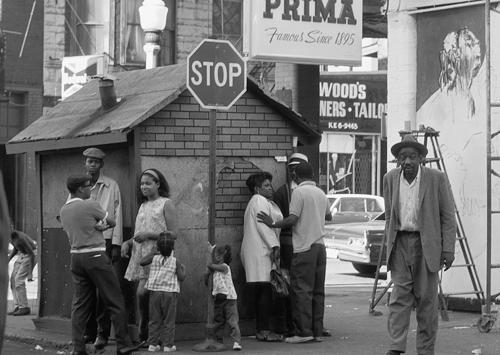
Jan Hestor, Curtiss Brooks and Dr. Philip Hauser discuss racial discrimination in Chicago ; part 5
1965 The discussion of discrimination in metropolitan Chicago continues with Jan Hestor, Curtiss Brooks and Dr. Philip Hauser talking about bigotry, prejudices, open occupancy and education. Included in this part of the interview is an excerpt of 17 year-old Jimmy talking about how his grandmother would rather work than be on welfare.
-

Jan Bauer, Mary Garrity, Ann Griffin, and Harry Wells discuss Chicago law system and community groups
Mar. 13, 1978 Jan Bauer, Mary Garrity, Ann Griffin and Harry Wells discuss crime, poverty, law, and community relations. They each come from different community programs which are trying to make Chicago safer for everyone.
-
James T. Farrell on his book "The Silence of History" as it is part of a new cycle of books
Mar. 9, 1963 Discusses future literary plans as well as past works (the Studs Lonigan trilogy in particular). Also, briefly on Chicago.
-
James Dapogny discusses jazz and the many faces of the genre
Aug. 14, 1984 Bandleader, jazz musicologist and composer James Dapogny discusses his work in reviving the sound and art of jazz. Dapogny's work is mainly associated with his group James Dapogny's Chicago Jazz Band and his career in publishing lost works of Ferdinand "Jelly Roll" Morton.
-
James Clement, Mrs. Barry Norton, and Pearl Shaw discuss Chicago schools ; part 1
1965 Discussing the "Chicago Schools Challenge " and interviewing James Clement, Mrs. Barry Norton, and Pearl Shaw.
-
James Cameron and Studs Terkel discuss their experience in Lincoln Park and how the peaceful demonstration changed to violence with the use of police tear gas ; part 1
Aug. 28, 1968 Studs Terkel and James Cameron talk about their witness of the peaceful demonstration at Lincoln Park the night before. They discuss the kind and caring interaction between older adults and the young. Both reflect on how the event changed from peaceful to somewhat violent when police gathered and used tear gas on the crowd.
-
James and Ann Harper discuss their social center, "Save the Alcoholic"
Jun. 25, 1980 James and Ann Harper join Studs Terkel to discuss their personal stories and the work of their social center called Save the Alcoholic, located in the Uptown neighborhood of Chicago. James discusses his struggle with alcoholism and how his experiences influence the mission of Save the Alcoholic. Ann says its often hard to work with “Skid row alcoholics,” but ultimately, they both believe it’s important to help those who are alienated by society, despite their frustrations.
-
Jack Fuller in conversation with Studs Terkel
May. 11, 1992 Interviewing editor and Chicago Tribune jazz critic Jack Fuller.
-
Jabbo Smith discusses his music from childhood and his career in Jazz as a trumpet and trombone player
Feb. 24, 1981 Studs interviews Jabbo Smith and presents some of his musical performances. The musical pieces are removed from this edited version of the original recording. Smith shares the story of his childhood in the Jenkins Orphanage and how he came to learn music there. He discusses the songs he wrote and people he played with throughout his career and how he came out of retirement in Holland on the trombone.
-
Irwin St. John Tucker and Carolyn Ashbaugh discuss labor history and Lucy Parsons
Apr. 4, 1977 Friar Tuck, as he was also known, was very active in socialist causes in Chicago. In the sweatshops, working fourteen or fifteen hours was the norm. Carolyn Ashbaugh's book "Lucy Parsons" goes over Parsons' movement for the 8-hour work day.
-
Irv Kupcinet discusses his autobiography "Kup: A Man, An Era, A City"
Dec. 8, 1988 Irv Kupcinet said he was embarrassed to admit how many hours he'd spend per day working on one story for his column. Kup explained his work life, his social life and personal life all gelled together because he was working about 18 hours a day. Reading papers every morning and making phones to his various contacts were the main ways Irv Kupcinet got his information.
-
-
-
Interviewing students at Metro High School on the Near North Side of Chicago
1970 Metro High School on the Near North Side of Chicago is only one of three high schools in the country that operates without walls and uses the resources of the city for learning. Four students convey how marine biology is taught at the Shed Aquarium, radio production at WIMD, TV production at Dick Barnett studio WMAQ, drafting at architectural firms and blue collar jobs at factories.
-
Interviewing Steve Tesich
Sep. 17, 1982 The Serbian-American dramatist, perhaps best known for his screenplays (Breaking Away and The World According to Garp), joins Studs to discuss his play, Division Street, at Chicago's New Broadway Theater.*Please note: some sections have been edited out from the original recording due to copyright considerations