

-

Robert Borisage and Richard Criley discuss secrecy vs. the Constitution
1975 Robert Borisage, founder of the Center for National Security Studies, and Richard Criley, part of the Alliance to End Repression, talk about government spying on citizens and the constitutionality of it. The pair talk about corruption in the CIA and FBI and how new laws can help curb the issues. They also explain the S.1 - Criminal Justice Reform Act 94th Congress (1975-1976).
-
Robert Allen discusses his book "The Port Chicago Mutiny"
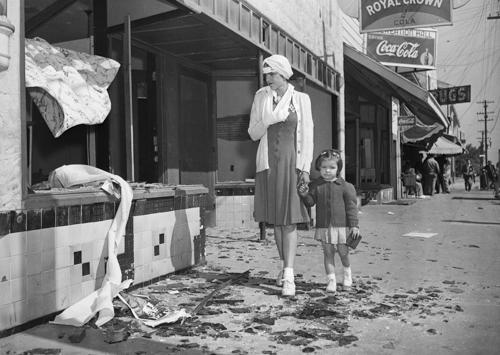
May. 12, 1989 On July 17, 1944, there was a huge explosion at Port Chicago in California. Of the 320 men on duty at the pier that died, 202 of them were Black. Robert Allen's book, "The Port Chicago Mutiny: The Story of the Largest Mass Mutiny Trial in U.S. Naval History," covers the story of poor working conditions, the explosion, work stoppage, the trial and the outcome. There is an excerpt of Joe Small, recalling what happened, when he was a sailor present there.
-
Rob Okun, Richard Fried, and Peter Novick discuss the exhibit “Unknown Secrets: Art and the Rosenberg Era”
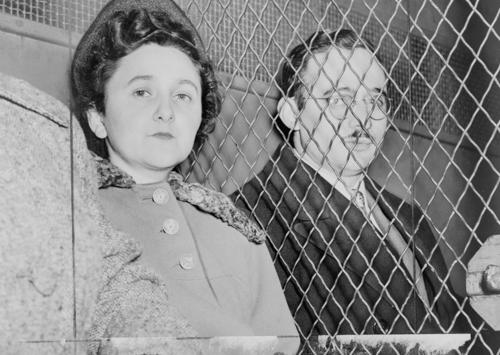
Jun. 15, 1990 Historians and exhibit organizers Rob Okun, Richard Fried, and Peter Novick discuss the Spertus Museum’s exhibit “Unknown Secrets: Art and the Rosenberg Era.” Julius and Ethel Rosenberg were both convicted and executed in 1953 for participating in spy activity for the Soviet Union. Okun, Fried, and Novick discuss the Rosenberg case and the subsequent response from the public after the execution, many of whom felt the Rosenbergs were wrongfully convicted. The art in this exhibit captures the passion surrounding this case.
-
Richard G. Hatcher and Alexander Poinsett discuss Gary, Indiana, their book "Black Power: Gary Style," and politics
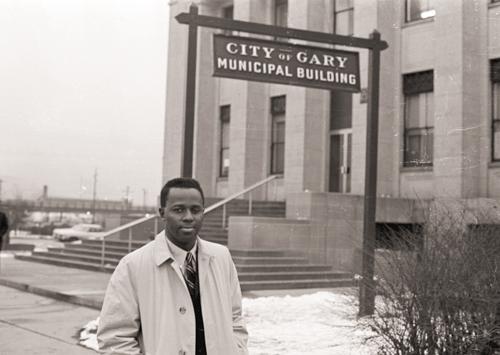
Jan. 18, 1971 Richard G. Hatcher and Alexander Poinsett discuss Gary, Indiana, their book "Black Power: Gary Style," politics, and race relations. They discuss the corruption in Gary, Indiana and Gary politics. Includes Richard G. Hatcher reading his old speech from his book "Black Power: Gary Style."
-
Reporter and author John L. Spivak talks with Studs Terkel ; part 1
1967 Studs and Spivak talk all things labor: unions, strikes, and spies. Spivak's work reporting on Fascism and Socialism is also discussed.
-
Reporter and author John L. Spivak talks about his autobiography with Studs Terkel ; part 2
1967 Several aspects of Spivak's career are discussed in detail, including his exposure of chain gangs, a Depression-era Communist forgery, investigating the anti-Nazi underground in Germany and how to exploit the insecurities of vigilantes.
-
Renault Robinson discusses public housing, crime, and Chicago police
Jun. 20, 1979 Renault Robinson, founder of the Afro-American Police League in Chicago and Chicago Housing Authority board member, discusses police programs in public housing projects. He discusses how public housing breeds crime because families are struggling and the building conditions are terrible, and how a new police program can help fix problems.
-
Renault Robinson and Robert McClory, author of "The Man Who Beat Clout City" discuss the the Chicago Police Department and race relations
Jul. 24, 1978 Renault Robinson, founder of the African American Patrolman's League in Chicago, and Robert McClory, journalist and author of a biography of Robinson, "The Man Who Beat Clout City," discuss Robinson's life and court case, Robinson v. Chicago Police Department. Robinson recalls how he was seen as a model policeman until he created the Afro-American Police League, when the Police Department started treating him differently.
-
-
Reading the letters of ex-convict Jimmy Blake
Jul. 11, 1962 Terkel comments and reads letters of ex-convict Jimmy Blake
-
Ramsey Clark discusses his book “Crime in America”
Oct. 14, 1970 Interviewing author and former Attorney General Ramsey Clark. He discusses law, crime, and violence in the United States. Content Warning: This conversation includes racially and/or culturally derogatory language and/or negative depictions of Black and Indigenous people of color, women, and LGBTQI+ individuals. Rather than remove this content, we present it in the context of twentieth-century social history to acknowledge and learn from its impact and to inspire awareness and discussion.
-
Ramsey Clark discusses crime and the poor in America
According to former United States States Attorney, Ramsey Clark, crimes of the poor and violence among the poor are due to their social situations like where they live, where they work, and their lack of education. Seeing the affluent and wealthy people around them add insult to injury, explained Clark. A passage from Clark's book, "Crime in America" is also read by Clark.
-
Ralph McGehee reads from and discusses his book "Deadly Deceits"
May. 11, 1983 Discussing the book "Deadly deceits: my twenty five years in the C.I.A" with the author Ralph McGehee.
-
Philip M. Stern discusses his new book "Lawyers on Trial"
Dec. 5, 1980 After enrolling in law school at age 49, Stern breaks down the double-standards and monopoly power of the legal profession.
-
Philip Hilts discusses his book "Behavior Mod"
Oct. 3, 1974 Philip Hilts, an author and journalist, discusses behavior modification and it advantages and dangers. He delves into B. F. Skinner and Ivan Pavlov's work and explains how behavior modification is used today. Hilts discusses cases used in prisons, schools, and workplaces. Hilts also talks about typical medications given to children who are said to experience hyperactivity.