

-
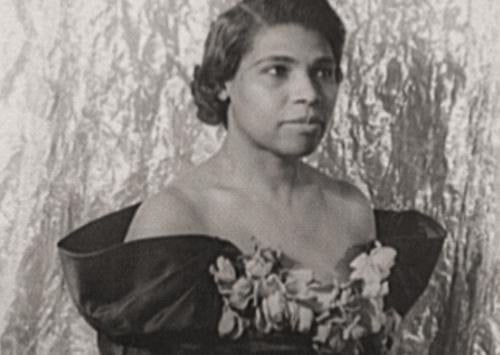
Marian Anderson discusses her career, and how she interprets songs
Feb. 20, 1960 Marian Anderson talks about her singing career, including her singing in Sunday School and her first singing experience in 4th grade. She shares how she interprets the songs she sings. Includes Studs reading the poem "Gertrude" by Gwendolyn Brooks. The interview takes place in Anderson's suite in the Sheraton Blackstone in Chicago.
-
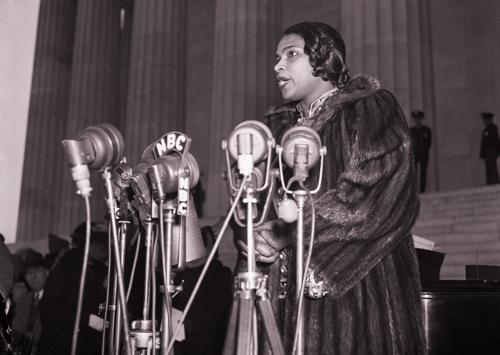
Marian Anderson and James DePreist discuss their experiences in music ; part 1
1966 Marian Anderson recalls singing on stage for the first time at the Metropolitan Opera House in 1957 and how it was the realization of a dream come true. Marion's nephew, James DePreist remembers being able to conduct a piece of music he had never conducted before because his aunt Marion had exposed him to it when he was a child. James said when his aunt Marion sung spirituals, he couldn't help but feel religious and he's an atheist.
-

-
Madeleine L'Engle discusses her novel "A Severed Wasp"
Jan. 30, 1983 Author Madeleine L'Engle discusses her novel "A Severed Wasp," about a retired concert pianist (Katherine Forrester, who appeared in L'Engle's first novel, "The Small Rain") who puts on a benefit concert at the Cathedral of St. John the Divine at the request of her old friend, Felix Bodeway. Like Katherine, L'Engle is a pianist and the interview is interspersed with Bach fugues throughout. In addition to discussing the plot, Terkel and L'Engle discuss several of the book's characters and their histories and motivations.
-
Madame Lotte Lehmann discusses teaching
Nov. 6, 1964 Now retired from singing opera, when Madame Lotte Lehmann is not traveling around Europe, she teaches, what she says, are the best students she has encountered, at Northwestern University. Lehmann explains her hope is to not only teach but to inspire singers to be larger than life and to bring out their own personalities in a song.
-
-
Lukas Foss discusses his career as a composer of classical music and conductor of the Milwaukee Symphony Orchestra
Mar. 14, 1983 Studs interviews Lukas Foss about his career as a classical composer and conductor. Foss talks about his work with the Milwaukee Symphony Orchestra. He reflects on how teachers influenced his career and how he learns from each orchestra that he works with. He shares his love for poetry and explains how he makes music from poems and uses "Thirteen Ways of Looking at a Blackbird," a poem by Wallace Stevens, to illustrate. They discuss how Foss composes and how it is very similar to the way Jazz is composed with improvisation.
-
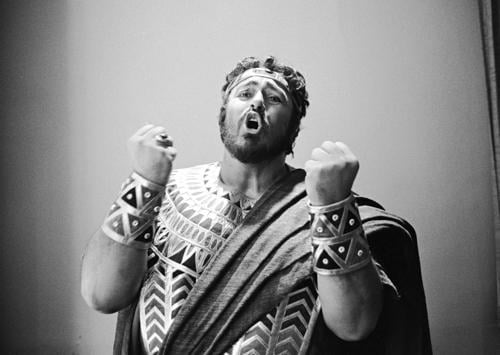
Luciano Pavarotti discusses some of his traits
Dec. 9, 1976 Being a Pisces, Pavarotti says he's always looking for perfection. He admits the biggest critic of his work is himself. Pavarotti said that he loves the charm of the French language and he likes to learn new languages. He talks of recording some music in Russian. Being able to reach those high C notes, Pavarotti says, is the most athletic part of his voice.
-
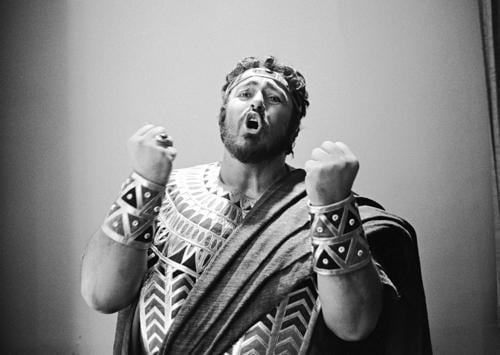
Luciano Pavarotti discusses singing for the Pope and other audiences
Oct. 8, 1979 Pavarotti recalls his meeting with the Pope was very special. Singing "Ave Maria" for him was like God lit up, explained Pavarotti. There are more younger people in the audience, said Pavarotti. They're very surprised that opera's so beautiful, as they believed it was an old fashioned thing.
-
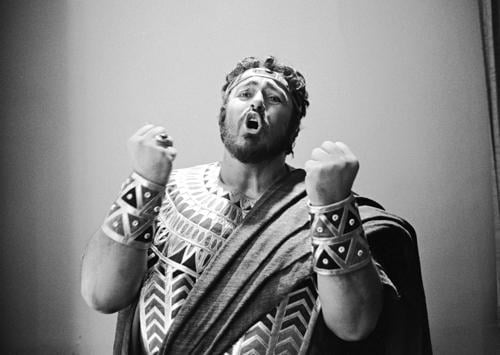
Luciano Pavarotti discusses performing
Nov. 20, 1975 Instead of being called "The King of the High C's," Pavarotti would rather be known as "The King of the Bel Canto". Pavarotti said he didn't have the greatest of enthusiasm prior to performing his first concert. However, it ended up being a phenomenal experience, he said. A great singer, Pavarotti added, is very human and romantic. One needs to feel what one's singing and lastly, one must be a beautiful person inside.
-
Lotte Lehmann talks with Studs Terkel
Apr. 14, 1960 Lotte Lehmann discusses her retirement from opera and how she knew when to stop singing concerts.
-
Lotte Lehmann discusses her opera roles and how opera has changed ; part 2
May. 9, 1967 Lotte Lehmann, legendary opera soprano, discusses her book "Five Operas and Richard Strauss" about her portrayals of famous roles. Interviewing Lotte Lehmann, recorded at the Orrington Hotel, Evanston (including excerpt from master class at Northwestern and recording excerpts from Walkure with Melchior).
-
Lotte Lehmann discusses her opera roles and how opera has changed ; part 1
May. 9, 1967 Short wrap-up of interview and a few words about some of her favorite recordings - "Morgen" and "Die Walküre" / "Valkyrie" by Strauss. Interviewing Lotte Lehmann, recorded at the Orrington Hotel, Evanston (including excerpt from master class at Northwestern and recording excerpts from Walkure with Melchior).
-
Lotte Lehmann discusses her opera roles and how opera has changed
Apr. 18, 1960 Interviewing Madame Lotte Lehmann about her opera roles and how the genre of opera has changed.
-
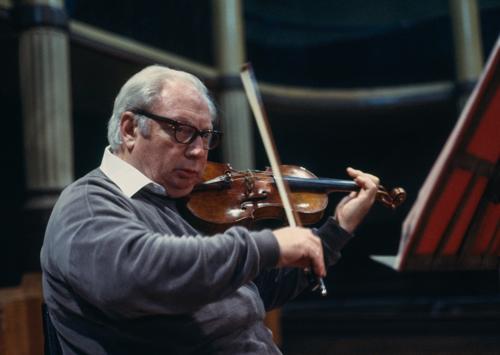
Live musical performance by Isaac Stern
Jan. 20, 1989 Studs Terkel sits down to interview American Violinist Isaac Stern. Stern performs for Terkel on the radio.