

-

James Steven George Boggs discusses his art and career
Sep. 29, 1988 Interest into James Steven George Boggs' artwork first started because Boggs had doodled a picture on a napkin at a coffee shop. The waitress there really liked Boggs' drawing and offered him $50.00 for it. Boggs, otherwise known as J.S.G. Boggs, also talks about how the Bank of England placed him on trial, accusing him of illegally producing currency.
-
James Spigelman discusses his book "The Nuclear Barons"
Sep. 23, 1981 Discussing the book, "The Nuclear Barons," with the author James Spigelman.
-
-
James Ridgeway discusses his book "The Politics of Ecology"
Nov. 20, 1970 Oil, natural gas, water, and pollution are main topics covered in James Ridgeway's book, "The Politics of Ecology." According to Ridgeway, conservationists are not interested in saving the land but rather they are interested in profits. What's best for the environment is not necessarily their biggest concern, explained Ridgeway.*Please note: some sections have been edited out from the original recording due to copyright considerations
-
-
-
-
James Mills discusses his book "Report to the Commissioner," his newest publication
Oct. 3, 1972 James Mills, a novelist and journalist, talks to Studs about his book "Report to the Commissioner". Mr. Mills and Studs discuss the story and Mr. Mills goes in depth into the process of police detectives working a case. Studs plays an excerpt of a Chicago policeman talking about working on the tactical squad on the police force. The policeman tells of how they go into a neighborhood as civilians to stop crime.
-
James McPherson discusses his book "Battle Cry of Freedom: The Civil War Era" ; part 2
Jun. 6, 1989 Historian James McPherson discusses the his book, "Battle Cry of Freedom: The Civil War Era." McPerson explores the American Civil War and introduces some Civil War music. He talks about black soldiers, photography, and reconstruction. Content Warning: This conversation has the presence of outdated, biased, offensive language. Rather than remove this content, we present it in the context of twentieth-century social history to acknowledge and learn from its impact and to inspire awareness and discussion.
-
James McPherson discusses his book "Battle Cry of Freedom: The Civil War Era" ; part 1
Jun. 6, 1989 Historian James McPherson discusses the his book, "Battle Cry of Freedom: The Civil War Era." McPerson explores the American Civil War and talks about some Civil War music. He also discusses the reasoning behind the Civil War and some of the key figures during that time and how many songs came to be written about the battles and leaders.
-
-
James Graham-Lujan discusses the works of Federico Garcia Lorca; part 2
1964 James Graham-Lujan concludes by talking about Garcia Lorca's most celebrated plays, Blood Wedding, Yerma, and The House of Bernarda Alba. Tragedy is brought about due to the passion of a woman in each of the plays.
-
James Graham-Lujan discusses the works of Federico Garcia Lorca; part 1
1964 Discussing the works of Federico Garcia Lorca with translator James Graham-Lujan. Garcia Lorca was a great poet and playwright and he re-vitalized Spanish theater with his eleven plays, according to Graham-Lujan. Garcia Lorca's life was joyous and full of life unlike the theme of his plays, which was tragedy and death.
-
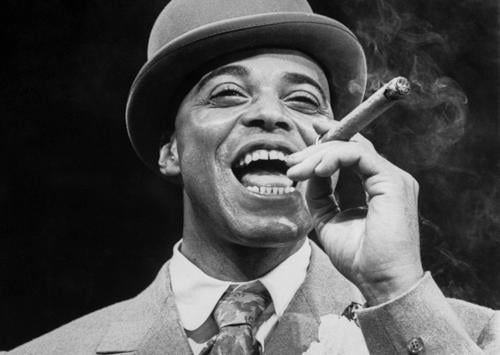
James Earl Jones discusses the play "Othello"
Feb. 1, 1968 Jones discusses the play "Othello" where he plays the lead character Othello.
-
James David Barber discusses his book, "The Pulse of Politics: Electing Presidents in the Media Age," with the author James David Barber
May. 30, 1980 James David Barber, author and political scientist, discusses his book, "The Pulse of Politics: Electing Presidents in the Media Age." He explains the premise of his beliefs that presidential elections run a cycle of "conflict, conscience, conciliation," and how media affects this. He uses examples of elections from Teddy Roosevelt to Jimmy Carter. Presidential campaign songs are played throughout the interview. A record is played to hear the voices of Teddy Roosevelt and Franklin D. Roosevelt.