

-

Interview with Joe Mantegna and Richard Fiere
Sep. 22, 1989 Discussing the play "Bleacher Bums: A Nine-Inning Comedy" with Richard Fiere and creator and actor Joe Mantegna.
-
Interview with Jo Henderson and Frank Galati
Apr. 16, 1986 Discussing Samuel Beckett's play "Happy Days: A Play in Two Acts," with actress Jo Henderson and director Frank Galati.
-
Interview with Elaine Scott Banks and cast members of "The Rake's Progress"
Mar. 13, 1990 Interviewing Elaine Scott Banks and members of City Musick's production of "The Rake's Progress."
-
Interview with Del Close and Bob Falls
Apr. 2, 1985 Discussing William Shakespeare's "Hamlet," with actor Del Close and director Bob Falls.
-
Interview with Del Close
Apr. 2, 1984 Discussing the play "The Time of Your Life," by William Saroyan with actor Del Close.
-
Interview with Claudia Allen, Brian Rabinowitz, and Meg Thalken
Jul. 17, 1989 Interviewing and reading the play "They Even Got the Rienzi," with playwright Claudia Allen and actors Brian Rabinowitz and Meg Thalken. "They Even Got the Rienzi," is included in the work "Short Stuff: ten to twenty minute plays for mature actors."
-
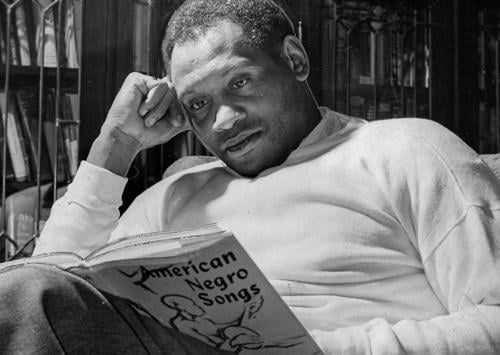
Interview with Avery Brooks
Feb. 7, 1991 Discussing Paul Robeson with actor, teacher, and musician Avery Brooks.
-
Hal Holbrook discusses his Mark Twain impersonation
Oct. 23, 1959 *Please note: some sections have been edited out from the original recording due to copyright considerations
-
Frederick Ritter discusses and preforms classic Austrian Vienna Volks Theatre music
May. 23, 1963 Frederick Ritter, professor, preforms musical numbers from Austria. He also discusses the history of baroque theater and Volk's Theatre, along with Viennese culture. He is joined by Sabine Roupp, Joseph Gardner and David Miller on piano during the performances. Ritter also compares Bertolt Brecht with earlier writers, Johann Nestroy and Ferdinand Raimund. Selected pieces includes works by Mozart and Ferdinand Raymond and Johann Nestroy.
-
Frank Galati discusses the play "Cry, the Beloved Country"
Jul. 20, 1993 Frank Galati and some cast members of "Cry, the Beloved Country," talk about the play. Fathers, sons, relationships, faith and redemption are all areas covered in the play. Galati explains how the story of the play itself draws the audience inward and gets them mesmerized.
-
-
Ernestine Jackson in conversation with Studs Terkel
Oct. 5, 1989 Promoting a production of "Lady Day at Emerson's Bar and Grill."
-
Eric Bogosian discusses his work as an author and actor
Apr. 13, 1993 Eric Bogosian discusses and displays acting techniques he picked up throughout his career. He also performs readings from his book “Notes from Underground.” Content Warning: This conversation has the presence of outdated, biased, offensive language. Rather than remove this content, we present it in the context of twentieth-century social history to acknowledge and learn from its impact and to inspire awareness and discussion.
-
Donna Blue Lachman reads from and discusses her play "The Language of Birds"
Oct. 20, 1993 Being enamored with Rosa Luxemburg's life resulted in Donna Blue Lachman's play, "The Language of Birds: Rosa Luxemburg and Me." The play is of Luxemburg reading letters or of her talking to birds. At one point, Lachman wanted to quit writing the play, noting it was too difficult to finish. Remembering the strong and courageous revolutionary Luxemburg was made her complete the play.
-