

-

Dorothy Donegan in conversation with Studs Terkel
Dec. 27, 1994 Interviewing jazz pianist and composer Dorothy Donegan.
-
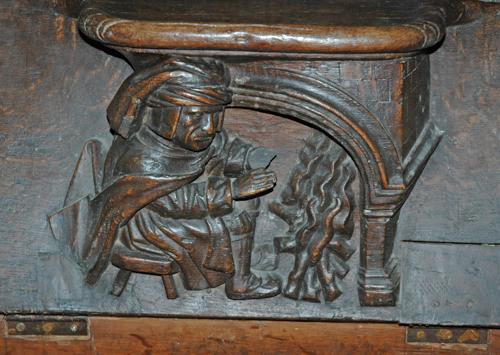
Dorothy and Henry Kraus discuss the book "The Hidden World of Misericords."
Feb. 10, 1976 Dorothy and Henry Kraus describe how they discovered an entire European collection of church-located woodcarvings depicting a wide variety of scenes crafted by local artisans. Hundreds of years of political, religious, and social events shaped the portrayals, and they explore many of the illustrations in their book, focusing on the themes of labor, animals, and religion. They marvel at the skill and craftsmanship and observe that the works can be a rich source of primary research material for modern scholars.
-

Dorothy and Frank Koehl discuss China's cultural revolution and the impact it had on society and politics in China
Aug. 2, 1971 Studs interview with Dorothy and Frank Koehl about the time they spent doing research in China with the Committee of Concerned Asian Scholars. The interview starts with workers singing followed by a short musical from an Asian flute. They discuss the change in China's politics and society after the revolution. Specific topics in the interview include education, women's liberation, the arts, and medical care in China with some comparisons to Korea.
-
Doris May Lessing discusses the inspiration behind "The Four-Gated City"
Jun. 10, 1969 Doris May Lessing discusses the inspiration behind "The Four-Gated City", her thoughts about science and humanity, and her predictions for the future.
-
Doris Lessing discusses her book "Walking in the Shade"
Oct. 8, 1997 "Walking in the Shade: Volume 2 of My Autobiography, 1949-1962", starts with Doris Lessing moving to England. Lessing wrote many books and she said it's annoying when her readers only remember 1 or 2 of her books. After having lived through 2 wars and a bombing, Lessing mentions how she's surprised that more people in society aren't crazy, similar to the craziness of all that's transpired in the world.
-
Doris Lessing and Arnold Wesker discuss this primitive society ; part 2
Dorris Lessing says in this society, we are all savages. According to Lessing, in 10 years, millions will die of starvation. Arnold Wesker says we live in a society of chaos and as a society, our end goal is produce something to deal with and eliminate the chaos.
-
Doris Kearns Goodwin talks about her book "Lyndon Johnson and the American Dream"
1976 Doris Kearns Goodwin talks about her book and her relationship with President Johnson.
-
Doris Kearns Goodwin reads from and discusses her book "The Fitzgeralds and the Kennedys"
Feb. 18, 1987 Delving into their Irish immigrant backgrounds is what makes Doris Kearns Goodwin's book, "The Fitzgeralds and the Kennedys: An American Saga" stand out from other books. Although they had wanted to settle on a farm in the West, the Fitzgeralds ended up in Boston. Goodwin talks a lot about Rose Fitzgerald and her husband, Joe Kennedy.
-
Donna Kay Borrenpohl discusses her life and interests
Studs interviews a junior college freshman, Donna Kay Borrenpohl. They touch on subjects such as her life growing up on a farm, auto mechanic work, and gender stereotypes in career interests. Content Warning: This conversation includes racially and/or culturally derogatory language and/or negative depictions of Black and Indigenous people of color, women, and LGBTQI+ individuals. Rather than remove this content, we present it in the context of twentieth-century social history to acknowledge and learn from its impact and to inspire awareness and discussion.
-
-
Donna Blue Lachman reads from and discusses her play "The Language of Birds"
Oct. 20, 1993 Being enamored with Rosa Luxemburg's life resulted in Donna Blue Lachman's play, "The Language of Birds: Rosa Luxemburg and Me." The play is of Luxemburg reading letters or of her talking to birds. At one point, Lachman wanted to quit writing the play, noting it was too difficult to finish. Remembering the strong and courageous revolutionary Luxemburg was made her complete the play.
-
Donna A. Demac discusses censorship and her book "Liberty Denied"
Jun. 16, 1988 In her book, “Liberty Denied: The Current Rise of Censorship in America,” Donna Demac points out that we, as a society, are not as free as we think we are. Demac can’t understand why anyone would want to keep people from reading great pieces of literature. While some groups called certain books anti-Christian, Demac said no one has ever died from reading a four-letter word.
-
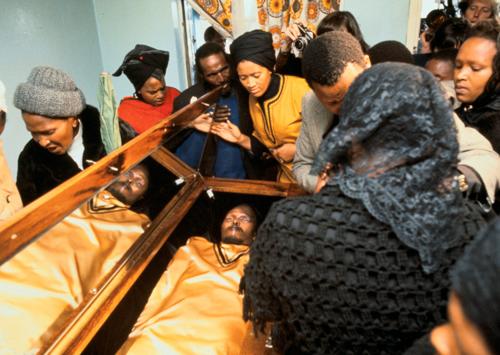
Donald Woods discusses his book "Biko"
May. 17, 1978 Discussing the book "Biko" with the author Donald Woods.
-
Donald Sassoon discusses his book “One Hundred Years of Socialism: The West European Left in the Twentieth Century”
May. 2, 1997 Author and historian Donald Sassoon discusses his book “One Hundred Years of Socialism: The West European Left in the Twentieth Century.” Sassoon discusses the history of socialism in European countries and the social and political circumstances that lead to socialist revivals. Studs plays "The Internationale (Recording of 1944)" - Arturo Toscanini, NBC Symphony Orchestra, The Westminster Choir.
-
Donald Sassoon discusses his book “One Hundred Years of Socialism: The West European Left in the Twentieth Century”
May. 2, 1997 Donald Sassoon, professor and writer, discusses his book “One Hundred Years of Socialism: The West European Left in the Twentieth Century.” Sassoon explores the history of socialism in Europe since 1889 and socialism's relationship with capitalism. He explains how the 1930 depression and World War II affected the growth of socialism in Europe and America. He also explains the creation and government of the Soviet Union