

-
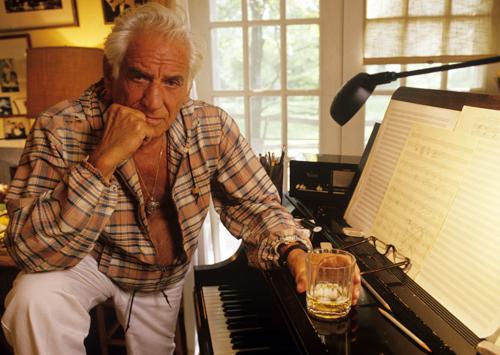
Leonard Bernstein discusses his career, music, and education
Feb. 1, 1985 Leonard Bernstein discusses his career as a composer along with his thoughts on American culture, musical theater, Black music, classical music, and education; music is played throughout the program including songs from Marc Blitzstein's play "The Cradle Will Rock."
-

Lawrence S. Ritter discusses baseball and his book, The Glory of Their Times.
1970 After interviewing multiple ballplayers whose careers spanned the first half of the 20th century, Lawrence S. Ritter published a well-received collection of their stories and perspectives. Included are some clips of Ritter's recordings.*Please note: some sections have been edited out from the original recording due to copyright considerations
-
Lady Dhanvanti Rama Rau discusses family planning in India ; part 2
Feb. 21, 1964 Lady Dhanvanti Rama Rau discusses economic inequality, poverty, and the growing population in India. She discusses the need for family planning to combat these issues. Studs plays “A Morning Raga” - Ravi Shankar.
-
Lady Dhanvanti Rama Rau discusses family planning in India ; part 1
Feb. 21, 1964 Lady Dhanvanti Rama Rau discusses economic inequality, poverty, and the growing population in India. She discusses the need for family planning to combat these issues. Studs plays “A Morning Raga” - Ravi Shankar.
-
Kenneth and Sarah Vaux discuss landscape architect Calvert Vaux
Mar. 19, 1982 Kenneth and Sarah Vaux discuss the father of landscape architecture Calvert Vaux and his influence on other landscape architects including Frederick Law Olmsted. Kenneth and Sarah focus their discussion on public parks and how these parks were a response against industrialization and served to provide a space for the working class to gather in nature. This program includes an excerpt of an interview with labor activist Edward Sadlowski discussing the working class’ interest in nature, books, theater, and music.
-
Kay Boyle discusses her book “The Long Walk at San Francisco State”
Interviewing novelist, essayist, and poet Kay Boyle. She discusses her work as an educator at San Francisco State College and as an advocate for her students.
-
Karen DeCrow reads from and discusses her book "The Young Woman's Guide to Liberation"
Karen DeCrow said both young ladies and young men should read her book, "The Young Woman's Guide to Liberation: Alternatives to a Half-Life While the Choice is Still Yours". DeCrow explained that young girls need to realize they should prepare themselves for being more than just a mother and a homemaker. She also stresses the importance of women not being totally dependent on men.
-
Kale Williams discusses Nigeria
Nov. 10, 1970 Relief worker Kale Williams discusses his trip to Nigeria and his understanding of Nigerian music customs.*Please note: some sections have been edited out from the original recording due to copyright considerations
-
Jules Feiffer discusses his cartoonist history and his play "Elliot Loves"
Apr. 12, 1990 Jules Feiffer and Studs read several of Feiffer's previous cartoons as they discuss his history as a cartoonist and his retrospective on display at the Walton Street Gallery in Chicago. Feiffer discusses his attempt to move away from political cartoons and instead shift focus to social commentary. Feiffer also discusses his play "Elliot Loves", a love story that captures the complications of love and the “gap” between the sexes.
-
Jules Feiffer discusses his book “Ackroyd”
Jun. 2, 1977 American author and cartoonist Jules Feiffer presents readings and discusses topics from his book “Ackroyd.”
-
John Logan discusses his career
Mar. 31, 1960 The poet and professor talks about his career and his new collection, Ghosts of the Heart.*Please note: some sections have been edited out from the original recording due to copyright considerations
-
John Jacob Niles talks with Studs Terkel
Nov. 13, 1964 The American folksinger and archivist joins Studs in the studio to share stories and songs discovered in his youth and through his years of research.*Please note: some sections have been edited out from the original recording due to copyright considerations
-
John Henry Faulk talks with Studs Terkel
Oct. 8, 1975 The American radio host discusses his part in the popularization of folk music, the fight against the blacklisting of the 1950s, and the corporatization of media outlets.*Please note: some sections have been edited out from the original recording due to copyright considerations
-
John Henry Faulk discusses the Vietnam War and current state of America
Nov. 1, 1969 John Henry Faulk discusses his experience lecturing at so-called knife and fork clubs and colleges across the United States; feelings of fear and powerlessness in America; the value of young people's activism in the United States; and the enlistment of poor men to serve in the Vietnam War. Faulk also speaks as several characters he plays to challenge and comment on the Vietnam War.
-
John Henry Faulk discusses politics and storytelling
1980 Content Warning: This conversation has the presence of outdated, biased, offensive language. Rather than remove this content, we present it in the context of twentieth-century social history to acknowledge and learn from its impact and to inspire awareness and discussion. American storyteller and radio show host John Henry Faulk discusses his experience lecturing in universities, the value of young people's activism in the United States, and speaks as several characters from his stories.