

-

Bill Leonard discusses the history of baseball and baseball today
Apr. 1, 1971 The game of baseball today is very different from when Bill Leonard was a young boy. Today, the last names of baseball players are on the backs of their uniforms. When Leonard was a boy, his father would tell him who was up to bat solely by the player's walk or his stance. The selling of players' contracts to other teams is when Leonard believes the business of baseball changed. This recording includes snippets of author Lawrence Ritter's interviews with early 20th century ballplayers Sam Crawford, Goose Goslin, Fred Snodgrass, Rube Marquard, and Chief Meyers.
-
Bill Leahy discusses his views on the political and social struggles in the Republic of Ireland and Northern Ireland
Oct. 20, 1975 Studs interview with Irishman, Bill Leahy, on the political complexities surrounding Ireland in the 1960s-1970s. Leahy provides some historical background of the IRA and British colonial occupation of Ireland. They discuss Irish music, the Civil Rights Movement in Ireland, and contemporary myths about Ireland. Several Irish songs were played, but many of the titles were not captured. Planksty's music was played twice.
-
Bill Cunningham discusses court cases he has participated in
Jan. 5, 1979 Bill Cunningham, Jesuit priest and lawyer, discusses some court cases he has participated in. He talks about the Berrigan Brothers who protested against the Vietnam War. Cunnginham also talks about the Rice-Poindexter case, where two Black Panther Party members were charged for murder. He also discussed the Freedom of Information Act and the COINTELPRO the FBI's Counter Intelligence Program. Studs reads poetry from David Rice and plays a song by Hank Ferguson.
-
Bill Crow in conversation with Studs Terkel
Jun. 26, 1990 Discussing the book "Jazz Anecdotes" (published by Oxford Press) with the author and jazz musician Bill Crow.
-
Bill Crofut in conversation with Studs Terkel
Jan. 14, 1981 Interviewing folk singer Bill Crofut.
-
Bill Crofut discusses his career as a folk singer and his work with other musicians
Dec. 8, 1981 Studs interviews Bill Crofut about his career. They discuss Crofut’s recording label, “Cousin Jacks” and his album with Benjamin Luxon, “Simple Gifts.” Crofut shares his experiences working with various musicians and describes some of his songs. He reflects on his work with the Natalie Wood film, “Brainstorm.” Crofut sings part of the “Grandfather’s Clock” and an unnamed children’s song. The music is removed from this edited version of the original recording.
-
-
-
Bill Ayers reads from and discusses his book "A Kind and Just Parent"
Jun. 25, 1997 Bill Ayers' book, "A Kind and Just Parent: The Children of Juvenile Court" takes a look at kids getting caught up and lost in the system. While observing in the courts, Ayers said all kids just became a thing.
-
Bill Ayers discusses his book "To Teach"
Jun. 23, 1993 According to Bill Ayers, in order to be a good teacher, one must 1st become a student of his/her students' lives. New ideas on how to become a better teacher are offered in Ayers' book, "To Teach: The Journey of a Teacher.'
-
Big Bill Broonzy discusses the blues ; part 2
Jul. 22, 1953 Big Bill Broonzy discusses the blues and growing up in Arkansas with parents who were former slaves. He talks about the family dynamic and sings: "Willie Mae", "Crawdad song", "Going down this road feeling bad" and "John Henry".
-
Big Bill Broonzy discusses the blues ; part 1
Jul. 22, 1953 Big Bill Broonzy discusses the blues and growing up in Arkansas with parents who were former slaves. He talks about the family dynamic and sings: "Crying Joe Turner", "C.C. Rider", "Make my get away", and " You've got to stand your test in judgement" . Part 1
-
Big Bill Broonzy discusses the blues
Sep. 13, 1955 Big Bill Broonzy discusses the blues with Studs. Big Bill talks about getting ready for a European tour, his young life, and his life as a musician. The following performances have been removed for copyright reasons: "Ride Alberta, ride," "Going Down the road feeling bad," "House rent stomp," "The glory of love," "Plow hand," "I feel so good," and "Make my getaway."
-
-
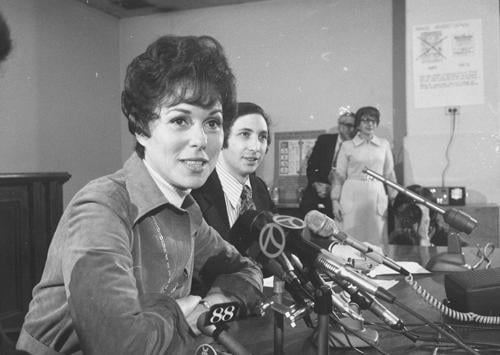
Bess Myerson discusses her career
Jun. 12, 1974 Bess Myerson discusses her career including her experiences as Miss America and as Commissioner of Consumer Affairs for New York City.