

-

Mike Royko discussing the book "Boss: Richard J. Daley of Chicago"
Mar. 15, 1971 Chicago newspaper columnist Mike Royko discusses his book "Boss: Richard J. Daley of Chicago" and its subject, former Chicago mayor Richard J. Daley.
-
Mike Royko discussing his book "Up Against It"
1967 Mike Royko discusses his book "Up Against It" which is a collection of early columns from the Chicago Daily News. The topic in his columns varies from machine politicians and gangsters to professional athletes, from well-heeled Chicagoans to down-and-out hoodlums.
-
Mike Royko discusses some of his journalist stories ; part 2
Jul. 29, 1966 Mike Royko, long time journalist of Chicago, discusses his column about William O. Douglas. Royko also talks about his column about Jim Lee Osborne, who moved from the Appalachians to Chicago. Studs and other staff members read the articles by Royko and some responses he received from the public.
-
Mike Royko discusses some of his journalist stories ; part 1
Jul. 29, 1966 Mike Royko, a long-time journalist in Chicago, discusses some of his most popular columns. Topics include Cook County Hospital's lack of air conditioning in surgery rooms, the future of workers, and the Civil Right's Movement. The responsiblities of journalists and the effect of newspapers are also discussed.
-
Mike Royko discusses his book "I May Be Wrong, but I Doubt It"
1970 Author-journalist Mike Royko's book, "I May Be Wrong, but I Doubt It" includes 65-70 of Royko's past articles. Royko talks about how his columns come to life. Never having been one to sit in an office, he talks about going out into the world to get the story and to report the facts. Royko includes a funny tale about the word, "clout," in his book.*Please note: some sections have been edited out from the original recording due to copyright considerations
-
Mike Royko and Herman Kogan interview Studs Terkel
Jan. 16, 1967 In a rare turn of events, Mike Royko and Herman Kogan interview Studs Terkel about his book, "Division Street: America." Kogan is in awe of how Studs was able to get people to talk to him and give in-depth interviews. When asked by Royko, "What would you do if you were God?", Studs answered that he'd let man be man.
-
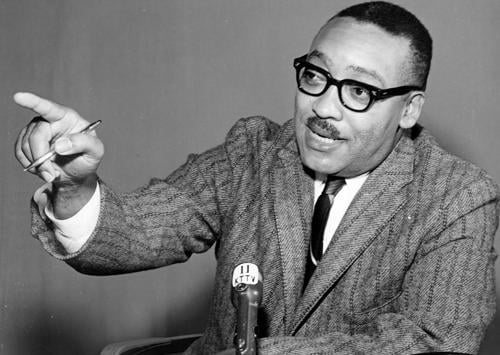
Louis Lomax discusses the book "Thailand: The War That Is, The War That Will Be"
1967 Discussing Thailand and interviewing journalist Louis Lomax. Includes passage from book.
-
-
James Cameron discusses journalist responsibility and expectations of political leaders with Studs in Ashburn Gardens, London ; part 2
1970 Studs Terkel interview with James Cameron, Brittish journalist. They discuss the objective truth and facts of journalism. Cameron shares his experience with a dying Winston Churchill and his views on science and human values. Politics, youth, and the atomic bomb are also topics in this interview. Studs quotes Albert Einstein and Sidney Burnstein, while Cameron quotes Oliver Cromwell. James Cameron's book, "Point of Departure" is also mentioned in the interview.
-
James Cameron discusses his experiences as a Brittish journalist and his book "Point of Departure" ; part 3
Jun. 4, 1973 Studs Terkel interviews James Cameron about his experiences as a journalist that includes thoughts about Cameron's book, "Point of Departure." They talk about his relationships with Winston Churchill, Lord Beaverbrook, Charlie Templeton, and Bertrand Russell. Cameron discusses his education, poverty, and the depression during his youth. They talk about Cameron's career with the "News Chronicle" and his home of Dundee, Scotland. This is part 3 of a total of 4 parts. The interview takes place at Lewis and Clark Community College.
-
James Cameron discusses his career ; part 1
Jun. 4, 1973 James Cameron reflects on his life in journalism and his near death experience in India which led to his heart operation in London. Cameron turned that near death experience into a BBC play called "The Pump". Cameron discusses that with Terkel as well as his autobiography, "Points of Departure". Cameron also discusses the June War or Six Day War with Terkel. Cameron reflects on the role youth play in society whether in Israel or Northern Ireland and how they should understand they possess a greater potential. The interview breaks at 27:18 and continues.
-
James Cameron and Studs Terkel discuss their experience in Lincoln Park and how the peaceful demonstration changed to violence with the use of police tear gas ; part 1
Aug. 28, 1968 Studs Terkel and James Cameron talk about their witness of the peaceful demonstration at Lincoln Park the night before. They discuss the kind and caring interaction between older adults and the young. Both reflect on how the event changed from peaceful to somewhat violent when police gathered and used tear gas on the crowd.
-
Interviewing Jessica Mitford
May. 17, 1979 The English journalist and social critic discusses her life and her work as a muckraker. Her book, Poison Penmanship: The Gentle Art of Muckraking, collects some of her most well-known essays and can also serve as a manual for investigative journalists.*Please note: some sections have been edited out from the original recording due to copyright considerations
-
-
Interview with Nicholas Von Hoffman
Sep. 22, 1965 Discussing the article "The wife of L.A. man."