

-

Interview with "Spoon river and beyond " cast members
Jun. 10, 1975 Interviewing "Spoon river and beyond " cast members William Deryl-Davis, Ron Dean, Elizabeth Garry and Roxana Alsberg, David Starr-flute and George Stevens-bass.
-
-
Henry Threadgill, Fred Hopkins, and Steve McCall discuss their trio jazz group, Air
Sep. 4, 1981 Studs interview of Air jazz trio with Henry Threadgill - reeds, Fred Hopkins - bass, and Steve McCall - percussion. They discuss their individual careers and the people who have influenced them. Studs quoted Nelson Algren. Studs explores the evolution of their music and how the three came together. They discuss various pieces of their music and the instruments they use. Pauses were taken for musical numbers but none were played on this recording.
-
Easley Blackwood, Leonard Meyer and Ralph Shapey talk about standards of composition in contemporary music, part 1
1965 The program begins with an excerpt from BBC Radio about a hoax piece of music by Pietorzac (Hans Keller). Hans Keller and a friend went into studio and made noise and presented it as music. In this round table discussion the three gentlemen - all composers, musicians, and educators, discuss with Studs, contemporary music and the standards for defining a composition as music. In the second hour, they discuss what level of knowledge of music a critic should have in order to form a proper opinion of music. All animatedly offer their opinion to both the pro's and the cons.
-
Easley Blackwood, Leonard Meyer and Ralph Shapey discuss the standards of composition in contemporary music, part 2
1965 In this round table discussion the three gentlemen - all composers, musicians, and educators - discuss with Studs contemporary music and the standards for defining a composition in music. In the second hour they discuss what level of knowledge of music a critic should have in order to form a proper opinion of music. All animatedly offer their opinion to both the pro and the con. A movement of both Blackwood and Shapey compositions is played.
-
Earl "Fatha" Hines and John McDonough discuss jazz music
Sep. 8, 1976 Earl "Fatha" Hines discusses various musicians he's worked with including Louis Armstrong, Charlie Parker, and Dizzy Gillespie. He remembers that bands became bigger after needing to add members to play bigger venues because people liked to dance. He also talks about how he liked to work to create shows and his approach to jazz composition. Music is played throughout: "Weather Bird" with Louis Armstrong, "My Monday Date", "Cavernism", "Boogie Woogie On St. Louis Blues", "Rosetta", and "Second Balcony Jump". Music has been removed from this file for copyright reasons.
-
Dr. M. Merchant discusses Shakespeare and the arts
Aug. 18, 1965 Welsh scholar Dr. M. Merchant speaks about Shakespeare and his impact on other arts and artists. Toward the end, there is an excerpt of Sir John Gielgud in Shakespeare's "Measure for Measure."*Please note: some sections have been edited out from the original recording due to copyright considerations
-
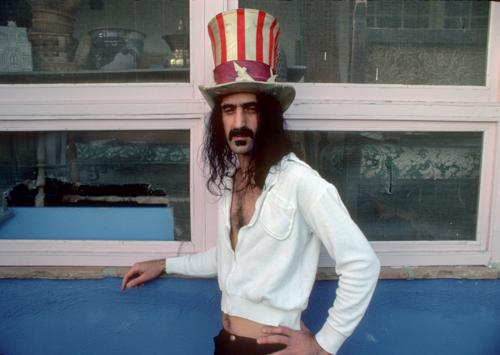
Discussing the music of the Mothers of Invention and interviewing Frank Zappa
Aug. 1, 1970 Discussing the music of the Mothers of Invention and interviewing Frank Zappa. Songs include "Who are the Brain Police," "Brown Shoes Don't Make It," "Concentration Moon," "Mom and Dad," "Bow Tie Daddy," "Harry, You're a Beast," "What's the Ugliest Part of Your Body?" "Trouble Every Day," "Very Distraughtening," "White Ugliness" and "There Will Come a Time."
-
Discussing the music of China with David Golub
Aug. 27, 1981 The American pianist and conductor talks about his cultural exchange visit to China as depicted in the documentary, From Mao to Mozart. Studs plays some recordings of Chinese music from his own trip to China.*Please note: some sections have been edited out from the original recording due to copyright considerations
-
-
-
Discussing contemporary music with Easley Blackwood, Paul Fromm and Ralph Shapey
Feb. 13, 1967 Studs Terkel has a conversation with Easley Blackwood, and Ralph Shapey, composers and Paul Fromm philanthropist and patron of the music arts. They discuss contemporary music, composing music, composers and the passion of creating music.
-
Chris Ethridge and Gram Parsons discuss their album 'The Gilded Palace of Sin'
Mar. 1, 1969 Studs Terkel interviews two of the band members, Chris Ethridge and Gram Parsons. The following topics discussed are: the artists' backgrounds; their musical perspective; their songwriting; Los Angeles; earthquakes; their early life; their lyrics; life in the south (America); and instrumentation. The following musical excerpts have been removed due to copyright restrictions: "Wheels"; "Sin City"; "My Uncle"; "Do You Know How It Feels"; and "Hippie Boy".
-
Carlo Curly discusses the history and future of the organ as an instrument and his career as a classical organist
Dec. 15, 1983 Studs interviews Carlo Curly, a RCA recording classical organist. Includes an interview from two years earlier with Curly giving a commentary about Virgil Fox, his greatest influence. Curly describes his family background in music. He explains in great detail the history of the organ, how it is made, and the music written for it. He explains the difference in music between pipe organs and electronic organs. Curly talks about his experience playing in Japan. He speaks of Bach and Mendelson and their influence on the organ as a classical instrument.
-
Brother John Sellers discusses his career as a blues artist and how church music inspired his music
Jul. 2, 1982 Studs interviews Brother John Sellers about his career and other blues singers. Sellers explains that religion influenced his music as did performers like Mahalia Jackson, Big Bill Broonzy, and Muddy Waters. Studs reads some of the lyrics of blues song, "In the Evening." Sellers describes street singers and blind singers. He describes the music and style of Jackson and Broonzy and some of his own songs. Sellers performs "Talk About A Child" and "Sally Go Round the Sunshine" live on the program.