

-

Jill Nelson discusses her book "Volunteer Slavery"
Jul. 14, 1993 Family and family secrets like Ms. Nelson's bout with alcoholism or her sister's mental health issues are covered in the book. Working for the Washington Post, she thought would be the highlight of her career, however, she talks about losing her journalistic integrity while working at that environment.
-
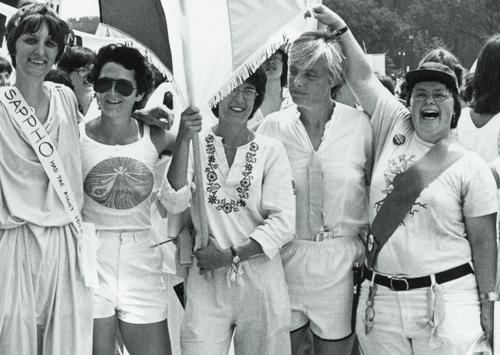
Jill Johnston discusses her book "Lesbian Nation: The Feminist Solution"
Jun. 29, 1973 Jill Johnston speaks about her book 'Lesbian Nation: The Feminist Solution', published in 1973. Johnston describes her political definition of lesbianism as self-commitment, and how her writings fits into the feminism on the whole.
-
Jill Breckenridge discusses her book of poetry titled “How To Be Lucky”
Feb. 4, 1991 Jill explains how growing up in an alcoholic and abusive household influenced her early works, specifically the book of poetry “How To Be Lucky.”
-
Jessica Mitford discusses her book "Kind and Usual Punishment: The Prison Business"
Sep. 14, 1973 Jessica Mitford an English born author, investigative journalist, and civil rights activist discusses her book "Kind and Usual Punishment: The Prison Business,". Ms Mitford and Studs discuss her finding that prisoners were used as test subjects for drug trials and other medical research, and slave labor. Ms Mitford's book makes the argument that prisons are a governments means to making money from the prisoners they have punished. They speak about reform needed in the laws and decriminalization of many things and the abolishing of prison altogether. Ms.
-
-
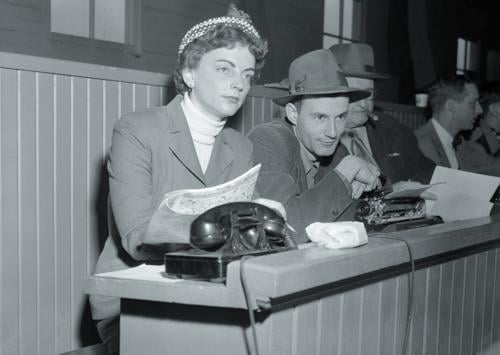
Jerome Holtzman discusses baseball, journalism, and his book "No Cheering in the Press Box"
Aug. 15, 1974 Sportswriter Jerome Holtzman discusses his book "No Cheering in the Press Box."
-
Jeremy Bernstein discusses his book "Three Degrees Above Zero: Bell Labs in the Information Age"
Nov. 22, 1984 Theoretical physicist and author Jeremy Bernstein discusses his latest work. The book focuses on the inventors and innovations that came out of Bell Laboratories, also known as Bell Telephone Laboratories, AT&T Bell Laboratories, and recently Nokia Bell Labs.
-
Jens Kruuse discusses his book "A War for an Afternoon" ; part 1
1968 When asked, Jen Kruuse said he wrote his book, “A War for an Afternoon,” as a result of life being madness. As a morale booster, to make the men of the SS army feel invincible, they were ordered to exterminate the town of Oradour-sur-Glane, France. The women and children of the town were rounded up, placed in the town’s church and the church was burned. All the men of the town were shot dead. The entire incident, explained Kruuse, was madness, pure madness.
-
Jeff Kisseloff discusses his book “The Box: An Oral History of Television, 1920-1961”
Dec. 11, 1995 Author and historian Jeff Kisseloff discusses his book “The Box: An Oral History of Television, 1920-1961” and the major changes seen in the television industry. This program includes an excerpt of an interview with Charlie Andrews in which he discusses how the television industry is moving away from spontaneity. Studs plays "The Cuckoo" - Kukla, Fran and Ollie and "Wanderin'" - Win Stracke (1957).
-
Jeanne Stellman discusses her book "Work Is Dangerous to Your Health: A Handbook of Health Hazards in the Workplace and What You Can Do About Them"
Feb. 11, 1974 Jeanne Stellman discusses her book, "Work Is Dangerous to Your Health: A Handbook of Health Hazards in the Workplace and What You Can Do About Them," and workplace safety issues in a variety of industries. Topics of discussion include the importance of prioritizing health in the workplace and consulting workers on workplace safety issues, and industry responses to occupational hazards.
-
Jean Vilar and Eugène Ionesco discuss French theater
1968 In the first part of this program Studs Terkel discusses French theater with critic Jean Vilar. In the second part, Studs and Eugène Ionesco discuss Ionesco’s work and the Theater of the Absurd.
-
Jean Shepherd discusses his views on cynicism
Nov. 12, 1970 Radio and TV personality Jean Shepherd says there is no good or evil. He said the world is not going to change its ways based on a book or a play. Shepherd believed there's no right or wrong on issues because everyone just wants peace.
-
Jean Shepherd discusses his book "In God We Trust: All Others Pay Cash"
Dec. 1, 1966 Jean Shepherd discusses his book "In God We Trust: All Others Pay Cash." Includes earlier clips of Shepherd speaking and excerpts of him reading from the book.*Please note: some sections have been edited out from the original recording due to copyright considerations
-
Jean Shepherd discusses his book "A Fistful of Fig Newtons"
Mar. 26, 1982 Storyteller, humorist, radio personality, and author Jean Shepherd discusses his book, A Fistful of Fig Newtons. Shepherd considers how his various career paths, particularly that of a radio personality, have affected his writing.*Please note: some sections have been edited out from the original recording due to copyright considerations
-
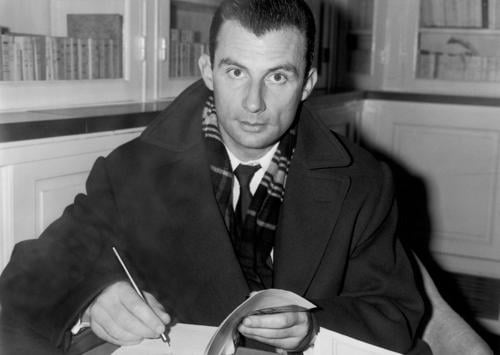
Jean Cau discusses his book "La pitié de Dieu" ; part 2
Nov. 1, 1962 When asked how he found time to write his book, Jean Cau said he took vacation time from his full time job. Cau was also asked if he wrote his book using a typewriter and Cau explained that he did all his writing with his own penmanship because he hated machinery, like the typewriter. In conclusion, Cau said he was writing a play about the Algerian War and its paratroopers. The play he finished writing was about the life and death of Adolf HiItler.