

-

Leonard Matlovich talks about his experience in the U.S. Air Force
Nov. 14, 1975 Interviewing Len Matlovich, formerly a Sergeant in the U.S. Air Force, about the status of gay men in the armed forces and his expulsion from the Air Force after he publicly stated that he was gay.
-

Laurence Shoup discusses his book, "The Carter Presidency and Beyond: Power and Politics in the 1980s"
1970 Author Laurence Shoup discusses his book, "The Carter Presidency and Beyond: Power and Politics in the 1980s," and explains how President Carter came to be elected. He describes the Trilateral Commission and other groups created by corporations and the richest American families to lobby. the government. He also discusses the Carter presidency and his double-dealing with major issues such as unions and regulating big businesses.
-
-
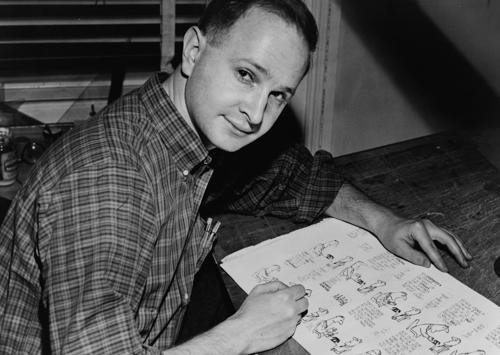
Jules Feiffer discusses his book "Feiffer on Nixon"
Nov. 10, 1974 Content Warning: This conversation has the presence of outdated, biased, offensive language. Rather than remove this content, we present it in the context of twentieth-century social history to acknowledge and learn from its impact and to inspire awareness and discussion. In his book, "Feiffer on Nixon: The Cartoon Presidency," Jules Feiffer tries to give his readers his take on politics and the government. In addition, through his descriptions of the cartoon panels, Feiffer offers his explanations of who President Nixon was.
-
Joseph Collins discusses the book "Food First"
Oct. 28, 1977 Dr. Joseph Collins co-authored the book, "Food First: Beyond the Myth of Scarcity". Among the topics in the book include world hunger, famine, food policies and politics. Collins asks the readers to think about being ok with eating food grown in another country when the workers of that country are so poor, they themselves are starving for food.
-
John Hope Franklin discusses racial inequality in America
Mar. 15, 1979 John Hope Franklin, historian, discusses his life and the racial inequality he witnessed. He also talks about John Hope and W. E. B. Du Bois. Dr. Franklin also talks about his Jefferson Lectures, Thomas Jefferson, and slavery.
-
John Frohnmayer in conversation with Studs Terkel
Apr. 30, 1993 Discussing the book "Leaving Town Alive: Confessions of an Arts Warrior" (published by Houghton Mifflin) with author John Frohnmayer.
-
John Bernard discusses his life, politics and his work with the Farmer Labor Party
Aug. 1, 1977 Interviewing labor organizer, civil rights activist, and former Congressman John Bernard. Bernard was elected as a Farmer-Labor candidate to the U.S. House of Representatives and served from 1937-1939.
-
John Bailey, Robert Tucker, and Dick W. Simpson discuss housing and transportation ; part 4
Oct. 9, 1974 Dick Simpson's book, "Chicago's Future: An Agenda for Change," is discussed with the author, John Bailey and Robert Tucker, all employees of Chicago universities. The group discusses housing and transportation issues that many working class citizens face. The group discusses possible ways to fix the issues including government help and re-zoning.
-
Jim Balcer, Lawrence J. McKeon, Joey McDonald in conversation with Studs Terkel
Mar. 19, 1993 Discussing gays in the military with Director of Veterans Affairs for the City of Chicago Jim Balcer, Illinois State Representative Larry McKeon and Joey McDonald.
-
Jill Conway reads from and discusses her book "The Road From Coorain"
Jun. 15, 1989 Jill Conway refllects on living on the great plains of Australia as a young child in her book, "The Road From Coorain". Conway recalls not seeing any other children until she was 7 ears old. Growing up in the bush, meant isolation, said Conway. Because she wasn't around people often, and because she wasn't used to crowds, 2 or 3 people at a time was pretty scary. Conway found the city to be a sinister place that was very noisy.
-
Jennifer Davis, Bill Sutherland and Zola Zembe discuss South Africa and apartheid
Feb. 27, 1979 Jennifer Davis, Bill Sutherland, and Zola Zembe discuss the South Africa and their experiences with apartheid. Jennifer Davis grew up in the white middle class society of Johannesburg, whereas Zola Zembe, a native black man who lives in Capetown. They, along with Bill Sutherland, an American who works as a Representative for the American Friends Service Committee, talk about the changes that need to made and how American people and companies can help. An earlier interview of Carl Douglas Fuchs is also played.
-
James Mills discusses his book "Report to the Commissioner," his newest publication
Oct. 3, 1972 James Mills, a novelist and journalist, talks to Studs about his book "Report to the Commissioner". Mr. Mills and Studs discuss the story and Mr. Mills goes in depth into the process of police detectives working a case. Studs plays an excerpt of a Chicago policeman talking about working on the tactical squad on the police force. The policeman tells of how they go into a neighborhood as civilians to stop crime.
-
James David Barber discusses his book, "The Pulse of Politics: Electing Presidents in the Media Age," with the author James David Barber
May. 30, 1980 James David Barber, author and political scientist, discusses his book, "The Pulse of Politics: Electing Presidents in the Media Age." He explains the premise of his beliefs that presidential elections run a cycle of "conflict, conscience, conciliation," and how media affects this. He uses examples of elections from Teddy Roosevelt to Jimmy Carter. Presidential campaign songs are played throughout the interview. A record is played to hear the voices of Teddy Roosevelt and Franklin D. Roosevelt.
-
James Cameron discusses journalist responsibility and expectations of political leaders with Studs in Ashburn Gardens, London ; part 2
1970 Studs Terkel interview with James Cameron, Brittish journalist. They discuss the objective truth and facts of journalism. Cameron shares his experience with a dying Winston Churchill and his views on science and human values. Politics, youth, and the atomic bomb are also topics in this interview. Studs quotes Albert Einstein and Sidney Burnstein, while Cameron quotes Oliver Cromwell. James Cameron's book, "Point of Departure" is also mentioned in the interview.