Listen to New Voices on Studs Terkel our partnership with 826CHI-here! Read the Story


Showing 676 - 690 of 777 results
-

Dick Simpson discusses neighborhood government system
Mar. 1, 1979 Dick Simpson, alderman of Chicago, discusses neighborhood governments. He describes the history, explains the uses of wards, and shows how the system can work in light of a recent election in Chicago. Studs reads an article about the recent election by Mike Royko.
-
Dick Simpson discusses his book, Strategies for Change: How to Make the American Political Dream Work"
Sep. 27, 1976 Alderman Dick Simpson discusses his book, "Strategies for Change: How to Make the American Political Dream Work," and his work as the 44th Ward Alderman. He explains the assembly system that now runs the 44th Ward, where members are able to bind him to a vote if the majority decides. He also discusses how the assembly has already changed redlining, the school system, truck load limits, and high rise development within their neighborhood.
-
Dick Gregory discusses American politics
Dec. 17, 1964 This interview begins with a clip of one of Dick Gregory’s performances, where he talks about nonviolence and Native Americans. Studs Terkel introduces his guest as an observer, explaining that comedians are the best observers in society. Gregory offers extended analogies to communicate his views on a variety of topics, including the Vietnam War, race relations, segregation, human rights, and urban renewal. [The date is unclear, but it has to be after 1970, since the Kent State Shootings were mentioned]
-
Derrick A. Bell in conversation with Studs Terkel
Oct. 8, 1992 Interviewing lawyer, activist and author Derrick Bell.
-
Derek Shearer discusses his book "Economic Democracy"
Jun. 13, 1980 Studs Terkel speaks with writer and economist Derek Shearer about the book “Economic Democracy: The Challenge of the 1980s,” which Shearer co-authored with Martin Carnoy. Terkel and Shearer also discuss workers’ rights and equality in economics. Shearer reads a few excerpts from his book as well as a quote from labor leader Sidney Hillman.
-
Denise Levertov and Chuck Matthei discuss non-violence protests
Nov. 15, 1969 Denise Levertov discusses her poetry regarding non-violent protest and using Chuck Matthei's life as a non-violent draft resister for inspiration. Chuck Matthei details his experiences as a draft resister and beliefs in this movement.
-
Denis Mitchell and Studs discuss film while in London
1962 *Please note: some sections have been edited out from the original recording due to copyright considerations
-
Del Close discusses hipsters and comedy
May. 15, 1970 Del Close discusses hipsters, what is hip, and comedy. Includes a clip of Del Close and his colleague John Brent from the beatnik satire "How to Speak Hip".
-
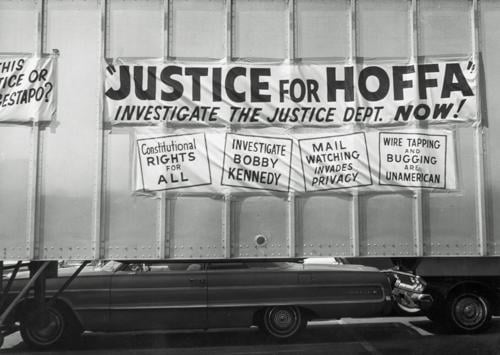
David Wise discusses his book "The Politics of Lying: Government Deception, Secrecy, and Power"
May. 25, 1973 Political author David Wise discusses his book, "The Politics of Lying: Government Deception, Secrecy, and Power", published in 1973. Wise talks about the current state of government information and transparency.
-
David T. Dellinger discusses his book "From Yale to Jail"
Apr. 23, 1993 The early influences of his father, his time in prison, and a bomb being sent to his home are among the topics covered in Dellinger’s book, “From Yale to Jail: The Story of a Moral Dissenter”. Dellinger is best known for being one of the Chicago Eight. He recalls a time in Lincoln Park, IL when he was warned to get out of there quickly because the police were told to attack Dellinger and his group.
-
David Scherman discusses “The Best of Life,” a book he edited
Oct. 12, 1973 Photographer David Scherman talks with Studs Terkel about the stories that photos can tell, famous photographers, and the book “The Best of Life,” which Scherman edited. A recording of the song “Brother, Can You Spare a Dime?” by the Weavers is played.
-

David Rossin and McKinley Olson debate nuclear energy
Oct. 5, 1976 David Rossin from Commonwealth Edison and McKinley Olson, a reporter and author of "Unacceptable Risk", debate the pros and cons of nuclear energy.
-

David McCullough discusses his book "Mornings on Horseback"
Aug. 5, 1981 Discussing the book "Mornings on Horseback" with author David McCullough.
-

David Lowe discusses his book "Lost Chicago"
Dec. 8, 1975 Discussing the book "Lost Chicago" with the author David Lowe.
-
David Hamlin discusses his book, "The Nazi/Skokie Conflict: A Civil Liberties Battle"
Mar. 5, 1981 David Hamlin, author and former Executive Director of ACLU, discusses his book "The Nazi/Skokie Conflict: A Civil Liberties Battle." Hamlin talks about Frank Collin, a jewish man turned leader of American Nazi Party leader and the court battle over the right to demonstrate in Skokie, Illinois. He also talks about the retaliation against the ALCU for defending Collin's case in court. At the end of the interview, Hamlin gives some advice on how to deal with people like Frank Collin.